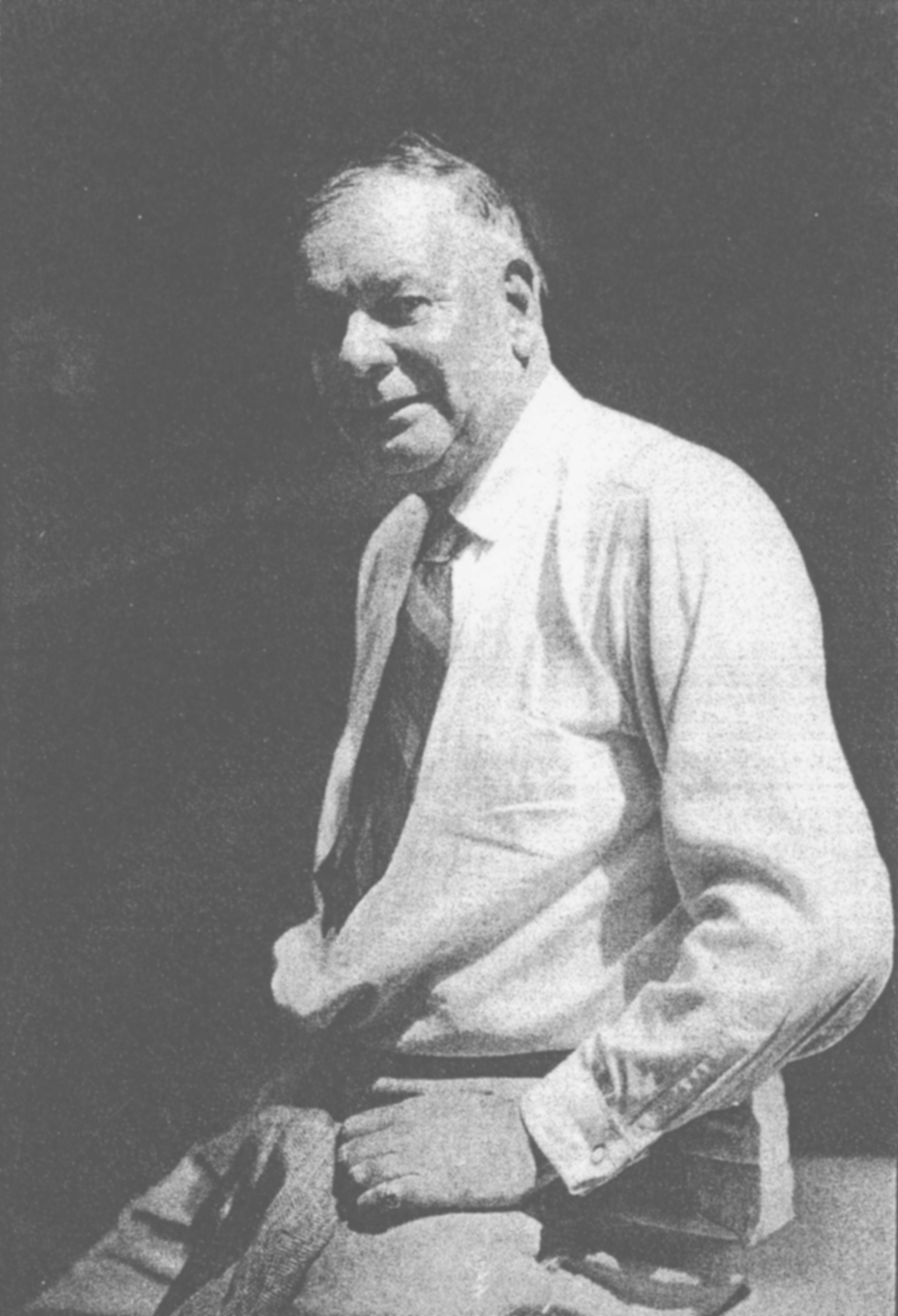
Garnet William HOLME [27081]
- Born: 11 Aug 1873, Brighton SSX
- Baptised: 15 Sep 1873, St Peter Brighton SSX
- Died: 12 Feb 1929, Ross Marin County CA USA aged 55
 Cause of his death was a fall. Cause of his death was a fall.

General Notes:
Garnet William Holme
Baptism Date: 15 Sep 1873
Baptism Place: St. Peter, Brighton, Sussex, England
Father: Robert Holme
Mother: Elizabeth
FHL Film Number: 1067136
Cambridge University Alumni, 1261-1900
Garnet William . Holme
College: JESUS
Entered: Easter, 1892
BORN: 11 Aug 1873
More Information: Adm. pens. (age 18) at JESUS, Easter, 1892. S. of the Rev. Robert (1847). B. Aug. 11, 1873, at Brighton. School, Repton. Matric. Easter, 1892. Joined the Benson Company as an actor, 1896. Afterwards with other theatrical companies, both as actor and manager. Subsequently went to the U.S.A., specialising in writing and producing plays and pageants. Professor of the Drama at Berkeley University, California, in 1910. First holder of the office of National Pageant Producer (created by Congress) which he held until his death, Feb. 12, 1929. Brother of Maurice I. (1899) and Leonard R. (1891). (F. Brittain; Repton Sch. Reg.)
San Rafael Independent (California)
Tuesday, March 5, 1929
page 8
The ashes of the late Garnet Holme, director of pageants for United States National Parks, who died 3 weeks ago at the Ross General Hospital from injuries received in a fall at his Larkspur home, will be scattered over Mt. Tamalpais which he loved so well.
This wish which he expressed so many times to his friends, will be fulfilled about the time the annual mountain play is given on the third Sunday in May, according to Sydney Schlesinger, San Francisco lawyer, who asks to be named Holme's Executor.
It was Holme who located the site of the mountain theatre in 1913, and he was assisted in the productions on the mountain each year since then. The play, "Drake", which was given there 3 years ago was written by Holme.
Holme's Will, which it is known he made 6 years ago, has not been found, although his Larkspur home and other places where he might have kept it, have been thoroughly searched. The Will named his 16 year old nephew, Hugh Holme, of Salisbury, England, as his only beneficiary. Holme is also survived by 2 brothers, Rev. M.I. HOLME of Salisbury, and Capt. H.E. Holme of Herts, England.
Inscription
Commemorative Plaque: "I Lingered On the Hill Where We Had Played" Line from one of Holme's Sonnets.
Research Notes:
Mount Tamalpais Mountain Theater Marin County, California.
National Register of Historic Places
Section 8 page 14
Among the mountain's many devoted hikers was an English expatriate named Garnet Holme. Holme led production from the Mountain Play's 1913 inception until his death in 1929. As chair of the drama department at University of California, Berkeley, Holme attracted student actors and established the Association's loose tradition of using amateurs. In his capacity as Director of Pageants for the National Park Service Holme developed pageant programs and staged theatre productions as he preached the open air theater ethic to an emerging park service. Along with the Mountain Play and the National Park Service pageants, Garnet Holme established the regular production of Ramona, a play based on Helen Hunt Jackson's influential novel of the same title, at Ramona Bowl, an outdoor amphitheater in Hemet, California whose site Holme also selected. From his first encounter with Rattlesnake Gulch in 1913 to his death in 1929, Garnet Holme in many ways defined the Mountain Play's purpose and the site's use. Others had walked through the slopes of Mount Tamalpais before, but it took one of New Drama's standard bearers to establish a play and impart an aesthetic sensibility that Emerson Knight would embrace when he gave permanence to the theater site in the 1930s. Like Knight's later design, Holme's play adaptations adhered fluidly with the natural landscape. Marion Hayes Cain, an actress who worked under Holme and later managed the Mountain Play in the 1960s, recalled Holmes' shrewd use of the physical surroundings and dogged consideration of audience. He directed rehearsals, megaphone in hand, from atop the hill to train the players for the unconventional distance between audience and stage. Holme's adaptations ensured adherence to Franklin Waugh's refrain "to produce in an outdoor theater only such entertainments as can be presented there to better advantage in the indoor theater."17 The sheer size of the site and audience, the Association routinely assessed the crowds to number around 4,000 in the early years, demanded unique direction. Cain recounted Holme's arrangement of a romantic scene where the actors were instructed to stand some distant apart to convey the emotional conflict explored to distant spectators otherwise unaware of embraced, emoting actors lost in the expanse of Mountain Theatre's backdrop. The raised vantage point diminished the separation and Cain, at first apprehensive of the approach, came to appreciate the interpretation as a style that allowed the entire audience to capture intent. The mix of stage size and scenic backdrop encouraged a sense of play in his arrangements. Just as intimacy demanded separation, the pageantry of some of Holme's adaptations required large numbers of people to rupture the openness of the natural theater. Frequently hundreds of extras would be used to distort the sought whimsy of the physical beauty. Absent the intimacy of interior theaters, the exposed stage cultivated the sense of the mystical that Mary Austin so prized in outdoor theater and that Garnet Holme utilized with great skill. Production success through the 1920s forced the Association to reconsider the natural state of the theatre. Erosion caused complaints of seating "not too comfortable and very often you'd find yourself sliding down the hill."18 The MPA commissioned Emerson Knight in 1925 to design plans for permanent seating. . . . . . .
Ref: http://ohp.parks.ca.gov/pages/1067/files/ca_marin%20county_mt%20tam%20mountain%20theater_nomination.pdf
Other Records
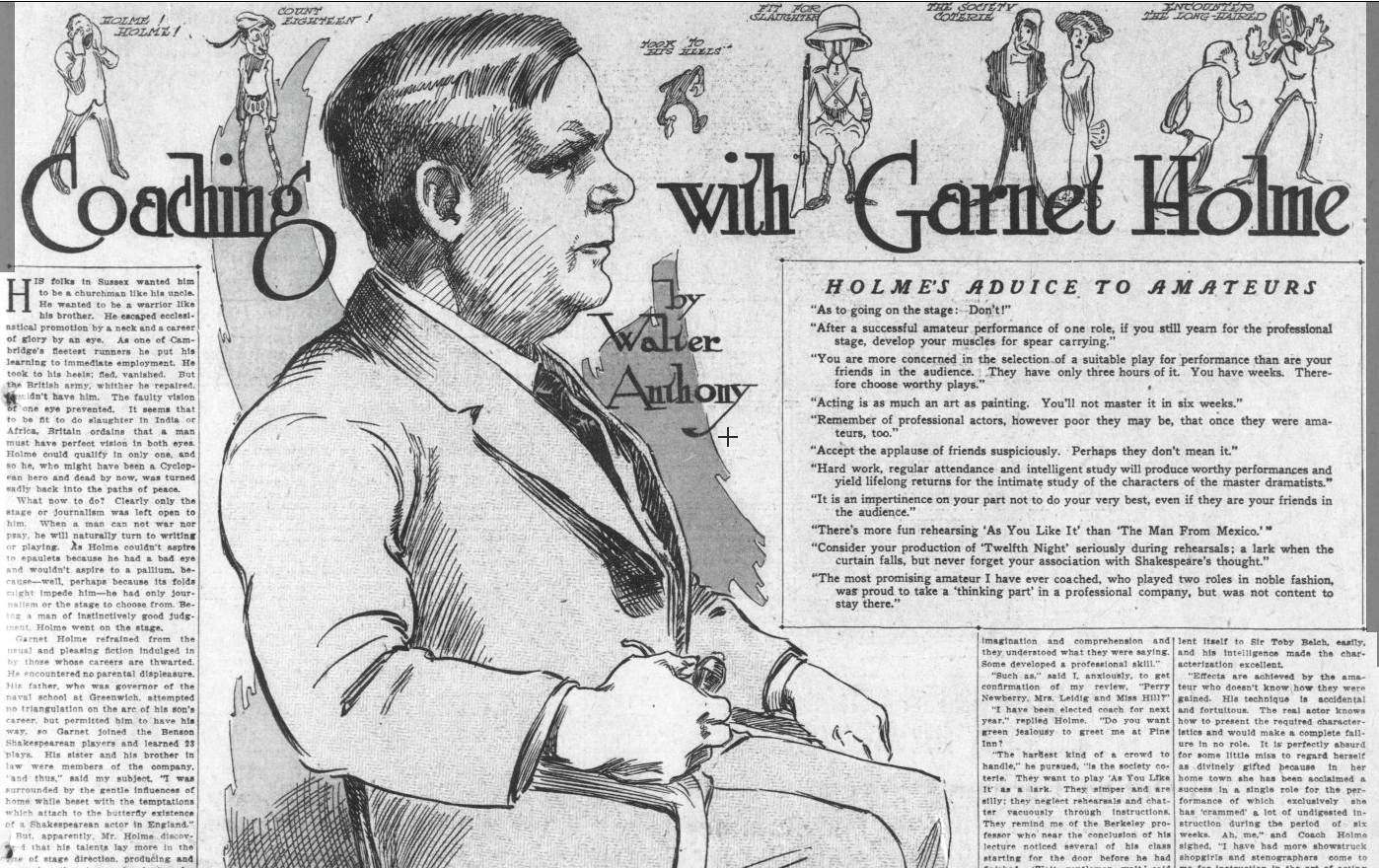
1. Garnet William Holme: News Paper Article, 1911, San Francisco CA USA.
Coaching with Garnet Holme
Walter Anthony
HIS folks in Sussex wanted him to be a churchman like his uncle. He wanted to be a warrior like his brother. He escaped ecclesiastical promotion by a neck and a career of glory by an eye. As one of Cambridge's fleetest runners he put his learning to immediate employment. He took to his heels; fled, vanished. But the British army, whither he repaired wouldn't have him. The faulty vision of 'one eye prevented. It seems that to be fit to do slaughter In India or Africa, Britain ordains that a man must have perfect vision In both eyes. Holme could qualify in only one, and so he, who might have been a Cyclopean hero and dead by now, was turned sadly back into the paths of peace.
What now to do? Clearly only the stage or journalism was left open to him. When a man can not war nor pray, he will naturally turn to writing or playing. As Holme couldn't aspire to epaulets because he had a bad eye and wouldn't aspire to a pallium, because - well, perhaps because its folds might impede him - he had only journalism or the stage to choose from. Being a man of instinctively good Judgment. Holme went on the stage.
Garnet Holme refrained from the usual and pleasing fiction Indulged in by those whose careers are thwarted. He encountered no parental displeasure. His father, who was governor of the naval school at Greenwich, attempted no triangulation on the arc of his son's career, but permitted him to have his way, so Garnet joined the Benson Shakespearean players and learned 23 plays. His sister and his brother in law were members of the company, "and thus," said my subject, "I was surrounded by the gentle influences of home while beset with the temptations which attach to the butterfly existence of a Shakespearean actor in England." But, apparently, Mr. Holme. discovered that his talents lay more in the line of stage direction, producing and managing, than In merely playing, for when he had added a speaking acquaintance with 23 classic dramas to the education he had received at Jesus college. Cambridge, he went into the producing business himself. Taking a partner, he formed a pastoral company, which played all over England under sometimes clement skies. "It was a fine business," said Holme, "except when it rained; but in England it rains often. I remember a production we pave of "Twelfth Night" one fair time. Showers fell at all sorts of inconvenient moments, Pluvius apparently being oblivious to the fact that the duke of Norfolk was sitting under the trees."
Thereupon Holme told me a story about the duke of Norfolk, who was marshal of the coronation spasm recently passed, which may interest you while it proves, that he, whom Holme reminded me was the most serenely high and aristocratic of all British nobility except the members of the royal family itself, was, after all, merely human. The duke of Norfolk got wet, just like any other man exposed to the rain. After the performance he looked Holme up and said he wanted to meet the boys of the company. Holme and his damp highness went into the dressing tent arm In arm. One of the principals had stripped to the waist, in order the better to remove what evidences of Orsino remained that the rain had not washed off. He had a sponge in one hard and stood like Poseidon surrounded in a sea. of soapsuds. "Permit me." said Holme, democratically leading the noble guest to the sputtering player, "to present the duke of Norfolk. This Is the duke of Illyria." "Have you taken out naturalization papers" I asked, reflecting on such audacious democracy.
And that leads me to introduce Garnet Holme, of whom, if you have been Interested in the performances of "Twelfth Night" and the historical pageant recently given in Carmel, you must have heard. Holme was the man that whipped the literati and the townsfolk of the famous little village by the sea into histrionic shape. He it was who handled the individualists and made them merge harmoniously In Shakespeare's merry comedy and in the picturesque pageantry of highly colored history.
I happened to be in Carmel at the time and saw chaos melt and reform into system, and concluded that we who happily have been addicted to this page have been overlooking; a very potent force in the drama of the day - the Coach.
• •
SINCE 1905, when most things began here, Holme has been coaching the students at the University of California and teaching them how to act In classic drama. He has presented them In Shakespeare's "The Merry Wives of Windsor," in a Sanscript play, "The Little Clay Cart," "Abraham and Isaac," "Thersytes," Ben Jonson's "Hue and Cry After Cupid," Shakespeare's "The Winter's Tale," Pinero's "The Cabinet Minister," Van Dyke's "The House of Rimmon," Stephen Phillips' "Nero" and George Bernard Shaw's "Caesar and Cleopatra" - list to make Henry Miller gasp!
I observed during the Carmel rehearsals the projection of sound knowledge of dramatic law, unusual perceptivities which discovered and manipulated human nature, an abiding sense of humor, and an ability for organization and control which kept the forces at work even though individuals in the mass hated him. For even in smiling Carmel, as elsewhere, cliques and politics rage.
Holme, you see, has trouble sometimes because, while he looks like a pugilist, he Is really an esthete with muscles. He encounters the long haired and feeble minded and shocks them with common sense. They do not understand him, and the accuracy of his judgments on matters of groupings, color arrangements and poetic reading of lines offends them, because they look so much more capable of entertaining them but are not capable of thinking them. This makes them angry. To complete an admirable exhibition of force and ability. Holme persuaded the townsfolk to double their exertions and not only give 'Twelfth Night," but attempt what proved to be the more notable event of the two, a pageant commemorating the history of Carmel in which the picturesque figures of Father Junipero Serra and Portola raised themselves nobly. "Decidedly," said I to myself, "Holme is a man you should know."
• •
IS it race vanity which inspires us with surprise when we discover an Englishman with a sense of humor? We hug the delusion and urge always, when the phenomenon appears, "there Is Irish blood in him." It's a harmless fable and the cause of much of our frequent enjoyment from the pleasures of surprise which we refuse to accept as habitual or common. Holme Is another of our acquaintances from England who surprises us. His sense of humor is irrepressible.
"The principal necessity with amateurs learning a play," he says, "is that you amuse them. If the coach can not keep them entertained they will not attend rehearsals, or, if they do, they will be Intensely bored by the blunders of the others in the cast and will sit around and talk about them. They must b< entertained." So Holme passes "the laugh" from one to another. Nobody escapes the shaft of his repartee. Fred Bechdolt, who is one of the most successful of Carmel producers of manuscript, played Malvolio in "Twelfth Night," and played him mighty well, I should not neglect to say; but not at first. He was too precipitate in the rehearsals. Like all amateurs, he hurried. Malvolio is nothing If not deliberate and an ass. Bechdolt found either quality difficult to impersonate. "Count three," commanded Holme from some place beneath the foliage of the Forest theater, "before you reply to Olivia's 'Hie thee, Malvolio.' Take the scene over again." It was done. "Did you count three?" shouted Holme. "I did," said Bechdolt, confidently. "Count 18," said Holme, sweetly.
At the conclusion of the performance on the night of July 3, there were loud cries for the coach. The shouting: developed into an ovation. "Holme! Holme!" they yelled. But the hero of the tumult came not, neither could he be found. Afterward somebody remonstrated with him. He should have acknowledged the tribute to his skill as coach. He should have accepted the honor due him as the responsible party for the success of the occasion. Why had he not? "Oh," said Holme, abandoning truth for the love of the joke, "I was hiding In the wings hollering "Holme! Holme!' to beat the band."
Every community, even the most Intellectual, must have its town delinquent. Carmel has. He held Holme up, in his harmless way, and said he had a suggestion to offer for the pageant. The pageant was Holme's pet, the very apple of his eye. He would listen to anybody's suggestions. "I've got a neighbor," said the harmless one, "who has a son, and he plays the banjo great. I'll speak to him and get him to play in the pageant for you. Folks like a bit of a tune, you know." And he winked his eye as one to whom the desires of the public are an open book.
"Thank you so much," said Holme, "but, you see, I haven't charge of the patriotic exercises. I'm an Englishman. Better tell Mr. Devendorf about It."
• •
"NO," answered Holme to question, "the players at Carmel were not the hardest I have handled. It is true they are Individualists and grown up, but their literary tendencies and training supply imagination and comprehension and they understood what they were saying. Some developed a professional skill."
"Such as," said I, anxiously, to get confirmation of my review. "Perry Newberry, Mrs. Leidig and Miss Hill?"
"I have been elected coach for next year," replied Holme. "Do you want green jealousy to greet me at Pine Inn?
"The hardest kind of a crowd to handle," he pursued, "is the society coterie. They want to play 'As You Like' as a lark. They simper and are silly; they neglect rehearsals and chatter vacuously through Instructions. They remind me of the Berkeley professor who near the conclusion of his lecture noticed several of his class starting for the door before he had finished. 'Wait, gentlemen, wait,' said he; 'I have still two more pearls to throw.'"
"How do you avoid trouble with society amateurs." I asked.
"By not coaching them,' said he.
"MY work at the university Is my principal delight." he went on, "to which is added great hopes for the start made on the fourth of July at Carmel by the pageant. I have plans for that, I have great plans for that. My ambition at Berkeley is to place the production of the English club on a comparable par with the presentations done by Yale and Harvard, where, as you know, such a high standard Is attained that the players have become a force in the nation's theatricals - an intellectual yet a potent impulse for good. My ambition at Carmel for the pageant is - well, you shall see.
"I do not pretend that you can teach amateurs in six weeks or six months how to act. You can teach them how to act acting, though. Acting is just as much a profession as law is. The amateur will break every rule. He does not know how to make an entrance or an exit and he doesn't know how to cross the stage; he understands nothing of the means for developing a situation, nor of pauses to accumulate effect, nor of introspective silence to punctuate the pause. These things must be learned. Among the best of the players who began their careers under me was George Manship, who played two roles at Berkeley in noble style. Yet when he went into the Benson company he was glad to begin by carrying a spear, and now that he has been promoted to a place where he occasionally speaks he rightly feels that he is making rapid progress.
"The amateur Is picked by the judicious coach with a sense for the relation of his natural capacities for the role he is to assume. Thus Perry Newberry's robust, hearty personality lent itself to Sir Toby Belch, easily, and his intelligence made the characterization excellent.
"Effects are achieved by the amateur who doesn't know how they were gained. His technique is accidental and fortuitous. The real actor knows how to present the required characteristics and would make a complete failure in no role. It is perfectly absurd for some little miss to regard herself as divinely gifted because in her home town she has been acclaimed a success In a single role for the performance of which exclusively she has 'crammed' a lot of undigested instruction during the period of six weeks. Ah, me," and Coach Holms sighed, "I have had more showstruck shopgirls and stenographers come to me for Instruction in the art of acting than you would be willing to believe, and the poor sillies always go away offended when the truth is rudely told. You may say, however, that I always discourage them on principle. There are so many bad actresses on the stage already.
"SINCE," said Holme, who professes to know me, "you are going to abuse me in this interview, I beg of you as a friend, let me say something in my own behalf on a subject which appeals to me with great force. It concerns the selection of plays by high school and university students of the drama.
"Select good plays. It is no harder to proceed to a satisfactory production of 'Twelfth Night,' 'As You Like It,' 'The Winter's Tale," or even of a modern Ibsen or Shaw play, then to do 'The Man from Mexico.' The latter entertains the student for a few rehearsals, but long before the piece is ready for performance it stales. It will be as empty to the players as it is profitless to the friends in the audience who might better be witnessing a superior presentation by a stock company of professionals.
"My chief concern in the selection of the dramas to be played by school and college players is with the students and not the public. The audience spends but two hours or so at the performance, and then it is all over. The players spend weeks on It. Those who have taken even the smallest role of a great play have been in intimate association with a great mind. Something has been added to their store of knowledge and to their experience. As the art of acting may not be acquired in six weeks' time, there is no use trying to abuse, our minds with the delusion that a 'fine' or even a 'professional' performance is possible. A medium good stock company in a week's time could do it better. So let us first select a play that is worth our while. The audience will come anyway, and the excellence of the play will justify its attendance and our effort. At a first rehearsal a Shakespearean play looks like a hopeless task, while the obvious humor of a modern farce promises much; but, as the work goes on, the better play develops Interest more and more, while the other seems less and less attractive. And when the play is over, and the curtain is rung down, what are the assets? Can you compare the advantage accruing to a lot of students who have become acquainted with Goldsmith's Kate Hardcastle, Tony Lumpkin and Old Grouse and Diggory, or with Shakespeare's delicious Viola, bumptious Malvolio and woebegone Olivia with the results achieved through an acquaintance with the personages in "The Man from Mexico?
"The effect on the students of the selected drama is to be considered before the effect on the audience; and the rehearsals are vastly more important in the long run than the performance. The student who has snuggled under the skin of one of Shakespeare's great characters has acquired the ability to discuss at one subject intelligently when his college days are over, and that's more of an accomplishment than many can boast."
Ref:
San Francesco Call, Volume 110, Number 46, 16 July 1911
<https://cdnc.ucr.edu/cgi-bin/cdnc?a=d&d=SFC19110716.2.89.2>
|