Sir Capt Frederick Blagg HAMPTON K.I.C. B.A.L. [4927]
- Born: 9 Nov 1813, Woburn BDF
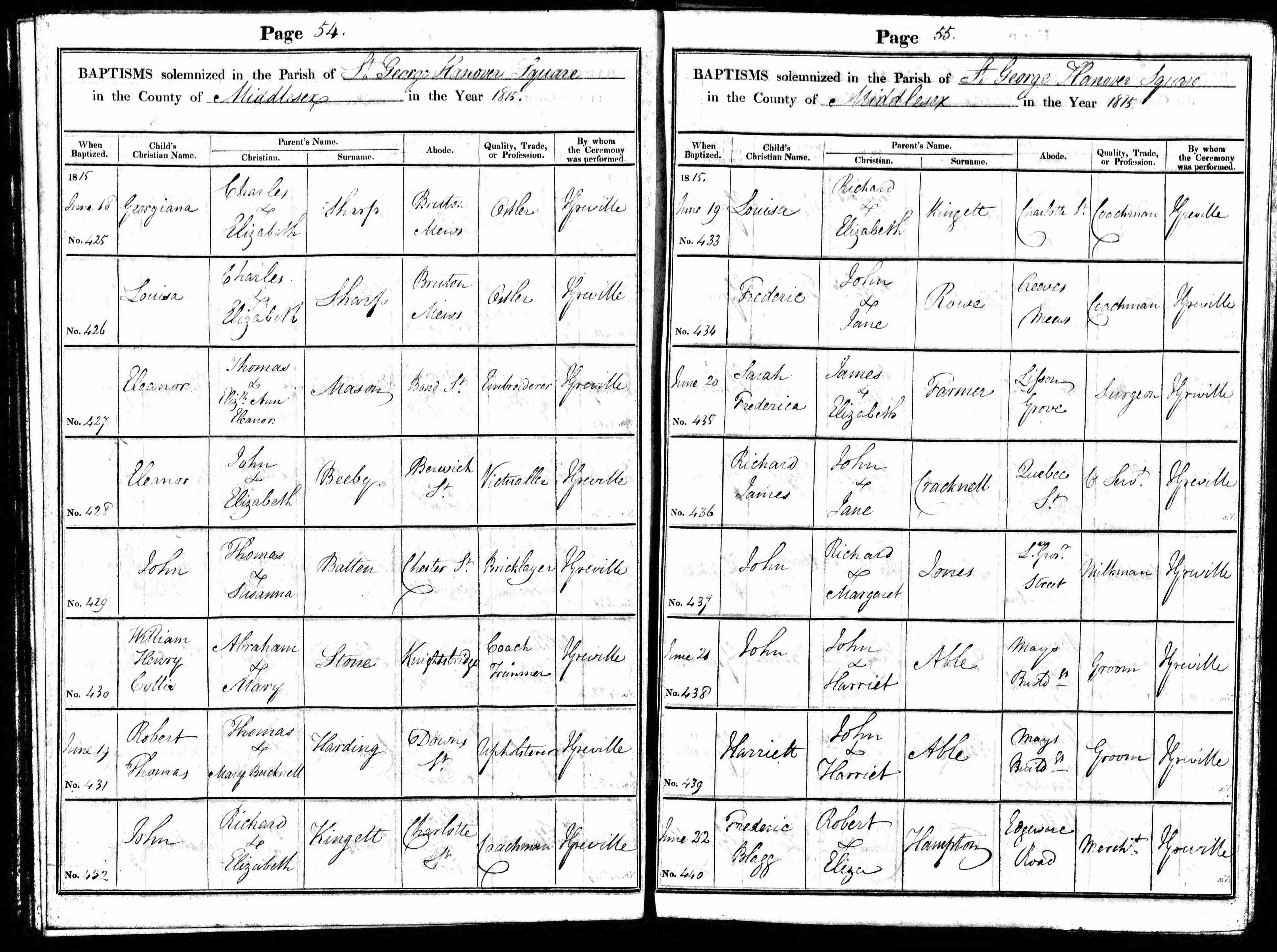
- Baptised: 22 Jun 1815, St George Hanover Sq
- Marriage (1): Matilda Collet STRATFOLD [4928] on 25 Oct 1841 in Woburn BDF
- Died: 26 Feb 1859, Brisbane Queensland Aust. aged 45

 General Notes: General Notes:
Frederic Blagg Hampton
Record Type: Baptism
Baptism Date: 22 Jun 1815
Baptism Place: St George Hanover Square, Westminster, England
Father: Robert Hampton
Mother: Eliza Hampton
Register Type: Bishop's Transcript.
Frederic Blagg Hampton
Age: 28
Birth Date: 1813
Marriage Date: 25 Oct 1841
Marriage Place: Woburn,Bedford,England
Spouse: Matilda Stratfold
FHL Film Number: 952421
Marriage to Matilda Stratfold
Marriage solemnized in the Parish Church in the Parish of Woburn in the County of Bedford
Oct 25 1841
Frederick Blagg Hampton of Chatteris batchelor Chief Constable on Isle of Ely
Father. Robert Hampton Merchant.
Married by banns by Hy Hutton minister
Matilda Stratfold of Woburn spinster.
Father. R C Stratfold Parish Clerk
Both of full age.
Witnesses. Robert Collet Stratfold, Marion Stratfold, Rosina Stratfold.
Death
Frederic Blagg Hampton 26 Feb 1859 Queensland. Father - Robert. Mother - Eliza Blagg Australian Death Index 1787-1985. Reg. No. B000320 Page 6023
Frederick was buried in the Church of England burial grounds, part of Paddington Cemetery Brisbane, it was closed in 1875 and later the graves exhumed, and the area redeveloped as sports grounds. Family researchers in the 20th century have been unable to locate his grave, or a headstone.
Probate
Frederick Blagg Hampton
Date9 September 1859
OccupationGentleman
SourceWills (SCT/P1-2 Microfilm Z49 & Z50)
Column or folio54
LocationMoreton Bay
Queensland Court Records
Research Notes:
2012 - Frederick is rather an enigma. He is described in the death notices of his daughters; Isabel as "Captain Frederick Blagg Hampton, K.I.C., B.A.L" and Edith as "Sir Frederick B. Hampton, K.l.C. B.A.L." he is described as Captain in his wife's death notice, and his son Robert marriage certificate. In all other media reporting of him he is accorded no specific honorifics, other than rank, K.I.C. & B.A.L.
2016 - Bob Thompson advises B.A.L. are post-nominal letters for the British Auxiliary Legion, a volunteer legion who fought against the Carlist's in the war for the Spanish Throne 1835. The B.A.L. were fighting to keep Queen Isabella II of Spain on her throne against her uncle Don Carlos, an usurper. It appears Frederick, as a result of service in this war was awarded a K.I.C., Knight of the Order of Isabella the Catholic, a well known decoration awarded by the Spanish State. Hence he was occasionally titled Sir Frederick.
Frederick is clearly identified in the 1851 census of Cambridgeshire, employed as the Chief Constable of the Isle of Ely. An ancient County under the control of the Bishop of Ely, it was generally incorporated into Cambridgeshire in 1837.
From a trial reported below Frederick was employed by the NSW Government as an Inspector of Sydney Police and to recruit policemen in Britain to emigrate with him to NSW. This he and his family did in 1855 on the Exodus, which arrived NSW 26 Jul 1855 with a large complement of police personel.
RURAL POLICE - At an adjourned meeting of the magistrates for the isle of Ely, holden at Wisbech on the 14th inst. for the purpose of appointing a chief constable for the rural police force, F. B. Hampton Esq. was duly elected to fill that office.
Ref: Cambridge Chronicle and Journal | Saturday 24 July 1841 Page 3
Frederick and his family are recorded in the passenger list as:
- Hampton Frederick B aged 40 an Inspector of Police born Pimlico London son of Robert (dead) and Eliza living at Chelsea literate a member of the Church of England no relatives in the Colony
- Hampton Matilda aged 30 born Woburn Beds. daughter of Robert & Mary Stratfold living in Woburn literate C of E no relatives in the Colony
- Hampton Osborne aged 12 born March Isle of Ely son of Frederick & Matilda on board literate C of E.
- Hampton Isabel aged 9 born March Isle of Ely daughter of Frederick & Matilda literate C of E
- Hampton Catherine aged 3 born March Isle of Ely daughter of Frederick & Matilda illiterate C of E
- Hampton Sophia an infant born Marylebone LON daughter of Frederick & Mathilda
Ref: New South Wales, Australia, Assisted Immigrant Passenger Lists, 1828-1896
Frederick is reported as giving evidence in the following trial.
Desertion from the Police Force
Neil Buchanan was indicted for having, on the 17th of December last, deserted from the Sydney Police Force before the expiration of his engagement, namely, to serve in the force as an ordinary constable for three years
The first witness called was Frederick B. Hampton, Inspector of Sydney Police. He deposed that he was engaged in England by Mr. Barnard as Inspector of Police in Sydney; and also to enlist other men for the same service. He engaged the defendant from a number of men belonging to the Liverpool Police Force. . . . .
Ref: Empire Sydney, NSW : 1850 - 1875. Saturday 9 February 1856
Frederick B Hampton is recorded in the NSW Public Service Lists 1858-70: Native Police; Northern District; Secretary; Frederick B Hampton; appointeed 18 May 1857 by the Governor; L200 per annum.
This appears somewhat of a comedown for Frederick in status and salary, perhaps he was in poor health as within 2 years he was dead.
Family Jottings by Muriel G Julius 1985
Frederick Blagg Hampton was Chief Constable, Isle of Ely. He came to Australia in 1856 and was with the New South Wales Police until 1857, when he came to Queensland and was attached to the Colonial Office, as Secretary to "Native Police". He died in 1859 and was buried in the Church of England burial grounds. On reference to the C. of E. Archivis, I was told that this was a portion of the Paddington Cemetery. In 1875 Paddington Cemetery closed and later fell into disrepair. In 1911 the Queensland Government resumed this Cemetery and relatives of persons buried there were advised by public notice regarding re-interment in other cemetries. The Lands Department made available to me many records regarding the Paddington Cemetery, but there was no record of the removal of the remains of Frederick Blagg Hampton. I also saw an officer of the Brisbane City Council, and obtained a report, together with a list of bodies and/or headstones removed. The name of Frederick Blagg Hampton does not appear therein either, and it is assumed that there was no headstone or identification of his grave, or response from any of his relatives, so the remains were presumably left there. Since the completion of the removal of remains in 1914 the area was redeveloped into playground areas, and is now the Lang Park Football Grounds. (Some headstones were removed and placed in the grounds of Christ Church, Milton, adjoining. Tho I searched the Church grounds I could find no Hampton stone. Grandmother Katherine Georgina Colet Julius, and Grandfather had returned to England in 1902, and other members of the Hampton family pre-deceased, so evidently no action was taken regarding the re-interment . (n.b. R.H. Julius was, of course in Brisbane at this time - I wonder if he took any action? Maybe he did, and maybe Grandma decided to leave the grave we will never know!)
Matilda, after Frederick Blagg's death remarried to T.F. Smythe (recorded in the Oxley Library). Matilda died in 1892 and is buried in Toowong Cemetery, Brisbane, under the name of Matilda Hampton (why not Smythe ?) in a 3 plot grave. I have seen this grave. In this 3 plot grave is, in the centre a headstone to Isabel Matilda Roehricht d.1881 (she is a daughter of Frederick Blagg and Matilda Hampton) . There are no headstones on either of the other 2 graves, but records at Toowong Cemetery show they are graves of Richard Hugo Oswald Roehricht and Matilda Hampton, so it is husband, wife, mother daughter in this plot .
Reverting back to Frederick Blagg, Margaret Bucknell carries the name of her greatgrandfather Hampton, and in her possession is a silver snuff box which bears the following inscription:
Presented to
Capt Frederick Blagg Hampton K.I.C.
late of the British Auxiliary Legion
and now Inspector in Charge of Division "D" of
the Metropolitan Police Force of New South Wales.
As a mark of esteem from a few of his friends in his district
Sydney 1st May 1857.
The family bible in my possession comes from the Stratfold family witrh the first birth inscription dated 1790.
Bob Thompson provides more research:
30/10/2016
Hampton, Frederick Blagg: Story to date
Previous military service was required to join the BAL. It was also required to achieve
his rank of Captain of Artillery.
There's at least one mention of him in Brett's book below.
British Auxiliary Legion 1835-36
The two Carlist wars are probably the least remembered, outside Spain, of the civil conflicts of the
country. In the first of these foreign volunteers fought on both sides, among them the 10,000 men of
the British Auxiliary Legion, an arm of Palmerston's foreign policy supporting the liberal Cristino cause
and the young Queen Isabella II against her uncle, Don Carlos, pretender to the throne. With the
Foreign Enlistment Act suspended in 1835, troops were recruited in Britain and Ireland to fight in a
savage struggle. Ill-paid, poorly supplied and inadequately accommodated in appalling weather, the
Legion suffered heavy mortality from typhus, yet fought bravely in battle, contributing to an eventual
Cristino victory. Ireland played a prominent role in the Legion with four designated Irish regiments and
many more men serving in other units.
REF: The British Auxiliary Legion in the First Carlist War in Spain, 1835-1838: A Forgotten Army
- Edward M. Brett Four Courts, 2005 - History - 240 pages
Presented to the House of Commons in 1839 were papers relative to the war in Spain. Among these
was a letter from H. H. Jacks, Colonel 2nd Lancers, B.A.L. in San Sebastian to Viscount Palmerston
G.C.B. dated September 25, 1837. [The right honourable Lord Palmerston was Her Majesty's
Principle Secretary for Foreign Affairs.]
Included with this letter is a petition from officers of the British Auxiliary Legion in San Sebastian
requesting financial assistance from the British government. They were destitute due to non payment
by the Spanish government.
"That, relying on the pledges of these high official British Authorities, your Memorialists have been
detained in this town until all their pecuniary resources have been exhausted, many of them being
wounded, some having lost their limbs, and several being in a state of utter destitution, without billets or
rations to subsist on.
That in addition to above 200 officers now here, there are also about 400 non-commissioned officers and
privates, wounded, invalided, and disbanded, the greater portion of whom are wandering about the
streets of this town, ragged and destitute, waiting without a shelter, a settlement of their claims, and a
passage to their homes, many having applied without effect to the British Consul to be passed to
England.
That it has been communicated to your Memorialists by Brigadier-General O'Connell, who arrived here
on the 19th instant from Madrid, that there was no prospect of obtaining a settlement of the claims of the
late Legion from the Spanish Government, and, further, that it did not appear to him that any means
existed at Madrid to afford us the slightest relief."
Among the 127 signatories was Fred Hampton Capt. Artillery.
REF: Parliamentary Papers, House of Commons and Command, Volume 50
Great Britain. Parliament. House of Commons
H.M. Stationery Office, 1839, "PAPERS RELATIVE TO THE WAR IN SPAIN" Page 30
https://goo.gl/6dhW4a (PDF page 141) accessed October 23, 2016
There is anecdotal evidence he was awarded the Spanish "Knight of the Order of Isabella the
Catholic" as the initials KIC appear in many references to him.
Frederick Blagg Hampton was a Police Superintendent on May 19, 1840 in Leighton Buzzard,
Bedfordshire, England.
REF: The Cambridge Independent Press and Huntingdon, Bedford, and Peterborough Gazette
Saturday October 24,1840. Col 4, "Bedfordshire Quarter Sessions Assault on a Constable"
http://bedsarchivescat.bedford.gov.uk/Details/archive/110338402 accessed October 23, 2016
The England Census, June 6, 1841, had Frederick Hampton, age 25, living at Market Place, Isle of
Ely, Cambridgeshire, England. His profession was listed as Commercial Gent.
REF: Ancestry.com. 1841 England Census [database on-line].
Provo, UT, USA: Ancestry.com Operations, Inc, 2010.
Original data: Census Returns of England and Wales, 1841.
Kew, Surrey, England: The National Archives of the UK (TNA):
Public Record Office (PRO), 1841.
Data imaged from the National Archives, London, England.
Piece - 88; Book - 8; Folio - 13; Page number - 20
He was appointed to the position of Chief Constable of the Rural Police Force on 14 July 1841, at a
meeting of the Isle of Ely magistrates at Wisbech.
REF: Cambridge Chronicle and Journal, 24 July 1841 Page 3, Col 4
http://www.britishnewspaperarchive.co.uk/search/results/1841-07-
24?NewspaperTitle=Cambridge%2BChronicle%2Band%2BJournal&Issue
Id=BL%2F0000420%2F18410724%2F&County=Cambridgeshire%2C%20England
Accessed October 23, 2016
Census
Household members the night of 30th March 1851 at No 20 Hurst Lane, March, Isle of Ely.
Name Relation Age Occupation Birth place
Frederic B Hampton Head 37 Chief Constable of the Isle of Ely, Born Chelsea London
Matilda Hampton Wife 26 born Bedfordshire, Woburn
Robert C. E. Hampton Son 8 Scholar born Cambridgeshire, March
Frederic C.O. Hampton Son 7 Scholar born Cambridgeshire, March
Isabel M Hampton Daughter 5 Scholar born Cambridgeshire, March
Mary R. C. Hampton Daughter 9Mo born Cambridgeshire, March
Susan Dickerson Nanny 17
Mary Swan Servant 15
REF: Ancestry.com. 1851 England Census [database on-line].
Provo, UT, USA: Ancestry.com Operations, Inc, 2010.
Original Date: Census returns of England and Wales, 1851:
Kew, Surrey, England: The National Archives of the UK (TNA):
Public Record Office (PRO), 1851.
Class: HO707; Piece: 1765; Folio: 716; Page: 5; GSU roll: 193658-193659.
The Move to Australia
In 1853 in the Colony of New South Wales policing was being carried out by former military personnel
and other untrained people. The government of the day determined it would be better to have trained,
experienced people doing tis job. Accordingly it was decided to recruit from Great Britain. The Police
Recruiting Act 1853 authorised Mr. Edward Barnard Colonial Agent General for the New South
Wales Colony in London to organise the recruitment.
REF: Police Recruiting Act 1853 No. 30a (October 24, 1853)
http://www.austlii.edu.au/au/legis/nsw/num_act/pra1853n30216
Accessed October 23, 2016
Mr. Barnard engaged, among others, Frederick B. Hampton, then Chief Constable of Isle of Ely to
carry out this task on behalf of the Colony. Hampton was offered free relocation for him and his family
to Sydney with the position of Inspector, Sydney Police Force.
An extract from "Reminiscences of a Colonial Judge" [written in 1890]
To Sir Charles Cowper the credit is due for having suggested the importation of trained policemen from
England. The idea was excellent, and the result was most successful. It is immaterial to enquire who selected
them. They came in two detachments, the first in the ship Bangalore which arrived on the 13th January 1855
and brought 46 chosen from the London police, officered by Inspectors John Francis Weale and William John
Brown. Of all who came in that vessel only three are now in the force, viz Superintendents George Read, George
Ryland and Charles Saunderson. The ship Exodus brought a further number on the 26th July 1855, consisting of
72 men chosen from the various provincial towns of England. The officers were Sir John Cecil Read; late
Governor of Darlinghurst Gaol, now on pension, and Mr James Black and Captain FB Hampton, both deceased.
REF: Reminiscences of a Colonial Judge James Sheen Dowling January 1, 1996
Federation Press Ch 10; P89
https://books.google.co.uk/books?id=Rm6Z9R20VYsC&pg=PA89&dq="F+B+Hampton"&hl=en&sa=X&ved=0ahUKEwjR45mr
_e3PAhUGVhoKHUWmBIEQ6AEINTAD#v=onepage&q=%22F%20B%20Hampton%22&f=false Accessed October 23, 2016
Conditions were brutal for the immigrants; this article appeared in the Empire newspaper Thursday
March 22, 1855. The writer arrived on the Bangalore in January 1855.
THE NEW POLICE.
To the Editor of the Empire.
Sir-I beg, most respectfully, a corner in your valuable paper, as the only means I have of making known to
the public the treatment which we (the police per Bangalore) have received since our arrival in this colony.
However unpopular the police may be in Sydney, I think the majority of your readers will agree that it was an
unjust, as well as a mean proceeding, to lure a number of men from England, causing them to break up their
homes, and give up several years' service, under the inducement of apparently high wages, when contrasted
with our pay at home, but which, on our arrival here, we find is far below the ordinary pay in the colony, and
will not enable us to maintain ourselves as respectable as we could in England.
We were promised that lodgings should be provided for us; they have found us tents, which has caused much
sickness amongst us. Already we have lost four children, and there are now two men in the infirmary with
rheumatic fever. There is scarcely a tent but some of the family are under medical treatment. The doctor
attached to the police force has, from the first, declared the tents unfit for dwellings, and at last two medical
men have been appointed to examine the state of the tents, and report upon the health of parties living in
them; the consequence, I believe, is that the tents are condemned as unfit for us to live in. Still we are kept in
them, whilst sickness is increasing throughout the camp. We are receiving 6s. per day, subject to 1s. per day
stoppage for sickness. I will leave it to your readers to judge if we can be expected to perform the duties,
required of us if we do not receive different treatment, during our three years' engagement, from those in
authority over us.
Sydney, March 20. BANGALORE
REF: THE NEW POLICE. (1855, March 22). Empire (Sydney, NSW : 1850 - 1875), p. 4.
Retrieved October 30, 2016, from http://nla.gov.au/nla.news-article60178973
The following article appeared in the Adelaide Times, July 13, 1855
"One sergeant and twenty men of the Manchester police force have been selected by the Government to
proceed to Sydney. Captain Hampton, who is acting on behalf of the Government in organising the
Australian drafts, has selected a number of men from the Liverpool police force. The men are to be paid 5s.
per day; sergeants to receive 6s. 3d. and superintendents 8s. 6d. By agreement they are to remain in the police
force at Sydney for three years."
REF: MISCELLANEOUS. (1855, July 13). Adelaide Times (SA : 1848 - 1858), p. 3. Col 4.
Retrieved October 27, 2016, from http://nla.gov.au/nla.news-article207071506
Frederick left London on April 21 and arrived in Sydney on July 27, 1855 aboard "Exodus". With him
were his wife Matilda, son Osborn 12, daughters Isobel 9, Catherine 3, and Sophia infant. Their
oldest son Robert 14 arrived the following year aboard "Prince Alfred". Frederick's age was noted as
40 and his occupation as "Inspector of Police".
REF: Source Citation: State Records Authority of New South Wales;
Kingswood New South Wales, Australia; Persons on bounty ships to Sydney, Newcastle, and Moreton Bay
(Board's Immigrant Lists) ; Series: 5317 ; Reel: 2469 ; ; Item: [4/4948] . Retrieved October 30, 2016
For the trial of Neil Buchanan for desertion from the Sydney Police Force Feb 10, 1856 Frederick
Black [sic] Hampton, Inspector of the Sydney Police, was called to give evidence regarding
Buchanan's engagement in England.
Hampton, in consideration for free passage under the Local Act, engaged 100 policemen in England
to serve as ordinary constables at the rate of 5 shillings per day.
He engaged men about a month before sailing, boarding them aboard "Exodus" in the Mersey River,
Liverpool, England.
REF: Court proceedings in SMH Feb 11, 1856
Trove: http://nla.gov.au/nla.news-article12979210 Accessed Oct 23, 2016
In May of 1857 Frederick was transferred to the New South Wales Native Police, Northern Division.
[Possibly a sinecure due to illness, he died less than 2 years later] On his departure from Sydney's 'D'
Division a sliver snuff box presented to him inscribed:
Capt Frederick Blagg Hampton K.I.C.
late of the British Auxiliary Legion
and now Inspector in Charge of Division "D" of
the Metropolitan Police Force of New South Wales.
As a mark of esteem from a few of his friends in his district
Sydney 1st May 1857.
Frederick B Hampton was the Secretary for the NSW Native Police appointed to the position by the
Governor on May 18, 1857, on a salary of £200 0s 0p p.a. plus 2s. 6p. per diem in lieu of provisions.
REF:: Ancestry.com. New South Wales, Australia, Returns of the Colony, 1822-1857 [database on-line].
Provo, UT, USA: Ancestry.com Operations, Inc., 2010.
This collection was indexed by Ancestry World Archives Project contributors.
Original data: Returns of the Colony, "Blue Books" 1822-57.
Kingswood, New South Wales, Australia:
State Records Authority of New South Wales. Series 1286, 176 rolls.
NSW Native Police
[Originally the New South Wales Northern District Native Police]
Australian native police units, consisting of Aboriginal troopers under the command usually of a single white
officer, existed in several Australian colonies during the nineteenth century. From 1848 the NSW Native Police
were deployed in the northern districts of New South Wales, nearly exclusively within the borders of the later
colony of Queensland.
Before the separation of Queensland from New South Wales in 1859, the border police and, subsequently, the
NSW Native Police were the main government instrument of Aboriginal administration. After separation, the
administration of Indigenous matters was transferred to the Colonial Secretary for Queensland. In 1864, the
Native Police were brought under the control of the newly appointed Commissioner of Police. In 1865 the force
was renamed the Native Mounted Police and the force continued to operate as a separate police unit until its
disbandment in 1900.
The Queensland Native Police was a large and notorious force, used to reduce aboriginal attacks and resistance
against squatters. Members were recruited from southern tribes and were foreign to the local tribes, regarding
other blacks as their enemies.
It was arguably also the most controversial. Its mode of operation cannot by any standard be classified as "law
enforcement". At least from the period 1857 onward to 1890s there are no signs that this force was engaged in
anything but general punitive expeditions, commonly performed as deadly daybreak attacks on Aboriginal
camps. All signs are that the force generally took no prisoners at the frontier and in the few cases on record
when this did happen these prisoners were on record as having been shot during attempts to escape."
CITE: Extract in part from Wikipedia "Australian native police"
https://en.wikipedia.org/wiki/Australian_native_police - accessed Oct 28, 2016
He died at the Colonial Secretary's house (part of the Sec. Office) in February 1859
REF: Julius Family Jottings by Muriel Gataker 1985
Frederick B Hampton's will granted probate to Matilda on Tuesday April 19, 1859.
REF: ECCLESIASTICAL JURISDICTION. (1859, April 19). New South Wales Government Gazette (Sydney : 1832
- 1900), p. 882. Retrieved October 23, 2016, from http://nla.gov.au/nla.news-article228716593
Other Records
1. Census: England, 7 Jun 1841, Ely CAM. Frederick is recorded as aged 25 a commercial ? not born CAM. (This entry is uncertain, Frederick appears to be boarding)
2. Census: England, 30 Mar 1851, Hurst Lane March CAM. Frederick is recorded as Frederick C Hampton head of house married aged 37 the Chief Constable of the Isle of Ely born Chelsea LON
Frederick married Matilda Collet STRATFOLD [4928] [MRIN: 1694], daughter of Robert Collet STRATFOLD [14891] and Mary MILLARD [14893], on 25 Oct 1841 in Woburn BDF. (Matilda Collet STRATFOLD [4928] was born on 17 Nov 1824 in Woburn BDF, baptised on 14 Dec 1824 in Woburn BDF, died on 14 Aug 1892 in Brisbane Queensland Aust. and was buried in Toowong QLD.)
|