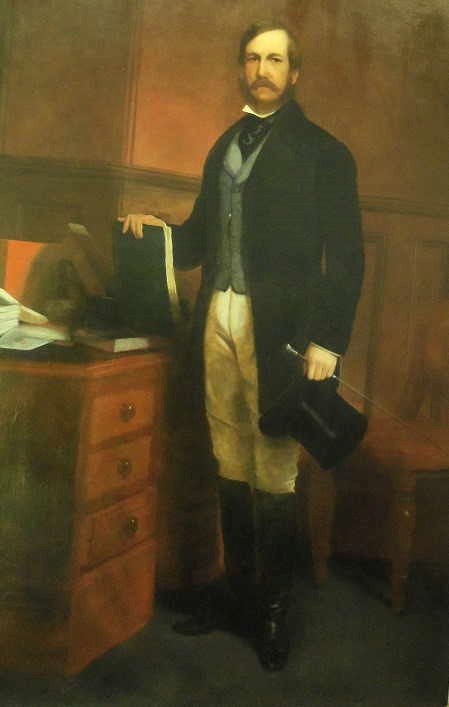
Edward Jerningham WAKEFIELD [1684]
- Born: 25 Jun 1820, London
- Baptised: 7 Jul 1820, St James Westminster LND
- Marriage (1): Ellen ROE [1891] on 3 Oct 1863 in St Peters Riccarton Christchurch
- Died: 3 Mar 1879, Ashburton NZ aged 58
- Buried: Ashburton Cemetery

 General Notes: General Notes:
At his christening the family were living in New Palace Yard Westminster.
Wakefield, Edward Jerningham
1820 - 1879
Adventurer, writer, politician
Biography
Edward Jerningham Wakefield, known as Jerningham, the only son of Edward Gibbon Wakefield and Eliza Anne Frances Pattle, was born in London, England, probably on 25 June 1820. His mother died 10 days after his birth, leaving Jerningham and his sister, Susan Priscilla (or Nina), to be raised mainly by their aunt, Catherine Torlesse. After study at King's College, London, Jerningham Wakefield's life was inevitably bound up in his father's colonial and political ventures. He acted as clerk and secretary, travelling with his father to Canada in 1838, and then with his uncle Colonel William Wakefield to New Zealand, arriving on the Tory in August 1839. As agent and explorer for the New Zealand Company, he was responsible for its land purchasing activities in Wanganui in 1840. Here his behaviour earned, from Governor Robert FitzRoy, the reproach that he was the 'devil's missionary' and the withdrawal of his magistrate's commission. He made extensive journeys in the Upper Rangitikei and Taupo districts, and in Nelson.
After FitzRoy's rebuke he returned to London, arriving in September 1844. For the next five years he worked in a desultory fashion for the New Zealand Company and the Canterbury Association. But he is remembered for the book he published in 1845 as propagandist and apologist for the company, Adventure in New Zealand. A lively account of his explorations and of the establishment of the first settlements at Wellington, Wanganui and New Plymouth, Adventure was a raging success. In 1848 he followed it with The hand-book for New Zealand, a practical book 'compiled for the use of intending Colonists'. Jerningham Wakefield was a restless traveller; New Zealand Company business took him to Scotland and Ireland, then back to New Zealand with the Canterbury settlers on the Lady Nugent in 1850.
In 1853 he was elected to the House of Representatives for Christchurch Country, and held the seat until 1855. For three days in 1854, in the turmoil that preceded responsible government, he was a member of the Executive Council. He represented Wellington City on the provincial council from 1857 to 1861. He persisted in standing for the House of Representatives, and suffered defeats in 1855, 1858 and 1861. Towards the end of his life, in 1871, he succeeded in Christchurch City East; he was defeated, however, by William Sefton Moorhouse in 1875.
He was marked throughout his life, and beyond it, by a damning reputation for flawed and wasted brilliance. Most commentators, including his own father, dismiss him as a wastrel and a failure, talented and intelligent, but reckless, weak-willed, contentious, promiscuous and generally unstable. The most acclaimed and most enduring achievements of his life are confined to a few years in his early 20s, when he lived and wrote Adventure.
The book was produced, with a companion volume of illustrations, both as propaganda to encourage new emigrants and as a public relations exercise. It sets out to celebrate and justify the New Zealand Company's grand enterprise. He has been accused of exaggeration and even of dishonesty, but within his own framework of loyalties, Jerningham Wakefield strives for complete accuracy and comprehensiveness. Basing his text on scrupulously kept journals, he records every interesting detail of his journeys, every impression and image of the new country. Significant events, such as the land purchase ceremonies or the Wairau affray, are reported with care. There are many digressions, including an analysis of the Treaty of Waitangi, and a chapter devoted to whaling. Innumerable facts are noted for their usefulness \endash botanical observations, geographical information, directions to the harbours, bays and channels, facts about winds, tides and sailing conditions.
Adventure is equally thorough in its account of the Maori. Jerningham Wakefield pays careful and respectful attention to the history, political background, tribal and family relationships, territory and status of the individuals and tribes he encountered. He describes everything from buildings and fortifications to cooking in a hangi and scraping flax. He explains points of etiquette, and records the oratory of great chiefs; he uses Maori terms and phrases with a natural smoothness.
His concern for thoroughness and concreteness does not however produce a dull book. Despite the formality of much of his language, the writing can be vividly colourful, fluent and fast-paced, full of drama and enthusiasm. Whatever its other qualities and objectives, Adventure is very consciously just that, a book of adventure. There is an irresistible exhilaration, a genuine delight in the strange and the exciting. Travelling through a wild new country, living off the land, trading and negotiating with flamboyantly exotic characters, both Maori and Pakeha \endash Jerningham Wakefield, still only in his early 20s, relishes the thrills and colour of pioneering: 'The whaling was at this time going on with great spirit; and I sailed away from Kapiti one morning in the midst of an animated chase, the whale and the boats having crossed my bows more than once.'
He communicates his feelings of the momentous importance of particular events \endash the Company's formal land purchases, their meetings with the most powerful chiefs \endash and conveys too a good appreciation of the dangers involved. There is real seriousness in his detailing of tribal wars and skirmishes, tense moments when weapons had to be kept close, the increasing insecurity after the Wairau affray, and the lawlessness of many Pakeha settlers. The difficulties and risks of travel are a constant concern, ranging from the sudden emergency of shipwreck to the excitement of running the foaming rapids of the Wanganui River. There are moments too of sheer romance \endash an overnight voyage to Wanganui with a Maori party: 'When I woke once or twice during the night, the canoe was lifting over the long swell, the moon and stars shining bright and clear, and a heavy dew falling on the sleepers coiled in their blankets, and the only sound to disturb the calm of the scene was the distant roar of the surf.'
Jerningham Wakefield is attuned to the romantic conventions and sensibilities of his time. The new country provides him with abundant opportunity for lyrical landscape description \endash the grandeur of mountains and forest, the clear beauty of coasts and harbours, the 'melodious chimes of the bell-bird' in the bush. Equally romantic is the glowing Utopian sentiment he applies to the yeoman farmers of Taranaki and the Hutt, or his tendency to view the Maori in the idealised colours of Rousseau's noble savage, or even in neo-classical terms: 'An old sage named Matangi now rose…. His silver-white hair and long beard, and benignant countenance, gave him the air of a Priam or a Nestor'.
There are strongly romantic qualities too in the rebelliousness and recklessness which eroded away Jerningham Wakefield's career. A pattern of controversy and scandal, of defiantly running counter to the orthodox respectabilities, shadows his life from early childhood, when his father was imprisoned in Newgate. After an extravagantly Bohemian lifestyle in the later 1840s as a celebrated young writer in London, his later career dissipated into good intentions, persistent failures and frustration.
Jerningham Wakefield married, on 3 October 1863 in Christchurch, a woman nearly 20 years younger than he, Ellen Roe, the daughter of a builder; they had two daughters. He published one more book, in 1868, an edition of Edward Gibbon Wakefield's letters titled The founders of Canterbury, and wrote several political pamphlets. His later life was clouded by alcoholism and disgrace, and he died in obscurity in the Ashburton Old Men's Home on 3 March 1879.
Ref: Dictionary of NZ Biography - By Ronda Cooper
EDWARD JERNINGHAM WAKEFIELD
HIS GRAND-DAUGHTER LOOKS AT HER FAMOUS ANCESTOR
The scene, just outside a confectioner's shop kept by one Peter Lang in Lambton Quay. Wellington; the time some where in the forties; the characters a group of well-dressed men on horseback, all in the most; riotous high spirits. Somebody dares, one of his companions to ride through the shop! The challenge is promptly accepted by the gayest of the party;, a tall, dark-eyed, handsome young man, who rides his horse triumphantly through the shop, to the great-detriment of the goods inside, flings a cheerful, "Send me in the bill" to an irate and astounded shopkeeper, and canters away with his companions, laughing. in high good humour at the joke. Spirited in his early days was Edward Jerningham Wakefield, only son of the great coloniser, Edward Gibbon Wakefield, and later himself politician, writer, and author of that well known, record of pioneer days, "Adventure in New Zealand," upon which attention was recently focused by the discovery and presentation to the Turnbull Library of the diary from which its author compiled his book. Perhaps a psychologist, seeing him as the central figure in this absurd but thoroughly typical escapade, might have foretold disaster for a temperament so irresponsible; but the average onlooker, watching, him in the pride of his gay and brilliant youth, would have never even dimly visualised a future that was to end in darkness and tragedy. Yet almost from the outset Jerningham Wakefield seemed foredoomed to tragedy; Born in London on June 25, 1820 he cost his young mother her life, she died ten days later, leaving her husband; so distracted with grief that for along time he could scarcely bear the sight of his infant son. His sister, catherine, took charge of the baby and his little sister Nina, and cared for them devotedly until their father, now transferred to the Embassy in Paris as Attache and Secretary General, at last took a house there, sent for both
his children, and engaged a French governess to look after them. The boy was subsequently sent to Bruce Castle School and later to King's College, London. When in 1838 Lord Durham became Governor General of Canada he appointed Charles Buller as his General Secretary and Edward Gibbon Wakefield. as his confidential adviser. It was then that Jerningham had his first big opportunity, accompanying his father to Canada as his private secretary.
The post gave young Wakefield a valuable insight into the world of politics and was to prove an important stepping-stone in his career. When the party returned from Canada, towards the end of the year, his father's pet scheme, the colonisation of New Zealand.in full accordance with his famous system, again loomed large on the horizon, and in 1839, at Edward Gibbons instigatation, and with the wholehearted support of the chairman, Lord Durham the New Zealand Land Company; determined to put an end to the Government's shillyshallying and to take matters into their own hands by chartering a ship and planting a colony themselves. A fast sailing ship, the Tory, was accordingly bought and fitted up, and Edward Gibbon's brother, Colonel William Wakefield, was chosen to lead the preliminary expedition.
No enterprise could have been better calculated to fire the imagination of a boy of 19, and it is not surprising that Jerningham conceived a burning desire to accompany the party as his uncle's secretary. Tall and handsome, combining his mother's good looks with something of his father's charm of manner and winning personality, an accomplished linguist in five or six languages, and possessed of considerable literary ability, he had already had some experience in Canada and was likely to be an asset to the party; but it was not for this reason alone that Wakefield gave his consent. He had already noted the same reckless streak in Jerningham as had wrought such havoc in his own career, and he believed that life in a new colony would provide the boy with an outlet for his energies' and satisfy his eager desire for action, for adventure, and even danger In many respects his faith was justified. The Tory sailed on May 12 and from the moment she left Plymouth Jerningham kept a faithful, detailed and picturesque record of the events of the voyage, the landing of the expedition, the difficulties and adventures which its members experienced, the planting of the various settlements, the life of the Maoris and their reactions to the pakeha, and the origin of many of the place-names now so familiar to us. During the four to five years of his first stay in New Zealand his courage, and energy, resourcefulness and ability made him outstanding as a pioneer, but even more outstanding was the graphic description of life in the young colony as recorded in his book. Historians nowadays, with their care for detail and their intolerance, of human nature, circumstances, and conditions of life at the time, are inclined to insist that the "Adventure in New Zealand" which was the outcome of these notes is not entirely reliable on all points in the light of modern knowledge. But historians are apt to pore so long over the microscope that they miss the wide view, the broad perspective, altogether; and one wonders how many of those who so-glibly comment on Jerningham Wakefield's, occasional inaccuracies ever stop to remember that these amazing records were begun
by an eager, impetuous boy of nineteen and that he was still only twenty four when he returned to England and finished writing, the two weighty volumes which he compiled from them. In any case and viewed from any angle, the books remain one of the most valuable records we have of pioneer clays in New Zealand, and their publication by John N Murray in 1845 did much to stimulate interest in the two new settlenients which Edward Gibbon Wakefield was then planning a Church of England settlement in Canterbury and a Scotch Presbyterian one in Otago. Jerningham had gone on several colonising missions for his father while in England, first to Dublin and later to Glasgow and Edinburgh, so when the first band of emigrants for the Canterbury colony set sail from England in 1850 he returned to New Zealand to become one of the pioneers in the new settlement, his father following him two years later. Father and son were both elected to the House of Representatives and sat in the first Parliament of New Zealand in 1854, the elder Wakefield representing Hutt and Jerningham being one of the members for the Canterbury Country District. It was in this year also that Jerningham collected and published his father's correspondence with John Robert Godley and others on the subject of the Canterbury settlement, the book bearing the title of "The Founders of Canterbury."
New Zealand's first Parliament was, however, a complete fiasco, and for several years, after this Jerningham Wakefield appears to have played no very active part in the public or political life of the country. In fact, it was at about this period that the future first began to cast its shadow over his life, though to the world at large he appeared to be in the full flush of his powers. He was now approaching his forties an attractive man of striking personality, popular, well to do and sought after by all classes of society. Among the Maoris he was affectionately known as "Tiraweke" or "Teddy Wide-Awake" to his friends he was a gay and amusing companion, lavish with money and generous of hospitality; to the young and romantic he was "that fascinating Mr. Wakefield," who hunted, rode, and danced supremely well, was a witty and brilliant talker, and the hero of many delightful and fantastic stories. But to his father and relatives in New Zealand he was an object of the most serious concern, since it soon become evident that his early tendency to improvidence and dissipation had been strengthened by life in the young colony, where men had every incentive, to play hard and drink hard as well as work hard. His failure to marry was also a bitter disappointment
to his father, who believed, that the right wife would be his salvation.
But though Jemingham showed no desire to emulate the youthful and dramatic marriages of his father and grandfather, he did possess that tenacity of affection which characterised all the Wakefields, as his one romance shows. During his frequent visits to Wellington he always stayed at Barrett's Hotel, that same hotel which still stands in Lambton Quay. The proprietor was, Mr. Edward Roe, who also owned a farm at Karori, and a little daughter of the house. Ellen, was an especial favourite with Jerningham, who always jokingly called the pretty child his "little wife." Joke became earnest, however, when in due course the family retired to their farm at Karori and Ellen developed into a beautiful girl of seventeen. Jerningham constantly rode out to the homestead, always announcing his arrival at the gate by vigorously blowing his hunting horn, which is still in possession of one of his daughters.
But Ellen had many suitors; Jerningham was twenty years older than she, and his mode of life did not inspire her with confidence. It was not until she paid a long visit to a sister in Christchurch that she became engaged to him. The two were eventually married at the Riccarton Anglican Church by the Rev. Croasdaile Bowen in 1863, and made their first home at Coldstream in Fendalton, Christchurch.
At first all went well. The Wakefields entertained lavishly, and their house was always full of guests. Their first child, Catherine Alice, was born there in 1864: but by 1866, when a second daughter was born, christened Nina after Jerningham's dead sister, reverses had already set in; Coldstream had been given up, most of the.furniture sold, and the family had removed to a small house in Worcester Street. A third daughter, Lilian Priscilla, was born in 1839 and by that time life had begun to assume a tragic aspect for the Wakefields. Except for some desultory journalistic work and the publication of several able political pamphlets Jerningham did little to retrieve his position till 1871. when he was again re-elected to Parliament as member for Christchurch East.
Thereafter life became a grim and unceasing struggle for young Mrs Wakefield. not only against adverse forces, but against the political enemies who sought to destroy her husband.
Though normally a brilliant and fluent debater, Jerningham was now in the grip of his besetting weakness and was a source of constant anxiety to his party because he could never be depended upon. He remained in the House till 1875 and did a good deal of valuable work in urging and outlining proposals for the construction of new railways; but he was defeated at the next elections.
It was the beginning of the end. In despair Mrs Wakefield agreed to her husband's entreaties to accept her brother's offer of a home for herself and the children in Palmerston North until he could again make one for her, and the little family separated. Always an affectionate husband and father; Jerningham took the keenest interest in his children's education. He wrote to them regularly, sent them books and music; and his daughters still cherish letters telling them of his doings, suggesting lines of study and correcting mistakes in their letters to him. He still made spasmodic efforts to change himself, and in 1878 published a very able pamphlet on taxation reform, planning a lecture tour on the subject throughout the, colony.
Early in September, however, he had a very serious illness and went to friends at Ashburton Forks to recuperate. The last letter his daughter Nina ever received from him was written from this spot, dated September 14, 1878, and referred optimistically to the lecture tour, which he planned to begin the following week in Ashburton, after which he hoped to continue it throughout New Zealand and eventually to rejoin his family at Palmerston.
After that silence. The letters abruptly ceased, and after a long and anxious wait, Mrs. Wakefield was horrifled, to learn that her husband had drifted into a home for the poor and infirm in Ashburton. In less than six months he was again taken very suddenly ill, but never dreaming his end was so near, and hating, the thought of his wife visiting him in such a place, he, refused to allow her to be sent for. The end came suddenly. Realising too late that he could not live much longer, Jerningham requested that word be sent to his cousin, Edward Wakefield, in Timaru, as being the only relative near at hand, but the message did not reach him in time, and he died with the portraits of his little girls in his hands.
By IRMA O'CONNOR
Granddaughter of Edward" Jerningham Wakefield.
Ref: Evening Post, Volume CXXVII, Issue 147, 24 June 1939, Page 21
RESIDENT MAGISTRATE'S COURT.
Thursday, April 21. Before J. 0. Crawford, Esq, R.M.
DRUNKENNESS. Thomas Walker, alias Edward Jerningham Wakefield, was charged with drunkenness. Having been released on bail he did not appear. Constable Stott deposed to having found Thomas Walker sitting on the footpath very drunk, his bail L1, was ordered to be forfeited.
Ref: Wellington Independent, Volume XXIV, Issue 2984, 23 April 1870, Page 5
MAGISTERIAL.
CHRISTCHURCH. This Day. (Before G. L. Mellish, Esq., R.M.)
Drunkenness. An inebriate, who had not been previously oonvicted, was fined 5s. Edward Jerningham Wakefield, who was evidently in bad health from the effects of drink, was remanded for a week for medical treatment.
Ref: Star , Issue 2642, 13 September 1876, Page 2.
ASHBURTON.
Wednesday. E. J. Wakefield, ex-M.H.R., was buried this afternoon by the Freemasons of Ashburton. Fully one hundred persons attended the funeral. Edw. Wakefield, M.H.R., of Timaru, was the chief mourner. [12179]
Papers Past: Thames Star 6 Mar., 1879. Pg., 2.
To the Editor
Sir,
A genuine and most hearty meed of thanks and gratitude is due to Mr F. Ferriman by us old colonists and pioneers, for his labours and cost in restoring to memory the last resting place, in the old Ashburton Cemetery, of Edward Jerningham Wakefield, by erecting a named cement enclosure round his hitherto unhonoured and undistinguished grave. Mr Wakefield was one of New Zealand's earliest pioneers even in the first place in the early "forties" (witness hie work "Adventures in New Zealand," of which, I think, our learned Chief Justice, Sir Robert Stout, is editor of the last edition), and was son of Edward Gibbon "Wakefield, chairman of the Canterbury Association, the projectors and founders of Canterbury. On my arrival in Ashburton, some two years since, I tried in vain to discover poor Wakefiold's last home in the old cemetery, but, of coxirse, was unsuccessful, and I wrote to your journal about it. I personally became acquainted with Jerningham Wakefield on my being articled to the late Crown Prosecutor and Crown Solicitor at Christchurch, and when Mr Wakefield was prospectively one of the richest men in New Zealand; and in course of my professional duties had, at his special instruction, from time to time, to prepare many of the deeds which ultimately denuded him of his most valuable possessions\emdash a splendid and most noble patrimony unwisely, as it proved, placed at his absolute disposal by his too indulgent father, Edward Gibbon Wakefield.
But there was always a sacred trust regarding the proceeds of the Canterbury properties, which the then trustees (now dead, and one of whom I knew very well) were supine and negligent enough never to enforce. These titles then consisted of land orders, which I have often handled, issued in England, signed by the Association, and exchangable for Crown grants or Canterbury Association Company is sues by the last endorsee.
The trust appears by a deed registered in the Deeds Registry Office, Christchurch, against some of the properties affected, and respecting which I could say a great deal more, if space would admit or circumstances justify. Thero was a very valuable oil painting of Edward Gibbon Wake-field by a Royal Academician, whose name I for get, and with a group of beautiful dogs subsequently painted in by that celebrated artist, Sir Edwin Landeur, which tainting is now in the Christchurch Museum. This was much prized by Jerningham, and at the special request of the latter I drew up and completed a special deed of trust regulating its future custody by trustees then named and appointed. What these trusts are I cannot remember, so I am only waiting the publication of this to write to His Honour the Chief Justice requesting him if possible to obaint and deposit the deed so that the trust may attach it to this valuable and unique work of art.
MICHAEL HART
Ashburton Guardian 23 April 1908
Research Notes:
Edward's diary is in the Turnbull Library.
Also of interest:
London Journal - Edward Jerningham Wakefield. Edited by Joan Stevens, Published Alexander Turnbull Library & Victoria University 1972.
A Sort of Concience - The Wakefields by Philip Temple Auckland University Press 2002
Other Records
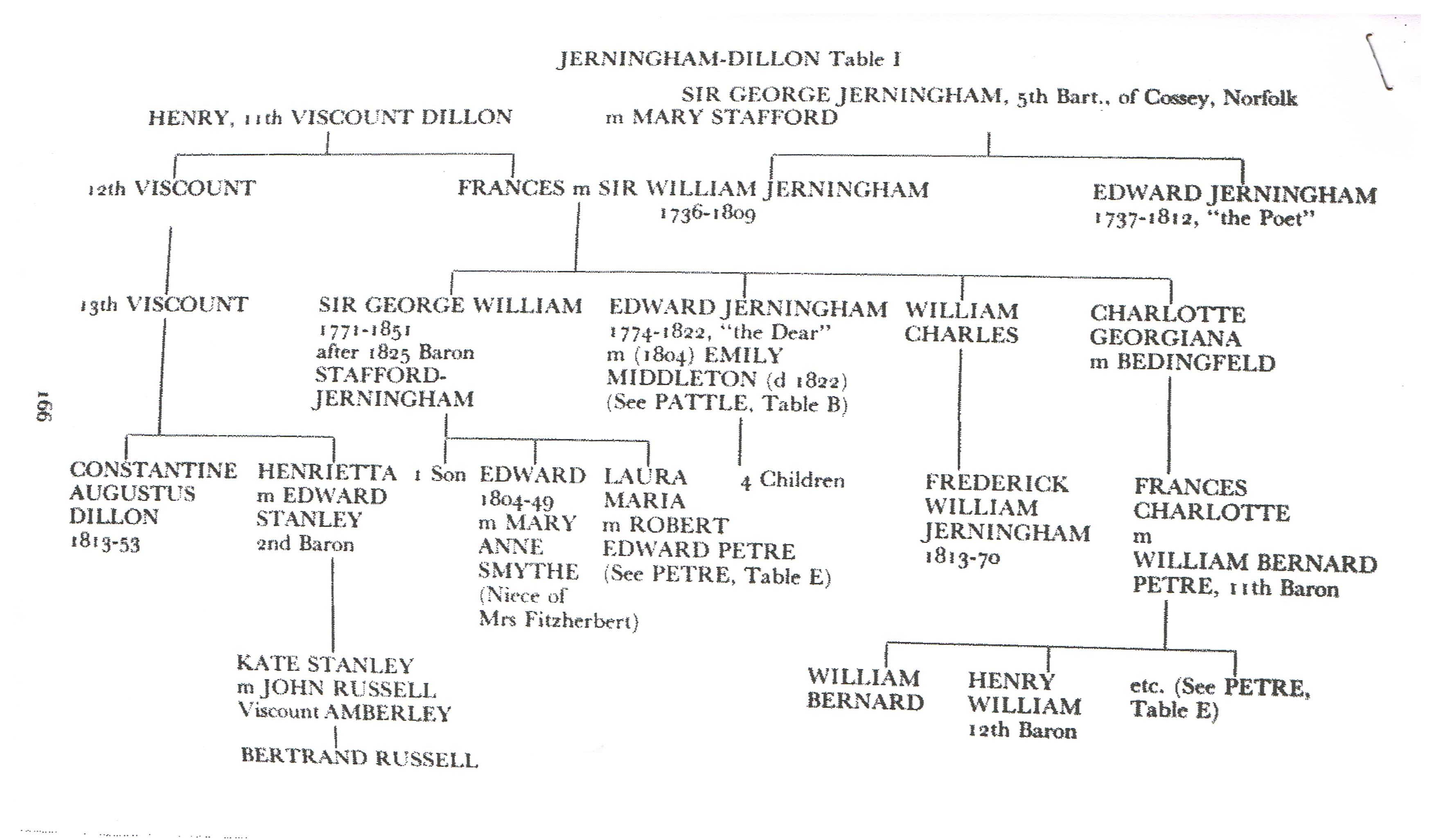
1. Jerningham Tree: London Journal.
Edward's connection to the Jerningham family is through his grandmother Eliza Middleton [14569] who was the half sister of Emily Middleton [15270] who married Edward Jerningham in 1804..
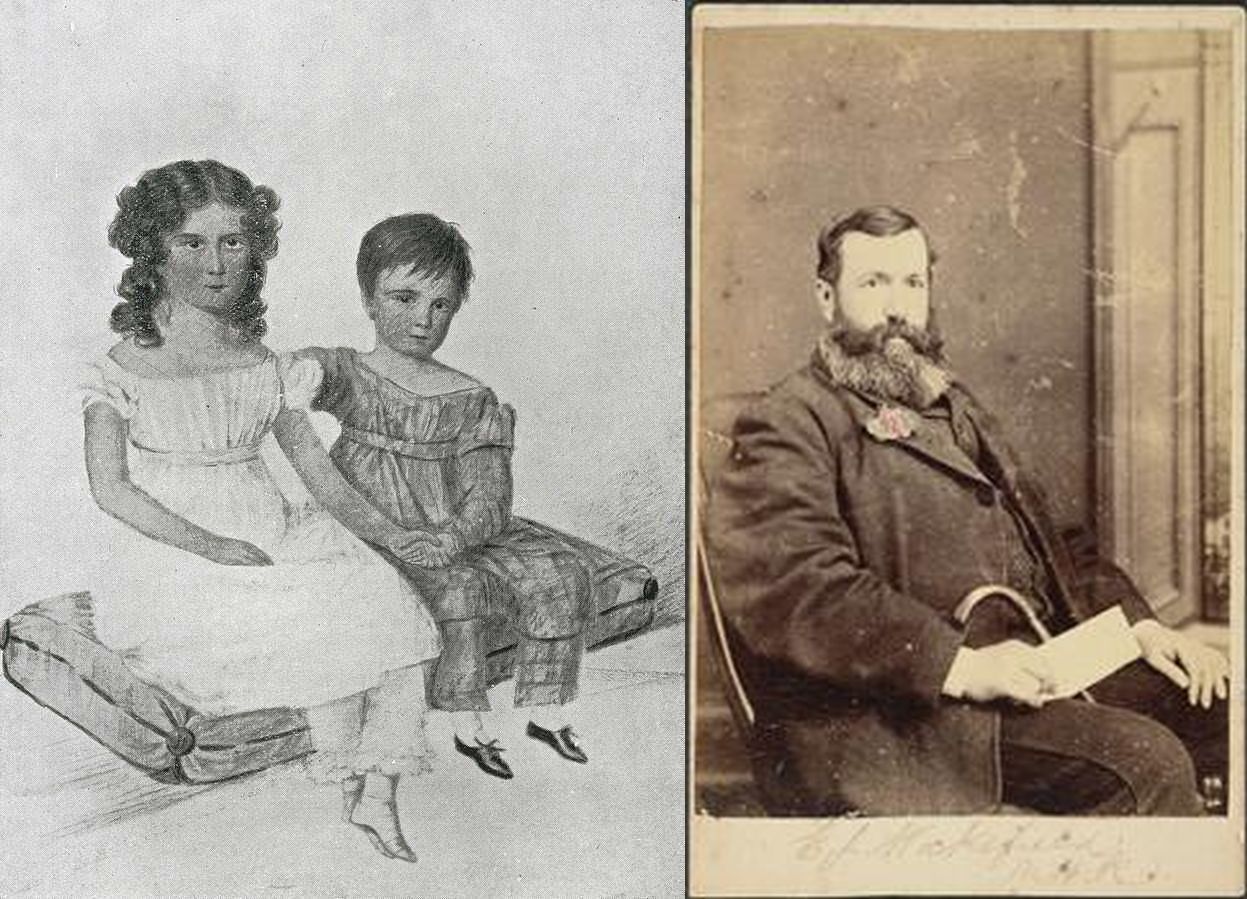
2. Edward J Wakefield: Pictured with his sister Susan P and in his old age.
Edward married Ellen ROE [1891] [MRIN: 608], daughter of Edward ROE [12193] and Amelia LAWRENCE [12194], on 3 Oct 1863 in St Peters Riccarton Christchurch. (Ellen ROE [1891] was born on 27 Jan 1839 in Walworth SRY and died on 2 Oct 1921 in Christchurch N Z.)
|