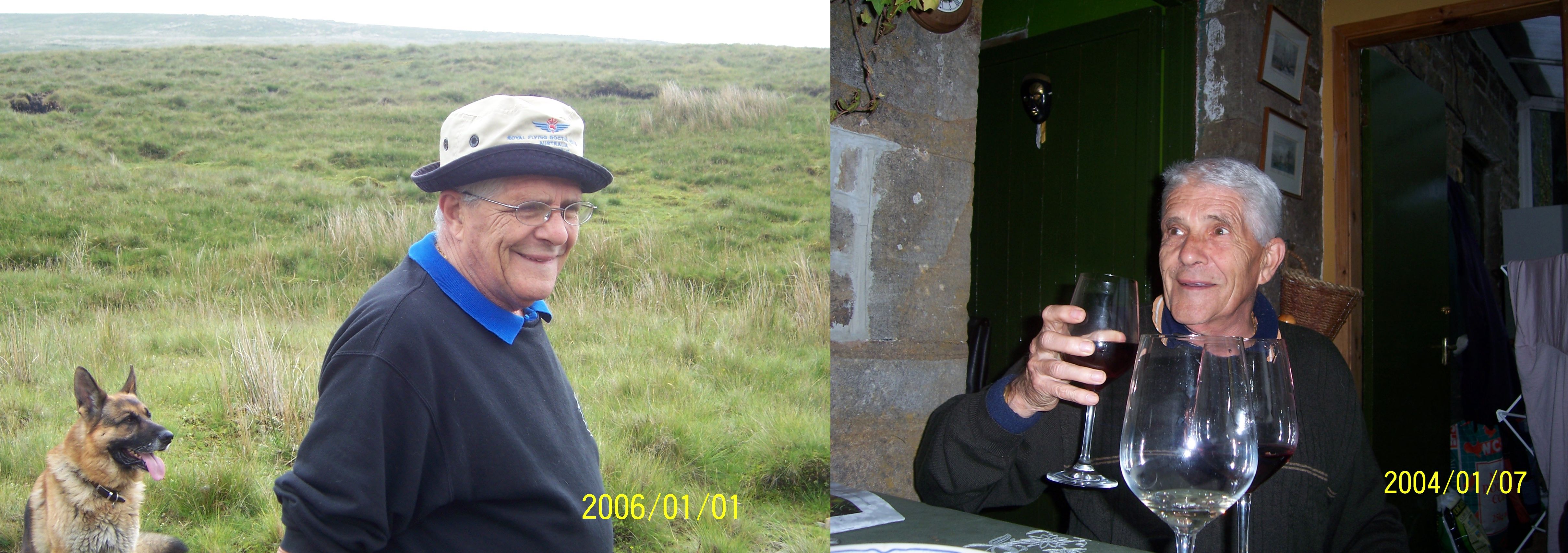
John Rowland HILL [9674]
- Born: 19 Dec 1931, Dar-es-Salaam Tanganyika
- Died: 11 Nov 2014, England aged 82

 General Notes: General Notes:
John was educated at Marlborough; Wigglesworth Co., London & Dar es salaam 1951-7; Regent Oil & Conoco 1957-90; to Carrshield, NBL., 1985, retired 1 Jan 1990.
Memories of Family and Life by John Hill.
John Frederick Rowland Hill was born in a house called Mason Alt Be in the south part of Cairo, Egypt, he was always known as Jack Hill. Jack writes: "My early childhood was happy, not only because of the care and love my parents bestowed upon me, but also because they were living in comfortable circumstances. Their house facing Abdin Square where the Royal Palace was situated, had a vast marble floored hall and a wide marble staircase.There was a huge kitchen which L would raid with the aid of the Sudanese cook. My parents often entertained on what seemed to me a lavish scale, and from the top of that marble staircase l would surreptitiously watch the guests arriving, the men always in formal evening dress the ladies in long gowns and long white gloves. And then from the railed garden l would watch the soldiers changing guard at the palace. Sometimes there would be a full parade whilst at other times horse drawn carriages would arrive at the palace for some reception or other. I thought the soldiers very smart. And the mounted police, an elite corps, were splendid, mounted on grey or white Arab horses, and when there was a formal occasion they carried lancers pennants.
I was never a robust child, in fact, by all medical standards of that era, I was lucky to survive for our doctor had given me up for lost when l developed a severe attack of bronchial pneumonia. If it had not been for the care of a second doctor, a Mrs Elliot and the constant and devoted nursing of my mother, I would not be writing this today. Later, when I was about 5 years old I was seriously ill with measles which was complicated by a bad attack of ophthalmia, and I had to have both eyes bandaged for more than a week.
When l was about 6 years old we went to live in Gezira, a fashionable island suburb on the Nile. We had a tall featureless house, built l suppose during the early Victorian years, but it was cool and well appointed. And it was within easy walking distance of the Gezru Sporting Club. Amongst the multitude of facilities here was a large children's playground, and my sister and l spent many hours with friends here. It was here that I received my first cricket lessons from a vast Nubian called Sambo. About this time too l went to my first school, run by a Miss Quibel and my father began to teach me French using a bright pink book called, French without tears which started of with an exciting story about 'Jean a une plume' whereas 'Henri a un canif'. Most of the European children were in the charge of nannies, that worthy but now almost extinct breed of, women who played a large part in the lives of their charges. But I can only remember one of ours, called Bessie, who was short and buxom, but a kindly lass. Like many of her ilk, she was fond of the British soldiers and after many flirtations, married one.We then had a governess called Miss Dalton, a very severe, forbidding, stringy female. Once when l was suffering from some childish disease she retreated to her room with a supply of food and locked the door. She did not emerge for a number of days, and when she finally did, she was promptly dismissed. l had a number of friends, including my first girl friend who was American and several years older than me. We had lots of parties, and at one Christmas party Santa's clothes caught fire, and he was so severely burnt that he never recovered. l was so horrified that henceforth l would dread having any Santa Claus at a party.
I recall one occasion in early 1914 when a team of French aviators came to Cairo to give a display of flying.At Heliopolis we witnessed what was then the amazing feat of looping the loop. Then in the summer of that year, when I was 9 years old, my parents decided to send me to school in England because the standard of education in Cairo was not good enough! They chose Pinewood School in Farnborough, Hampshire. It proved to be a pretty rotten school, and my time there was neither very happy nor rewarding. The school building was a large, gaunt Victorian country house, and there were extensive playing fields and plenty of woodland. The house itself retained it's 19th century plumbing system, and the lack of heating was accentuated during the war years when fuel became scarce.The headmaster was a vicious little man called Mr Bull who rampaged about the place with great speed but seemingly to little purpose. He had a fearsome handlebar moustache, and he wore his fingernails long.He was excitable and quick of temper, and he wielded his cane severely and often. I suppose he must have had moments of even temper and gentleness, but I don't remember them.
Farnborough was a major Royal Flying Corps station, and there were constant flights of slow moving bi-planes in the skies above the school. There were airships, and searchlights at night. Twice I saw a British plane hurtle to the ground, not shot down, but falling in flames due to some mechanical failure. Troop convoys passed by the school. We knew a war was on!
At school we suffered terribly from the intense cold, and also from time to time from shortage of food. Food rationing was strict and quantities were meagre.We were regularly fed with horse meat, dark dangerous looking stuff and as tough as our leather boats. It is no wonder that Mr Bull dictated that we should have forty bites of each mouthful! Potatoes were doled out as though they were precious stones, and other vegetables consisted solely of Swedes, turnips, and well boiled cabbage. Supper consisted of a mug of cocoa and one very hard biscuit. Breakfast was a plate of porridge and one slice of bread and dripping. Holidays were always something of a problem with my parents stuck out in Egypt. Most holidays were spent with elderly relatives, deep in the countryside of Sussex near the small village of Rogate.This was the home of Col. Nixon and his wife Edith, and they lived there with their youngest daughter Dorothy. Their house was named "Commonside", and it was nearly 2 miles from the village. Whilst it was a charming old house with a beautiful garden, it was a cold and damp place. Water had to be pumped daily from a well, and hot water drawn from a wood fired boiler in the scullery. Lighting was from oil lamps. There was an inside lavatory, but I was made to use an outside one. There was no bathroom, but there was a tin hip-bath, and the colonel kept a strict rote list for making use of it. When it was my turn, I had to carry the bath upstairs to my room, and a canvas sheet as well. Then I had to carry large cans of hot and cold water upstairs to fill the bath. And, having got myself clean, I was then obliged to reverse the procedure. What a performance all that was. I had to lend a daily hand at chopping wood, and drawing up water. The colonel had retired from the Royal Engineers, and he had served far many years in India, Burma, and South Africa. He was a typical British soldier of his time, Victorian and imperialistic in attitude, a martinet and a strict disciplinarian. He was probably a damned good soldier, and although he was straight-laced, conservative and narrow-minded, he had a heart of gold and would never have harmed a fellow creature intentionally.
The holidays were pretty boring for a young lad. Family prayers were conducted every morning and evening by the colonel, who seemed to enjoy reading dull passages from obscure prophets. On Sundays, come hell or high water, we had to march to the village church to suffer further mournful intonations from the local parson. No games were allowed on Sundays. The war had prevented me from spending my holidays in Guernsey with uncle Vernet (Vernet Quilter) and aunt Ethel. I was there with my sister in 1914, and was not able to visit them again until 1919. This was the only place where I enjoyed my holidays! They had a large straggling house on the west coast, at Coba, called Mare de Carteret. There were lovely gardens and woods, and a duck pond,and they had a donkey and trap in which we would ride to town. And they had four friendly goats called Golden eyes, Homer, Big Brownie and Little Brownie. Vernet was an architect by profession, and he had an excellent reputation for the quality of his work., but he was not a very good businessman. He would often do work for people he knew could ill afford to pay, and he never bothered to press for payment. Aunt Ethel was a person of prodigious energy, managing the house and cooking vast quantities of food for us, but she still found time to play badminton and endless bridge. There was also a Miss Green who helped. She was a very timid and pale person, and I think she was retained as a help more or less as an act of charity. Looking back at my prep school days I realise that I was far from happy, either at school or during the holidays. I missed my parents far more than I understood at the time, for I did not make friends easily, and I retired into myself to an unwarranted degree. I was not utterly miserable but certainly not joyous nor carefree, and whilst I may have acquired some self reliance from this experience, I surely became a bit of an introvert and somewhat suspicious of the world about me!"
John married Living
John next married Living
|