Prof. Edward Henry Torlesse LIVEING ARSM MIME [445]
- Born: 30 Jun 1855, Nayland SFK
- Baptised: 29 Jul 1855, Nayland SFK
- Marriage (1): Ida ERDEBJI [26928] before 1890
- Marriage (2): Emily Sarah JONES [446] on 17 Nov 1904 in Emmanual West Dulwich Lambeth London
- Died: 14 Dec 1950, Longstanton CAM aged 95
- Buried: Stoke By Nayland SFK

 General Notes: General Notes:
Births.
On the 30th ult, at Nayland, Suffolk, the wife of Edward Liveing, Esq, of Caius College, Cambridge, of a son.
Ref: Morning Chronicle Wednesday for July 1855.
Edward Henry Liveing
Registration Year: 1855
Registration Quarter: Jul-Aug-Sep
Registration district: Sudbury Suffolk
Volume: 4a
Page: 347
Edward was educated at Charterhouse School without merit and the Royal School of Mines ARSM 1877. Articled to A L Stevenson chief engineer to Bell Brothers. Obtained a certificate of Collery Manager 1880. Prospected for coal and metals in the Morocco 1883/4, goldmining in Hungary 1884 - 1890. Goldmining in many other countries 1890 - 1898. Professor of mining in Yorkshire College Leeds 1898 - 1901. Consulting engineer to the associated Gold Mines of Western Australia and associated northern blocks of West Africa 1900 - 1921.
Ref: Red Book. The dates above appear to conflict somewhat with Edward's work at Buckingham Palace and Windsor Castle
Edward presented a number of specimen gold nuggets to Cambridge Museum about 1940 that are housed there in a special Cabinet.
Ref: Red Book.
Julius Archive: Image Note 1
Petition
Werry umble
May We ave
A Whitening for
T this day without sin?
ISS
Friday = been a farstin orful.
Unsigned but attributed to Edward.
In April 1890 aged 24 accompanied by his wife aged 24 Edward travelled from London to Melbourne Australia on the Orizaba. Ages from ships manifest. (This indicates Edward & Ida married prior to 25th April 1890)
Ref: findmypast. 2011
Liveing, E. H. 1896-1897 Member Federated Institution of Mining Engineers
Ref Durham Mining Museum.
Register Of Passport Applications 1851-1903
E H Liveing
Application year1897
Dates1896 Nov 2 - 1898 Oct 12
Archive referenceFO 611/18
Foreign Office: Chief Clerk's Department and Passport Office
SeriesFO 611
The National Archives.
Edward and his first wife Ida divorced c1898, see "Other Records" Ida Erdebji [26928] for the documentation in Hungarian (can you help with a translation?).
Edward was Professor of Mining at Leeds 1898 - 1901.
Cablegrams have been received from Mr Landau (Chairman of the Associated Gold Mines of Western Australia Co.) "My object has been obtained. Have appointed as manager Liveing and William Dick as a provisional arrangment. My opinion is on the whole favourable. Future prospects are excellent"
Ref:Glasgow Herald 22 Mar 1900
E H Liveing Specialist arrived in Port of Sydney 2 Apr 1903 on the "China" from London.
Ancestry.com
Company Meetings Reports.
Murchison Goldfields Ltd
This is a report by a newly formed company to purchase and resell mines, and mine gold in Western Australia.
It says " Murchison Goldfields Ltd, is represented on the spot by two engineers of undoubted eminence in their profession, namely, Mr Edward H. Liveing, associate Royal School of Mines, Member of the Institute of Mining Engineers, who has already had, practical experience of mining in Australia and in other parts of the world, and Samuel Mitchell J.P. (A Western Australian worthy) . . . . . "
" Before leaving Northampton W.A. for this goldfield on the 23rd January last, Mr Liveing cabled as follows: Murchison - from all that I can learn, I consider that this field holds out the best hopes of properties suitable for English mining companies"
Ref: Extracted from the Aberdeen Journal 25th of February 1895. also reported in The Freeman's Journal 25 February 1895 and other publications.
Note: Edward was indeed right, the Murchison Gold Fields discovered by Tom Cue in 1895, was part of a large and prosperous gold rush to Western Australia in the 1890's, Cue sold his claims soon after, did he sell them to Murchison Gold Fields Ltd ?
1919 Edward is registered as a shareholder in the Gt Western Railway
Edward Henry Torlesse Liveing
Date 29 May1919
Event roleEXEC
Volume176
Folio95
Entry number389
Column5
Record setGreat Western Railway Shareholders 1835-1932
Edward used for note paper a notice of a Board Meeting of Associated Gold Mines of Western Australia Ltd, 26 Nov 1920, which company he must have been a director of.
Associated owned gold mines in the famous Kalgoorlie/Coolgardie area of WA. https://www.mindat.org/loc-135301.html
Longstanton Church registers contain no family records but the organ was presented by E H Liveing
Ref: Red Book
Kelly's Directory has Edward at Brookfield House Longstanton 1916
Edward shows in the Electoral Registers of Brookfield House All Saints Longstanton Spring 1909.
Suffolk Record Office, Bury St Edmunds Branch:
STOKE-BY-NAYLAND PARISH RECORDS
Catalogue Ref. FB80
CLERGY
Churchyard - ref. FB80/C2
FILE - Envelope - ref. FB80/C2/2 - date: 1929
Containing declaration of Trust for the administration of a fund for the maintenance of the churchyard, which has been donated by Edward Henry Liveing, of Brookfield House, Longstanton, Cambridgeshire.
Ref A2A
1939 Register
Brookfields, High Street , Chesterton R.D., Cambridgeshire, England
Edward HLiveing30 Jun 1855MaleMining Engineer (Retired)Widowed
EdithGlee21 Sep 1895 FemaleHouse KeeperWidowed
LIVEING - On Dec. 14, 1950, at Longstanton, Cambs, Professor Edward Henry LIVEING, aged 95 years. The Times, Dec 16, 1950, pg. 1; Issue 51876; col A.
Victoria Wills & Probate
Edward H
SexMale Liveing
OccupationProfessor Of Mining
StateVictoria Australia
Nature of grantPLS
Country of residenceEngland
Death date14 Dec 1950
Grant date17 Jul 1952
File number449/559
Order link VPRS 28/P4, unit 313;<
Research Notes:
Edward became the custodian of Liveing family records and memorabilia, he produced a catalogue of the items. These passed to his nephew R H T Liveing at his death.
Three Family Tree's have passed down to family in the 21st Century via Edward, they are:
A Descendant Tree from John Liveing: Image 3839
Pedigrees Downing Baldwin Chambers Woolley & Descendants: Image 3937
LIVEING FAMILY MINIATURES (1)
Copied by Edward Henry Torlesse Liveing from originals in his possession and given to me by my mother, Elizabeth, younger daughter of Catherine Downing Liveing and James Waugh Butters
Of the eleven in my possession, eight have handwritten notes on the reverse revealing the identity of the ancestor in the portrait:
1NATHANIEL CHAMBERS Born 1689
Died 1755
Buried at Hackney
2EPHRAIM CHAMBERS Born 1696
Pub. his Encyclopaedia 1728
Died May 1740
Buried in cloisters W. Abbey - from a miniature in my possessionE.H.Liveing
3REV. JOHN WHITMOREBorn 28th Nov 1765
Died 5th Sept 1840
Rector of Polstead & buried there. He was brother of Aunt
Harrold (Sarah Whitmore) he was much troubled by the
unenviable notoriety acquired by the parish on acc* of the
murder of Maria Martin 1826
4CATHERINE DOWNINGBorn 27th Nov 1767
Died 8th July 1802
From a miniature in my possession
E.H. Liveing 1933
5CAPT. WILLIAM LIVEING R.N. Born 31st Oct 1791
Died 14th June 1870
Commanded the Postal packet from Holyhead & afterwards
fr Weymouth to France
Was Chairman of Paddington Board of Guardians
Buried in Paddington Cemetery
6CHARLES LIVEINGBorn 13th Feb 1798
Died 1859
Chief Clerk of the National Debt Office
Lived at Denmark Hill
Buried in Norwood Cemetery
7REV. HENRY THOMAS LIVEINGBorn June 14th 1805
Died March 27th 1884
Rector of Tansor (Tailsor?)
From a photograph taken by me at Tansor July 1875
E.H.L.
8EDWARD BOWLES KNOTTESFORD FORTESCUEBorn Apr 1816
Died 18th Aug 1877
Sometime Dean (otherwise Provost) of St. Ninians Perth
Before that incumbent of Wilmcote nr Stratford on Avon where he built the Church Vicarage & School (a**1848?)
Under the influence of the Oxford Movement
finally joined the Church of Rome in the 70's
9REV FRANSIS FORTESCUE KNOTTESFORD
NB This likeness was not identifiable since nothing was written on the reverse. However it was identified from miniature collection (3)
10 UNKNOWN MALE AND FEMALE portraits of the same
&11period and in matching oval frames.
They are possibly portraits of George Downing, Rector of Ovington, (son of Dixon Downing and Bridget Baldwin) and his wife, Catherine Chambers. (This may be just wishful thinking on my part and I have not done any research on the costume of the period, but there is some resemblance in the male to the portrait of George Downing b. 1762)
Claudia Buxton
June 2008
A Pedigree of Torless or Torlesse of Berkshire endorsed Edward H Liveing, Longstanton, Cambridge, June 1923 . With the following note: "The early part of this pedigree is the work of my late father Dr Edward Liveing. I have completed the pedigree to date and have had it printed with a hope that it may be of some interest to some members of the Torlesse family.
The only uncertain point in the pedigree is the parentage of Dr Richard Torless, I have shown him as the son of John Torless of Godalming which is most probable but not absolutely certain. his baptism does not appear in the Godalming register where those of John Torless's earlier children are recorded, but he may easily have been baptised elsewhere.
The last on the register is Francis Torless baptised April 1636 and if Richard followed in 1637 he would have been 16 years old when he entered St Johns College Oxford in 1653. He is entered on the College Register as the son of a gentleman but unfortunately his fathers name is not stated, he claimed founders Kin so he was certainly one of the family if not the son of John then the son of Francis Torless as there were only two men of that generation who married"
Sothebys offered for sale in London 10 July 2013 the following collection of Edward's papers.
Liveing, Edward H
SCIENTIFIC AND MINING PAPERS, COMPRISING:
13 autograph notebooks, in pencil and black ink, containing detailed notes on laboratory experiments on various subjects including metallurgy, speculative ideas for further research, work on his Patent Gas Indicator (1870s), notes on the Lewis Thompson Calorimeter, reports and results of mining assays, mostly relating to coal deposits in South Wales and Queensland, and engineering notes relating to Siddeley and Wolseley motorcars, including many diagrams and sketches, 12mo, most with labels on spines; together with more than 100 leaves of further loose notes and letters, including letters received (some carbon copies), drafts of letters sent, and other papers, relating to subjects including his patented inventions and his involvement in various mining projects such as gold mining in Kalgoori, Western Australia, Southern Australia, and Transylvania, a small quantity of family correspondence, and notes from printed sources; also with 10 printed items including pamphlets by Liveing; c.1874-1923, nicks and tears, some dust staining
CATALOGUE NOTE
A significant archive relating to science, engineering, and mining technologies in the late-nineteenth and early-twentieth century. Edward Henry Liveing was closely involved in the mining industry, both in technological developments within the industry (for example in his Patent Gas Indicator), and also in searching out new mineral deposits in Western Australia and elsewhere. His interests were much wider, however, and of particular interest are a group of papers relating to the contested invention of the electric light bulb. One of his notebooks includes "my Idea of a perfect Electric light (Feb/79)", and in the early 1880s Liveing got drawn into the patent dispute between Thomas Edison and Joseph Swan. The papers include a letter from Swan's lawyers explaining their defence against Edison (2 pages, 4to, 14 June 1883), and Liveing's draft reply outlining his involvement in and knowledge of the crucial technological innovation of a "fine Carbon Thread lamp of high resistance" that Swan had developed by early 1879, independently of Edison.
Ref: http://www.sothebys.com/en/auctions/ecatalogue/2013/english-literature-history-l13404/lot.216.html
Lyon & Turnbull of Edinburgh offered the same lot 15 Jan 2014.
http://www.the-saleroom.com/en-us/auction-catalogues/lyon-and-turnbull/catalogue-id-srly10030/lot-2ccd50a8-a9c1-435c-82bb-a43200476558
Other Records
1. Census: England, 8 Apr 1861, 52 Queen Ann St Cavendish Sq Marylebone MDX.
Edward is recorded as a son aged 5 born Nayland SFK

2. Edward H T Liveing: School reports, 1868-1869, Charterhouse School Charterhouse MDX.
Liveing Archive - Index items 282 - 283
Edwards school reports might indicate he was dreaming of greater things than latin verbs!
"See Blue Book"
"Liveing's work is very poor"
"Takes a very long time to do very little"
"Wants steadiness of purpose"
"Makes no progress"
"Wanting in energy"
"Not sufficiently industrious"
But his
"Conduct good"
However his most successful and interesting life belied his teachers view.

3. Edward H T Liveing: Headmasters letter, 1870, Charterhouse School Charterhouse MDX.
Liveing Archive - Index item 283
Edwards Headmaster did not despair of his lacklustre record at Charterhouse.
Charterhouse. Oct. 1. 1870
My dear Sir,
I regret very much that your boy has not made the progress for which I looked. He has an excellent moral character but he is very sluggish in the performance of his schoolwork. There is however no sufficient ground for anything like despair about him. I have known instances of boys showing similar disqualifications for schoolwork & yet attaining by late developed talent to honourable positions. I hope that this is in your boy that which will yet prove him to be something different from the character which a view of some portion of his schoolwork would assigne to him.
I must earnestly wish him well, & trust that your plans for his advancement will be as successful as you devise them to be.
I am dear Sir,
yours faithfully
Mr Haig Brown
It appears Edward was at Junior School University College London 1865-66 https://en.wikipedia.org/wiki/University_College_School
4. Census: England, 2 Apr 1871, 52 Queen Ann St Cavendish Sq Marylebone MDX.
Edward is described as a son aged 15 a scholar born Nayland SFK

5. Edward Henry Torlesse Liveing: Indenture of Apprenticeship with A L Steavenson, 5 Jun 1877, Darlington Middlesborough.
This Indenture made the fifth day of June 1877 Between George Downing Liveing of Cambridge in the County of Cambridge Prof of chemistry of the first part Edward Henry Torlesse Liveing of 52 Queen and Street London in the County of Middlesex of the second part and Addison Langhorn Steavenson of Holywell Hall1 in the city of Durham Colliery Viewer2 and Mining Engineer of the third part. Whereas the said Addison Langhorn Steavenson in consideration of the services of the said Edward Henry Torlesse Liveing and of the sum of £100 now paid and of the two further sums of £50 and £50 each hereinafter covenanted to be paid by the said George Downing Liveing to the said Addison Langhorn Steavenson hath agreed to take the said Edward Henry Torlesse Liveing as his apprentice for the term of three years from the fourth day of May 1877 to be taught and instructed in the profession of a Colliery Viewer and Mining Engineer. Now This Indenture Witnesseth that in pursuance of such Agreement and in consideration of the services to be performed by the said Edward Henry Torlesse Liveing and of the sum of £100 paid by the said George Downing Liveing to the said Addison Langhorn Steavenson on the execution of these presents the receipt where of is hereby acknowledged and of the said to sums of £50 and £50 each hereinafter covenanted to be paid by the said George Downing Liveing to the said Addison Langhorn Steavenson He the said Addison Langhorn Steavenson doth hereby for himself his heirs executors and administrators covenant promise and agree to and with the said George Downing Liveing his executors administrators and assigns in manner following that is to say. That the said Addison Langhorn Steavenson shall and will during the said term of three years to be computed from the fourth day of May 1877 according to the best of his skill and knowledge teach and instruct or cause to be taught and instructed the said Edward Henry Torlesse Liveing in the said profession of a Colliery Viewer And mining engineer and all and every the matters and things whatsoever incident or relating thereto respectively. And also shall and will repay and allow the said Edward Henry Torlesse Liveing all such monies for Board lodging and travelling expenses as he the said Edward Henry Torlesse Liveing shall necessarily incur or be at when required to go and be from his place of residence or lodgings continuously or at any other place or places for a period less than four weeks such. To be computed from the time of the said Edward Henry Torlesse Liveing leaving his residence or lodgings. But this covenant shall not be applicable in cases said Edward Henry Torlesse Liveing shall be absent or be or remain continuously from his residence or lodgings upwards of four weeks in and about the business of the said Addison Langhorn Steavenson except in respect of the necessary travelling expenses of the said Edward Henry Torlesse Liveing. And in consideration of the covenants herein before contained on the part of the said Addison Langhorn Steavenson his executors administrators and assigns and of such teaching and instructing as aforesaid. He the said Edward Henry Torlesse Liveing dust place and bind himself unto the said Addison Langhorn Steavenson for the term of three years to be computed from the said fourth day of May 1877 and doth hereby covenant with the said Addison Langhorn Steavenson. That he the said Edward Henry Torlesse Liveing will during all and every part of the said term of three years well and faithfully pursue the said Addison Langhorn Steavenson as an Apprentice in the said professions of a Colliery Viewer and Mining Engineer and will not do any wilful damage or injury to his said master or knowingly suffer the same to be done without acquainting him there with. And will keep secret the business affairs of the said Addison Langhorn Steavenson and in all respects acquit and demean himself as an honest and faithful Apprentice ought to do. And he the said George Downing Liveing doth hereby for himself his heirs executors and administrators in consideration of the premises Covenant and Agree with the said Addison Langhorn Steavenson his executors administrators or assigns on the fourth day of May 1878 the further sum of £50 and on the fourth day of May 1879 the further sum of £50. Provided always and it is hereby declared that in case of the deceased of the said Addison Langhorn Steavenson during the said term of the subsistence of this Indenture then that the said Edward Henry Torlesse Liveing shall be released here from and all the covenants clauses and agreements herein contained or reserved on the part of the said George Downing Liveing and Edward Henry Torlesse Liveing his and their heirs executors and administrators shall be thereby determined except in respect of the proportions of the amount of premium accruing due between the last payment thereof and the date of the death of the said Addison Langhorn Steavenson which proportion shall be payable to the personal representatives of the said Addison Langhorn Steavenson. And for the true performance and observance of the several covenants and conditions on their respective parts here in each of them the said George Downing Liveing Edward Henry Torlesse Liveing and Addison Langhorn Steavenson doth hereby bind himself his heirs executors and administrators into the other of them his executors and administrators firmly by these presents.
In witness whereof the said parties to these presents have hereunto set their hands and seals the day and year first before written.
GD Liveing
EH Liveing
A L Steavenson
Witnessed;
.......
May 4th 1880.
I hereby certify that the various covenants of this indenture have been duly complied with and that Mr EHT Liveing has served his articles of apprenticeship in a good and satisfactory manner.
A.L. Steavenson
1. Addison Langhorn Steavenson https://skeltonincleveland.com/wp-content/uploads/AddisonLanghorn.pdf
2. A colliery viewer or coal viewer was the manager of a coal mine or colliery. The term was mostly used in the late eighteenth to nineteenth centuries, .
6. Census: England, 3 Apr 1881, 52 Queen Ann St Cavendish Sq Marylebone MDX.
Edward was described as a son aged 25 an unmarried mining engineer (A R S of Mines?) born in Nayland SFK

7. Edward H T Liveing: Electrical Engineer for installation of Electric light in Windsor Castle & Buckingham Palace, 1883-1885, London.
Liveing Archive
Edward appears also to have worked as an electrical engineer:
Edward and a Mr Massey were entrusted with the work of installing the first electric light in parts of Buckingham Palace and Windsor Castle. c1883/85. Two telegrams and a letter from Sir John Cowell1, and a letter from the Comptroller (?) of Queen Victoria's household with congratulations to Edward on the success of the venture contrast with the media reporting of the time.
The Queen "found the light too strong for her eyes" (Pall Mall Gazette 3 Nov 1890) and it was not until the 24 May 1899 that the Leeds Mercury reported the lights in St James Hall Windsor Castle were "switched on" in the Queens presence.
The Civil Service estimates (Bristol Mercury 4 Mar 1898) provides for a sum of "£3500 for beginning the installation of electric power in Buckingham Palace".
Ref: Red Book
Post Office Telegraph's
4 May 1882
Windsor Castle
From
Sir John Cowell
Windsor Castle.
To
Mr Liveing
Electrical Engineer
52 Queen Anne Street
Cavendish Square
Could you arrange to show the reflector here tomorrow in front of the Queen's Rooms that is at South last Angle if not it might be arranged as last night please reply answer paid
Post Office Telegraph's
6.28pm 23 Jul 1883
Windsor
From
Sir John Cowell
Windsor Castle.
To
Mr Liveing
Electrical Engineer
Buckingham Palace Ldn.
Glad to hear electric work is all right I wish we could have electric in other corner candelabra but suppose there is not time.
The Garter House,
Windsor Castle2.
30 May 1883.
Dear Mr Liveing,
I must send you one line to tell you how delighted everyone was with the result of all your hard work - it really was a most brilliant success, and you can have no idea of the difference of security & brilliancy in the light, as compared to the old system - All the diamonds showed so much better - & the change was the one topic of conversation amongst all the guests. Numbers of people spoke to me about it, & I was perfectly delighted that all should have gone off so well - I am sure you and Mr Massey were very glad to feel it was well over & truly it was a most complete success in every point of view.
I have not yet heard if my protégé has found his Election
With my congratulations
Believe me
dear Mr Liveing
Yours truly
J E Cowell?.
Embossed Crown with the word Osborne below
22 December 1885
Dear Mr Liveing
As the electric lighting at Buckingham Palace has firm satisfaction, I feel sure that from your having been engaged in it under the responsibility
Page 2
of Mr Massey, that you are entitled to your share of the credit for this, & though I am not in a position to award that, I am satisfied that Mr Massey would be the first to acknowledge your merits in any work that he has had your cooperation in.
Believe me
yours truly
J C Cudek ?
E H Liveing Esq.
Footnote:
1. The Master of the Household, Sir John Cowell, was a courtier of long standing. He was an officer of the Royal Engineers and had been governor to Prince Alfred and also to Prince Leopold. He was appointed Master of the House-hold in 1866 and remained in that position till he died in 1894.
2. In 1883 electricity was installed in the ballroom (Windsor), the largest room in the palace. Over the following four years electricity was installed throughout the palace, which now uses more than 40,000 lightbulbs.
This was carried out by Crompton & Co of Chelmsford Essex for whom Edward must have worked.
Ref: https://books.google.co.nz/books?id=Ahs7AwAAQBAJ&pg=PA78&lpg=PA78&dq=First+Electric+Lighting+in+Windsor+Castle&source=bl&ots=_35M_D5u_y&sig=cvnHsOT4MQ0zeGYFReBUOV-3Sqo&hl=en&sa=X&ved=0ahUKEwjt-aLnvfbUAhWES7wKHS3dC8kQ6AEINjAD#v=onepage&q=First%20Electric%20Lighting%20in%20Windsor%20Castle&f=false

8. Edward Liveing: Patent Gas Detector - Silver Medal, International Inventions Exhibition London, 1885.
Liveing Archive. Index items 284 - 286.
North Country News
A New Gas Indicator For Mines.
Mr Edward Liveing, assistant to Mr A. L. Stevenson, Hollywell Hall, Durham, has invented a gas indicator which will show the minutest particle of gas found in a mine. It has been very successfully tried in some of the Durham coal mines.
Ref: The Northern Echo 14 August 1880.
ON A NEW METHOD OF DETECTING VERY SMALL QUANTITIES OF INFLAMMABLE GAS, AND OF ESTIMATING THE PROPORTION PRESENT.
By E. H. LIVEING, A.R.S.M.
With respect to the importance of being able to detect very small quantities of gas, especially in the examination of the return air-ways, it is hardly necessary to make any remarks.
The following method occurred to the writer some six weeks ago, since which time he has made a considerable number of experiments on the subject, which have been so successful that he ventures to think the following description will be worthy of the consideration of the members of the Institute.
A and B (Fig. 1, Plate XXXIX.) are spirals of fine platinum wire (or riband wire two thousandths of an inch in diameter answers well) joined in series by copper wire, as shown in Fig. 1. A is sealed up in a glass tube containing atmospheric air; B is naked, but both are surrounded with a strong cylinder, the upper part of which is of glass and the lower portion of brass. This is closed at the top and bottom, but there are two entrances, E and F, consisting of short brass tubes filled with a bundle of iron or copper wires (like Hemming's oxyhydrogen blowpipe). F is provided with a mouth-piece.
The charge of air to be examined is introduced by drawing a breath through the apparatus. This being done, the platinum wires are raised to a red heat by a current of electricity from a small magneto-electrical machine turned by hand, which will be afterwards described. If no gas be present both wires glow with equal brilliancy, but if the air contains inflammable gas, even in as small a proportion as 1 in 100, the exposed or working wire glows with greater brilliancy, and the more so as the proportion of the gas is increased. The increase of comparative brilliancy is brought about in two ways; first, by the slow combustion of the gas around the exposed wire; and, secondly, the rise of temperature in the working wire increases the electrical resistance of the circuit (both wires being in circuit); less current therefore passes, and so the wire in the closed tube falls in brilliancy.
[288]
It is proposed further to estimate the proportion of gas present in the following manner:-
In front of the two wires (see Fig. 2, Plate XXXIX.) is a small sliding frame carrying two thin wedges of neutral tint glass, or strips of glass smoked with a gradual increasing density, the thickest part of one being equal in density to the thinnest part of the other; these being so placed side by side that when the slide is at one end of its run, as in the position shown in the figure referred to, both wires are seen through equally dense glass, but if the exposed wire glows brightest owing to the presence of gas, the slide will have to be moved to make the wires appear equal through it, and the amount of such movement will depend on the proportion of gas present.
The slide rod X (Fig. 2) that moves the wedges will, therefore, be graduated empirically by fitting the apparatus with known mixtures of gas and air, the graduations being little nicks capable of being counted by the nail in the dark.
The writer has not yet had time to construct the apparatus in a compact, portable form, or to try it underground, but various mixtures of coal-gas and air have been examined, as well as marsh gas (chemically prepared) and air. 1 per cent. of coal, or marsh gas in air, makes an appreciable difference in brilliancy, and with a little practice considerably less may be detected; 1 part in 60 makes a very decided difference; 1 in 30 a very great difference; and so on until the feebly explosive point is reached--that is 1 in 14. Before this point is reached a blue cap makes its appearance above the exposed wire like that over a Davy flame. In case of explosion inside the apparatus no communication with the outside is possible, as the hot gases become completely cooled in passing through the bundle of iron wires that fill the two entrance tubes.
It will be seen that the above apparatus enables considerably smaller quantities of gas to be detected than has hitherto been possible.
It may also be used as a lamp for travelling in a very explosive atmosphere, where it would be impossible to carry an ordinary safety-lamp. The platinum wires afford quite sufficient light for a man to travel with, if the machine be turned with moderate rapidity.
With respect to the magneto-electrical machine, the writer has very little to say at present, except that the one exhibited is only a rough, temporary machine put together for experimental purposes; it weighs about 6½ lbs., with no attempt to render it portable, and it is made with the old form of Siemen's armature. There is no doubt but that a machine of more approved construction, weighing about 4 lbs., could be made capable of performing the necessary work.
[289]
The writer apologises for bringing the matter in a somewhat incomplete state before the Institute, but hopes that the importance of the subject will form a sufficient excuse. He will be happy to communicate further details when the subject has been worked out more fully.
The form of apparatus shown in the drawing is not drawn to any scale.
The President asked Mr. Liveing what sort of battery he used?
Mr. Liveing said he used a magneto-electrical machine, something like that in use at the Post-office for the A.B.C. telegraph. He considered a machine far preferable to a battery, because batteries, especially those of a portable kind, were unreliable as they were so very inconstant.
The President said, the great consideration would be to get it as portable as possible, because if it had to be used practically, a man would have to carry the battery and the apparatus about with him in the workings of the colliery in the same way that he carries a lamp at the present time; and if the presence of gas could be detected when mixed in the proportion of sixty of air to one of gas, there was a very large margin between that and the explosive point of gases, and therefore this lamp would be a very useful apparatus.
Mr. Greenwell asked what size Mr. Liveing thought the apparatus might be made?
Mr. Liveing said, he did not know exactly what was to limit the size of that part of the apparatus; it need not, he thought, exceed the size of an ordinary lamp; but as to the magneto-electrical machine, he could hardly answer the question at present, because he did not know how small it might be made. The present one was about eight inches long, five inches wide, two inches deep, and weighed about six pounds.
Mr. Greenwell said, the great value of the apparatus would be in using it for trials within short intervals, so as to discover whether the condition of the air was changing.
Mr. Liveing-No doubt; it was very sensitive in the presence of gas.
Mr. D. P. Morison asked Mr. Liveing if he had found, in his experiments, any difference by his testing machine in the brilliancy of marsh gas, of ordinary gas met with in collieries, and of coal gas? That was the important point.
Mr. Liveing said, he had tried both marsh gas and coal gas, but not pit gas at present; and he thought that if anything, marsh gas acted
[290]
better; but he did not think there was, practically, anything to choose between them; they gave equally good results.
Mr. D. P. Morison asked if the composition of marsh gas, and the inflammable gas met with in collieries, was not usually the same?
Mr. Liveing said, the great body of coal gas consists of marsh gas, but it contains variable quantities of other gases-such as olefiant gas, hydrogen, and nitrogen.
Mr. D. P. Morison said, he meant pit gas or fire-damp.
Mr. Liveing-Well, it was chiefly marsh gas, but there were generally, he thought, denser hydrocarbons present in small quantities as well as marsh gas (CH4), and very often carbonic acid also.
Mr. D. P. Morison said, his reason for asking the question was this: the cap which was observed upon the flame of a lamp or a naked light, as the case might be, in collieries, varied very much in different seams, as he dared say some members would know practically. In the Durham field, the cap observed in the Hutton seam was widely different from that which was detected in the Busty Bank seam; and he thought there might, perhaps, have been some difference observed in the extent of the brilliancy of the bright point of the wire when different gases were used.
Mr. G. Bailes said, gas, in different seams, was more or less highly carburetted. A long brown-coloured cap was always seen where a larger amount of carbonic acid gas was present; and a much lighter, bluer, and shorter cap where there was a more or less pure carburetted hydrogen.
Professor Herschel said, he thought that the small proportion of gas which this new instrument showed would make it a very valuable application, and the members would, he felt sure, be pleased
with the inspection of the instrument when they saw the great difference which the luminosity of the two wires presented with the addition of a very small trace of the ordinary coal gas. The plain simplicity with which Mr. Liveing had arranged this illustration would, he thought, commend itself to them, and to their practical appreciation of the advantages of the instrument. As to the use which Mr. Liveing suggested for it, namely, employing it occasionally for the purpose of affording light in the mine, that, he thought, required consideration; because, if it was made of such a small size as to be portable, it would hardly serve for the purpose of illumination; and if a miner or viewer was to use it for that purpose, and try to push the strength of the light in its present and portable size to the intensity necessary to serve for illumination, he (the Professor) thought he would meet with an accident such as unhappily had befallen the instrument that morning. It had been over-driven, and much trouble
[291]
and difficulty were experienced in putting it into the working order in which he hoped it would be found presently. This led him to ask whether Mr. Liveing had made any arrangement for removing the two wires from their places, and replacing them by a new pair? He supposed that new wires might be kept in stock?
Mr. Liveing-Certainly; and if the instrument was suitably constructed, they could be put in without difficulty.
Professor Herschel-So that they could be used as occasion required.
Mr. Liveing said that the diagram was not intended to show the actual construction, but only to illustrate the description.
Professor Herschel-And the wires can be kept made up, and arranged very quickly?
Mr. Liveing-Yes.
Professor Herschel said, another point which he wished to mention was about the explosion which was likely to take place in working the wire, if it acted upon an inflammable mixture of coal gas. Mr. Liveing had provided for safety against any danger of that kind, by admitting the air to be tested by the instrument through a safety jet; and he would like to ask Mr. Liveing if it would not be safer to substitute a stop-cock for this jet, and to make the instrument strong enough to resist any explosion which might occur. He (the Professor) thought that if the instrument was made of sufficient strength to contain the explosion, and of a suitable form, it might then be considered perfectly safe. At the same time, this seemed to be a drawback to the use of the instrument, that a slight ignition was possibly liable to take place by the introduction of gas.
Mr. Liveing said, as regarded the use of the stop-cock, he thought it might be just as easy as the present arrangement. There might be two stop-cocks, one to each aperture, and they might be so connected together, and with a kind of commutator, that the current from the machine could not pass till the stop-cocks were closed. This would render it impossible to ignite the wires unless the apertures were completely closed. He did not think, however, that any explosion of coal gas and air,
or marsh gas and air, even in the most explosive proportions, could get through the present arrangement as the bundle of wires had such a powerful cooling effect upon the gases.
Mr. William Cochrane asked if the whole apparatus was not enclosed in a Davy lamp gauze? If that was so, an explosion could not communicate with the external mixture.
Mr. Liveing said, it was enclosed in a glass and brass vessel, the only
[292]
openings being at E and F, and these were filled with a bundle of iron or copper wires forced into a tube, which was better than wire gauze.
Mr. Bunning said, Professor Herschel had stated that some little accident had taken place that morning with regard to the lamp. Might he ask what that accident was? Were the platinum wires melted or destroyed?
Professor Herschel-Yes.
Mr. Bunning-Professor Herschel also made some observation with regard to its being unsafe, supposing an explosive mixture should be present inside the lamp. But where gas was supposed to exist, could not the inhalation, as it were, of the gas by the instrument be completed, and the instrument be filled with gas and taken away, and tried at a distance so as to make it perfectly safe, and still with perfect reliability? because the machine would be full of gas taken from the pit. Was it necessary that the air should be actually tested in the pit?
The President thought the suggestion of the Secretary would not answer very well. He thought that if the lamp had to be of any practical value, the air would have to be tested where it was. It would be almost impracticable to fill the lamp at one place and to test it at another, and then go back to another part of the workings to get the lamp re-filled, and so on; but he could not see that there would be any difficulty in making the lamp sufficiently strong to withstand an explosion in its interior. If the apparatus was made sufficiently small, the force of the explosion would be correspondingly small; and he should think the apparatus could very easily be made of sufficient strength to withstand such an explosion.
Mr. Greenwell said, the most important value of the instrument would be in ascertaining the changes which might take place in the atmosphere, because it was very clear that if any gas could explode in this apparatus it would be indicated, in the first instance, by the safety-lamps used in the places where the instrument would be tried; and, therefore, it would be only used as a test to see whether the air was approaching to such a point that it would show in the lamp. If it did not fire in the safety-lamp, he thought that the accidents from explosion in the instrument which Professor Herschel had spoken about could scarcely occur, because if the air was in an explosive condition it would certainly be seen in the lamps. If it was not in an explosive condition, any accident which could happen to the apparatus would do no harm.
Professor Herschel said, he had often heard the smallest proportion of coal gas in air sufficient to make it explosive, mentioned as being about
[293]
1 to 14 or 1 to 16; but in the very frequent laboratory experiments which they had made during the past year, they had never been able to obtain an explosion of coal gas mixed with air until the proportion reached 1 to 10 at the very least. The most exceptional proportion with which the mixture was sometimes inflammable was 1 to 10; but the least value was most frequently 1 to 6 and 1 to 7. He did not know where the numbers from 1 to 14 and 1 to 16 had been arrived at, but he thought it very rare that any explosion had arisen from that state; and, of course, before reaching even that preliminary state, it would be indicated by the cap on the flame in the lamp. It was in purer states of the air, no doubt, where caps do not serve as a very good test, that this instrument would be of the greatest value.
Mr. Liveing did not think the difficulty suggested was one of very great importance. Explosions of fire-damp and air in small volumes of this kind had very little effect. Everybody knew the effect of a lamp when it exploded inside a gauze; it was very different to an explosion of oxygen and hydrogen. Of course the explosion of fire-damp on a large scale was a very different thing.
Mr. Liveing then, in the Laboratory of the College of Physical Science, exhibited the instrument, showing experiments with mixtures of gas of 1 in 46, 1 in 23, and 1 in 60.
Professor Herschel said, perhaps Mr. Liveing would tell them whether palladium wire had been tried in the apparatus to prevent explosions, of which there was risk.
Mr. Liveing said, Professor Marreco had suggested the use of palladium wire instead of platinum, for it was known that when this metal was heated to redness in a mixture of oxygen and hydrogen, it did not explode the mixture, but simply caused it to burn quietly around the wire, even when mixed in explosive proportions. He had not himself tried palladium wire; but the suggestion was well worth trying, no doubt, because then the apparatus possibly might be used without any cover.
Mr. William Cochrane asked Professor Marreco to inform them whether the use of palladium wire was practicable? because, owing to the different action of palladium and platinum it might be possible to dispense with any gauze over the instrument, and it might be perfectly safe to travel in an explosive mixture with such an apparatus.
Mr. Freire-Marreco said, some mixtures which would explode with platinum would burn quietly enough with palladium wire, but there were two or three practical difficulties; first, palladium wire was more expensive
[294]
and difficult to get; and after being used some time it got very brittle, possibly from occlusion of the gas, and it had a very low melting point, so that great care had to be exercised in using it. However he thought it worth a trial.
Mr. Cochrane asked whether the fact that it did not explode was due to the palladium being at a lower temperature than the platinum wire?
Professor Freire-Marreco-No. When heated up to the same point it appeared to burn the gas quietly.
Mr. John B. Simpson proposed a vote of thanks to Mr. Liveing for his very interesting paper, and for the very able experiments he had made. He (Mr. S.) was quite sure there was a future before the instrument which Mr. Liveing had shown to them, and he thought that further experiments by Mr. Liveing, and possibly the Professors of the College of Physical Science, would show that this instrument would be of very great benefit in mining.
Mr. William Cochrane seconded the motion; and it was carried unanimously.
Ref: https://mininginstitute.org.uk/wp-content/uploads/2016/NEIMME%20Vol%2027.pdf Pg 287
Further details on this subject:
https://mininginstitute.org.uk/wp-content/uploads/2016/NEIMME%20Vol%2028.pdf
https://iopscience.iop.org/article/10.1088/1478-7814/4/1/309
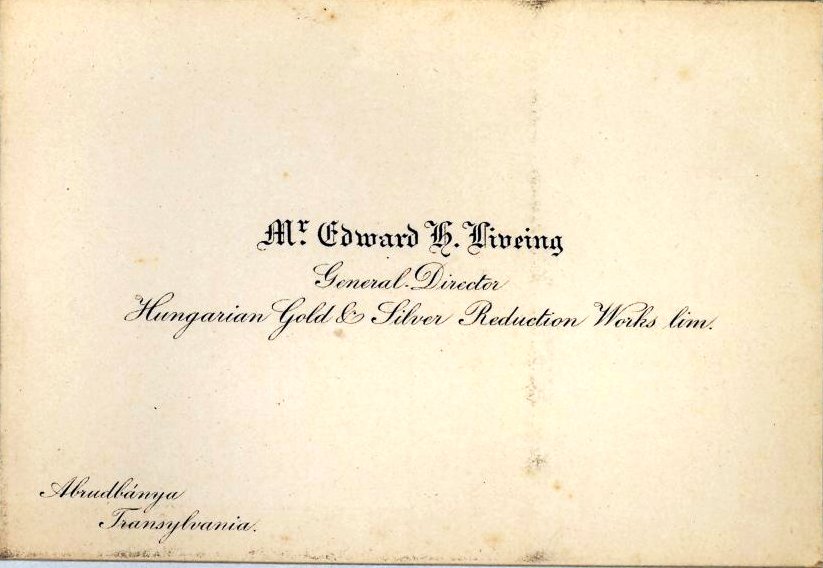
9. Edward H T Liveing: This Paper given by Edward is on Gold Mining in Transylvania, 13 Feb 1886.
Edward was involved in the Hungarian Gold & Silver Reduction Works Lim, at Abrudbanya, Transylvania late in the 19thC, at about this time he married Ida Erdebji a Hungarian.
Gold mines in Transylvania date back to the Roman period.
GENERAL MEETING, SATURDAY, FEBRUARY 13th, 1886, IN THE WOOD MEMORIAL HALL, NEWCASTLE-UPON-TYNE.
JOHN DAGLISH, Esq., President, in the Chair.
The Secretary read the minutes of the previous meeting, and reported the proceedings of the Council.
The following gentlemen were elected, having been previously nominated:-
Associate Member-
Mr. J J. C. Allison, Hedley Hill Colliery, Waterhouses, Durham.
Student-
Mr. Frank K. Sykes, Esh Colliery, Durham.
The following gentlemen were nominated for election :-
Ordinary Members-
Mr. John Davis, Hartley House, Coundon.
Mr. Robert Knowles, Arncliffe, Cheetham Hill, Manchester.
Associate Members-
Mr. Alfred H. Bennett, Dean Lane Collieries, Bedminster, Bristol.
Mr. Robert Michael Brown, Norwood Colliery, Darlington.
The following paper by Mr. Edward H. Liveing on "Transylvanian Gold Mining," was read:-
TRANSYLVANIAN GOLD MINING.
By EDWARD H. LIVEING.
The writer having recently resided for some months in Transylvania, trusts that the following brief notes on the gold mining industry of that district may be of interest to some members of the Institute.
Transylvania, or Siebenb forms the most eastern province of the present Austro-Hungarian empire. It is bounded on the south and east by Roumania, and on the west by Hungary proper. That portion of Transylvania that lies between the towns of Klausenburg, Karlsburg, and Deva, or say, between the 46th and 47th parallel N. lat., and the 22nd and 24th E. long., is commonly called the Transylvanian Erzgebirge (see Plate IX.); it has long been known for its mineral wealth, and particularly for its gold mines, which are still the most productive in Europe.
The district is a mountainous one, several of the hills exceeding 4,000 feet in height. It is intersected by numerous valleys, chiefly those of tributaries of the rivers Maros and Körös, whose waters finally join the Danube. The hills are largely covered with forests, and agriculture is carried on to a very limited extent.
GEOLOGICAL STRUCTURE.
The geological structure of this district is somewhat varied. In the north is a large area of granite, surrounded by metamorphic schists, crystalline limestones, and other altered rocks; but in the central portion of the district the greater part of the hills are formed of rocks of Eocene and of Neocomian ages. Amongst these are several large masses of eruptive rock, some of trachytic, and others of basaltic character, besides extensive beds of tuff, which in places become coarse volcanic breccias.
The gold (except that which occurs in the gravels) is always found associated with these eruptive rocks. It occurs in veins which are, for the most part, small, rarely exceeding a foot in thickness, and more commonly only a few inches, or even fractions of an inch. In the neighbourhood of Verespatak these veins are very numerous, as many as a hundred, of more or less distinct character, being cut by a single drift (the St. Kereszt adit) in this district. They here traverse a mass of quartz
[82]
trachyte, which passes in parts into a tuff or breccia of a peculiarly porous and decomposed character, and having crystals of iron pyrites disseminated throughout the mass. The veins are exceedingly irregular, both in thickness and extent, and even more so as regards their gold-bearing character. The gold occurs in the veins either alone or associated with quartz, calcite, iron pyrites, copper pyrites, zinc blend, galena, and fahlerz; more rarely with rhodonite and ruby silver, and at Nagyag and Offenbanya with tellurium, forming the rare minerals Nagyagite and Sylvanite (foliated and graphic tellurium). The gold is often also disseminated in minute particles through the rock itself, so that the stone may be worth removal and treatment for many feet on either side of the vein. This is particularly the case where the rock is of the porous character above-mentioned, and also in places where important intersections of veins occur. At such points large excavations, or "stock " works, are frequently made in the mines.
The gold is often found beautifully crystallized in hollows in the veins, sometimes in regular octohedra, at others in leafy and filamentary forms. Some of the specimens from the Verespatak neighbourhood are exceedingly remarkable. The gold from the whole district is considerably alloyed
with silver, much more so than is Australian or Californian gold; but the proportion varies widely. In a number of samples which the writer has assayed, he has found the fineness vary from 23 carats down to 13.5 carats, the latter being a sample of free gold in quartz, from the Volkoi mines near Zalathna. With so large a proportion of silver as this the metal appears nearly white. The average fineness of the gold of the district appears to be about 16 to 17 carats.
Gold also occurs in gravel deposits in various places; that at Szaspian and Ohlapian, in the neighbourhood of M being as remarkable as any. There the gravel beds are of considerable thickness; they cap and flank the low hills to the south of the Maros valley, and seem to be of glacial origin. They contain quartz and garnet pebbles. These gravels, when washed, yield gold in small quantity. It is here in coarse particles, and of a fine yellow colour, probably 22 to 23 carats. So also in the valleys of the Abrud, the Aranyos, and the Körös, and other streams, gold is found in the river gravels; and a few of the Wallachian inhabitants occupy themselves during the summer months by extracting it, employing for the purpose a small inclined table and a wooden hand pan. In this way they make about a florin (1s. 8d.) a day if they are fortunate in selecting their position; but the amount of gold thus obtained in the whole district is very insignificant, compared with that obtained by mining.
[Plate IX map of Transylvania]
[83]
HISTORY.
Transylvania has been the scene of mining enterprise from a very early period. It formed a part of the ancient kingdom of Dacia, which was annexed to the Roman empire by Trajan, in A.D. 107, and remained a Roman province until A.D. 270, when it was abandoned by the Emperor Aurelian.* During this period the Roman settlers seemed to have worked the gold very extensively; they not only washed the gravels of the river beds, but carried on vein mining to a large extent; and, according to some accounts, in a very reckless and wasteful manner, so that the Emperors latterly took the working of the principal mines into their own hands, permitting, however, private adventurers to explore and open new ones.**
Near Verespatak and Abrudbanya many interesting evidences of the Roman occupation still remain; perhaps the most remarkable of these is the "Cetate Mare," a large crater-like excavation on the summit of a hill, which the Roman miners have produced in their search for gold.† So also at Volkoi, they have worked open-cast a large quartz vein, leaving a great gash in the hills that can be seen miles away. There are, besides, many mines worked by drifts, the smooth chisel cut walls and regular forms of which point to their Roman origin. Amongst these may be mentioned the celebrated mine at Ruda, now the largest in Transylvania, which was commenced in Roman times. In the rubbish heaps of many of these mines Roman coins, both gold and silver, have been found from time to time. The writer has in his possession a silver coin of Claudius found at the Cetate in Verespatak, and another of Plautilla Augusta found near Ruda.
At Verespatak may be seen several Roman tablets, with inscriptions, built into the walls of buildings. This place was known to the Romans as Alburnus Major.
Heaps of ancient slags, too, have been found in several places, from which it appears probable that the Romans practised some mode of
* Gibbon, "Decline and Fall of the Roman Empire," Vol. I., chap. xi.
** Chalmers (1580) remarks that for a century and a half Transylvania became to the Romans what Mexico afterwards was to Spain. Much of the gold that glittered on the tables of the wealthy Patricians, or adorned the reigning beauties at the gladiatorial shows, was dug from the hills of Abrudbanya or washed from the sands of the Aranyos and other streams. During the culminating epoch of Roman luxury Transylvania was regarded as a vast treasure-house to be ransacked for wealth.
† Pliny (Lib. XXXIII., c. 21), in describing the gold mining operations carried on in Spain about a century earlier, mentions the use of fire-setting and an iron-headed battering ram, as a means employed by the Roman miners to loosen the rocks. He also mentions the use of vinegar for the same purpose, but this is probably only a fable.
[84]
smelting for extracting the gold from the pyritous ores that would not yield it to the simple process of crushing and washing. After the withdrawal of the Roman power in A.D. 270, the mining industry was gradually destroyed by the very unsettled times that followed; for from this date until the latter part of the 11th century Transylvania formed the great theatre of battles between the Ostrogoths, Hunns, Longobards, Bulgarians, Magyars, Kumans, and other eastern races, which kept pressing on towards western Europe; so that it is improbable that the mining industry revived again until after the union of Transylvania with Hungary, between A.D. 1078-95, when this district began to enjoy again some approach to peace and order; and from that period until the present day, gold mining has been carried on pretty continuously, although on a much smaller scale than in Roman times. It is probable that the Romans exhausted all the richest and most easily available deposits, for the best of the gold ore in the district seems to have been found in the upper and middle parts of the hills, and the veins do not appear to hold good to any considerable depth; at least this is the prevailing opinion in the district. It should, however, be remarked that no exploration has anywhere been attempted far below the level of free drainage, owing to the very primitive pumping appliances in use.
MINING.
In Transylvania at the present day the modes of mining and of treating the gold ores are still of the most primitive character, and differ little, if at all, from those employed in the middle ages. The present population may be said, roughly, to consist of one-third Hungarians and two-thirds Wallachians or Roumanians, who consider themselves descendants of the ancient Roman settlers, and still speak a Latin language; and it is these latter, almost exclusively, who carry on the mining industry. The mining laws are very favourable, and tend to encourage small adventures in this way. Any person expecting the presence of ore in a piece of ground may, by the payment of four florins (6s. 8d.) to the local government authorities, claim a Freisch, that is the right to search for minerals within a circle of 465 yards radius from any point that he may chose, provided, of course, that the ground is not already covered by prior claims of the kind. He is permitted to take out one or more of these prospecting claims, paying an annual tax of four florins on each so long as he desires to hold them. In this way he may protect himself while he is prospecting, and in the event of success he may then claim one or more permanent mining rights, Grubenmassen as they are called, each having
[85]
an area of 8.6 square acres,* but in this case he has to deposit a rough plan showing the position and extent of the ground so claimed. These claims extend to an infinite depth, but in the neighbourhood of Verespatak a local peculiarity in the law exists. Here spherical masses (Kuglemassen) have been granted, and owing to the numerous claimants, and the very imperfect plans that are kept, extraordinary complications arise and constant disputes occur. Here, within a space of some two square miles, no less than 300 mining companies exist, though but a small fraction of this number are in actual work. At this place a mining company often consists of only three or four people, who agree together to risk a few hundred, or perhaps a few thousand, florins in a mining venture, much as the Hungarians and Austrians put money into the State lotteries. They generally appoint one of themselves as director to carry out the work and commence by purchasing a Freisch, or, more commonly, an old abandoned mine. The capital is expended in drifting in various directions, and perhaps in re-timbering the adit level. If they are fortunate and happen to come upon a good deposit, the mine is for a time profitable, and they may receive back in profits more than they have invested; but as they do not, as a rule, set apart any portion of the profits to carry on explorations, the undertaking is soon brought to a close when a dead portion of the vein or rock is reached. The hills near Verespatak are literally riddled by small mines of this kind, so that from a distance they much resemble a rabbit warren.
Besides these very small mines there are some of a more important character - the Ferdinand mine in the Verespatak Valley and the Valea Verde mine in a valley of the same name are good instances; they are both worked by local companies. The produce of the mine, after being carefully mixed to render it as uniform as possible, is divided into as many parts as there are shareholders, who convey it to their own stamp works (Pochwerks) for treatment, employing for this purpose narrow waggons drawn by oxen. These waggons carry about 8 cwts. of ore, and although made almost entirely of wood, they hold together remarkably well, in spite of the extreme roughness and steepness of the roads. The ore from the higher and more inaccessible mines is conveyed down into the valleys in baskets on the backs of ponies, a primitive but expensive mode of transport.
* There are also smaller claims, known as Kleinmassen, which extend only in a horizontal direction, and have a vertical section of 967 square yards. They are usually taken so as to surround an exploring drift 16 feet in each direction. Besides the large prospecting claims above referred to smaller ones are also granted, if desired, at a less cost.
[86]
The cost of working the mine, that is the cost of wages, timber, powder, and other stores, is paid for by the shareholders in proportion to the shares they hold and the ore they receive. The director and officials of the mine are generally paid by having shares in the mine allotted to them. Those
shareholders who live at a distance, or who do not possess stamp works, permit their ore to be sold weekly at the mine by public auction, the other shareholders generally-buying it.
The gold is commonly classed under three heads- 1st, the frei gold, or free gold;* 2nd, the m gold, which is in too small particles and too much disseminated in the stone to be seen, but which is extractable by the simple crushing and washing of the stamp works; 3rd, the schlich gold, which is entangled or combined with the pyrites, and which is here extracted by smelting operations. When frei gold is found in the mine the stone is carefully removed and stamped by hand in iron mortars with a little mercury; the amalgam formed is washed out and heated in a crucible to drive off the mercury. The gold is sold for the benefit of the company, the money going to the payment of the working expenses, or if it exceed these in amount, the excess is divided amongst the shareholders.
The produce of both these mines amounts to between 200 and 300 tons of ore per week, at a general cost to the shareholders of 2 fl. 50 kr. (4s. 2d.) per ton at the mine, to which, however, must be added the cost of transport to their stamp works, which will certainly average another florin per ton. As some of these are at a considerable distance, and as much of the ore of these mines only yields about 1/6th. to 1/8th. oz. of (16 carat) gold per ton, there is not a very wide margin for profit after the expenses of the stamp works are paid. The shares of these mines are nearly all in the hands of local Wallachian inhabitants. They are occasionally bought and sold, but the prices are very variable, as there is no regular market for them.
The largest mine in the Verespatak valley is the Government mine of St. Kereszt, originally a private undertaking, started about 200 years ago, but now worked by the State. It is approached by the adit level before referred to, which has been driven for over 1.55 miles into the hills. The first part passes through Eocene sandstone, but further on it strikes into the trachyte breccia or gold bearing rock of the district. Although in its course this drift cuts over 100 veins of various thicknesses, on some of which immense excavations have been made, and although considerable "finds" of gold have been made at different times in the mine, yet, on
* More correctly called visible gold, since the m gold is also free.
[87]
the whole, it has not been a commercial success; but the adit level, being the lowest in the district, serves to unwater many of the mines above, and it was partly for this object that it has been carried to its present extent. The ore is conveyed from this mine by means of a horse tramway, which extends the whole way down the Verespatak valley to the point of its junction with the Abrud stream, and here large stamp works have been erected.
The result of last year's working was a loss to the State of £2,500, but some years a profit of about an equal amount is made. The average yield of gold from the stone stamped is poor, latterly it has not been more than 5 grams (1/6th. oz.) per ton, and it is said they have stamped stone down to 2 grams (1/13th. oz.) per ton. The yield of most of the stamp ore of the Verespatak district is poor, 1/4 to 1/3 oz. ore being considered good, but much ore, carrying no more than 1/9 or 1/7 oz. per ton, is
stamped at the nearer stamp works. It is, however, the finds of frei, or visible gold, that are the great source of attraction to the mining speculators of the district. Some magnificent finds of gold were made in these mines at the end of the last century and the beginning of this, but latterly they have become less common, though they are still occasionally made. If the large amounts of gold obtained here by the Romans, and the steady production of the metal that has gone on for the past 800 years are taken into consideration, it is not surprising that the neighbourhood of Verespatak is to a great extent worked out.
A few miles to the south-east, in the Buchum valley, is situated the Concordia Mine, which is certainly the most successful of recent undertakings in the district. The company, which consists of 25 shares, was started in 1876, and the original capital did not exceed about 1,000 florins per share (£80). For the first two or three years little or no profit was obtained, but since that time the mine has paid wonderfully well, the shares being now valued at at least £1,660 each. The produce of the mine is divided into 34 parts, 9 of which go to pay the manager and officials, and 25 to the shareholders. Last year a single share yielded 4,000 grams (130 ozs.) of gold, and in 1883 3,500 grams (120 ozs.), and in some years considerably larger amounts have been obtained. The yield of gold per ton varies from about 1/3 oz. in the poorest to 11/3 or 12/3 oz. in the best ore. A considerable amount of picked free gold is also obtained; last year this amounted to £1,500 worth, and a few years back as much as £8,000 worth was found in a space of 15 feet cube. The total value of the gold produced by this mine last year, inclusive of that obtained
[88]
by smelting the pyrites, was £14,500. By far the richest and most interesting part is an immense stock work, which has been excavated to a depth of 240 feet below-the adit level, by a series of large chambers descending in a spiral direction, so that the descent can be made by walking. The rock is a porous volcanic breccia, containing many veins and strings of calcite, with which the gold is associated. This rock, though porous and comparatively soft, is very free from joints, and allows immense open spaces to be left without the use of timber. As this mine is worked considerably below the adit level a horse-pump has recently been introduced, but wooden hand-pumps of the most primitive kind are still employed in the lowest part of the workings.
A few miles further to the south are the mines of Volkoi and Botes, which have quite recently been sold to a French company who are starting a battery of heavy stamps of American type, provided with modern amalgamation appliances and driven by steam. These mines are undoubtedly good, and with judicious and economical management the undertaking should pay well.
So also the ancient mines of Ruda, near Brad, in the Körös valley, have recently been acquired by a German company, who intend applying modern machinery. The principal lode or vein at Ruda is of great thickness-13 to 23 feet; it dips at a high angle, and strikes nearly east and west in the line of the small valley in which it occurs. The rock is a greenstone porphyry on the one side of the vein and a trachyte tuff on the other; the filling material of the vein is, to a large extent, calcite, but the centre portion, for a width of from 11 to 30 inches, is usually filled in with a soft clayey material, through which is disseminated iron pyrites and gold. The vein is opened up by four drifts, the mouths of which are passed at different points in ascending the valley, the highest of these being 170 yards above the lowest. The ore of this mine yields on an average 10 grams (1/3rd. oz.) of gold to the ton, and is soft and easily stamped. Besides the principal vein there are several cross veins which, though
of less importance, have yielded at some points considerable quantities of gold. In this mine there is certainly a very large amount of fairly good stamp ore still available and proved by the present drifts; and as there are some considerable deposits of fair brown coal close by, which, though not at present worked, ought to be obtainable at a price not exceeding 3s. a ton, the cost of stamping need not be high.
There are many other interesting mines in various parts of the district, but it is impossible to refer to them in detail without making the present notes too long.
There are many other interesting mines in various parts of the district, but it is impossible to refer to them in detail without making the present notes too long.
[89]
CONDITION OF THE MINERS.
The average wage of miners in the district is 50 kr. to 60 kr. (10d. to 1s.) per day,* but work is often let by the metre, and in such rock as is prevalent in the Concordia and Valea Verde mines 7s. 6d. per yard would be considered a fair price for a drift 21 square feet in section; the men in this case providing themselves with powder and candles. But in some of the hard greenstone rock as much as 45s. has sometimes been paid.**
The Wallachian miners are very much given to drinking. They consume a spirit that is distilled from fermented plums, and which costs only from 10 kr. to 15 kr. per litre (about 1.5d. to 2d. a pint), this they drink in immense quantities. It is very difficult to get them to work more than four days in a week; they very rarely attempt to work on Monday at all, in consequence of the heavy drinking that goes on on Sunday night; and as there is generally one Greek church saint-day in each week, which is always kept as a holiday, it affords them the opportunity of wasting another day in drinking. They are improvident in the highest degree, and often suffer from extreme want in the winter when
* With regard to this wage, it may be as well to recollect that the price of pork is 2d. to 2½ d. a lb.; mutton about 3d. a lb.; beef, from oxen that have worked for years at the ore carts, the only quality obtainable, 3½ a lb.; chickens 5d. to 9d. each; wheat bread about 1¼ d. a lb., or nearly the present price of bread in England. The Wallachian miners, however, live almost exclusively on bread or cakes made from maize or Indian corn; this they eat with onions and a few other vegetables, and occasionally a little bacon, but rarely any other meat. The maize bread is cheaper than wheaten bread, probably about two-thirds the price, and though unpalatable is more nutritious. (See Dr. Letheby's Lectures, page 7.) Many of the cottagers grow small patches of maize on the sides of the hills, and the rest is imported from the flatter surrounding districts; they generally grind and make the bread themselves. It must be remembered that beyond the cost of food, and of the spirit which he drinks, the expenses of a Wallachian miner are small. He generally has no house-rent to pay, his house being a mere log hut; firewood he can generally help himself to from the forests; and his clothing is of the cheapest description-a coat and breeches of a coarse homespun flannel, with a wide leather belt containing many pockets round the middle, and often no shirt, form his usual dress; in winter an outer cape of sheepskin, with the wool turned inwards, is employed when travelling; the lower part of the legs and feet are bound with long woollen rags, and leather sandals secured by thongs are generally worn in place of boots amongst the poorer people. The houses are of logs roughly squared, the cracks being filled with clay; they are roofed with thatch or wooden tiles, and are generally without a chimney, the fire being burnt on the floor or on a slightly raised hearth, the smoke finding its way through the thatch or the cracks in the roof. The life these people lead is
beyond doubt a very hard one, and although their families are not large, suffering from want and disease is often terrible in winter.
** In mines where free gold occurs stealing is extensively practised by the workmen, in spite of many precautions employed to prevent it; and there are in Abrudbanya and other places persons who will buy gold and valuable pieces of gold ore at a price that yields them a good profit, and ask no questions.
[90]
the stamp works are stopped by the frost. They are as superstitious as any race in Europe, and never do anything without considering whether the time and circumstances are lucky or otherwise; yet these men are the supposed descendants of the ancient Roman colonists.
MODE OF TREATMENT OF THE ORE.
With the exception of the picked free gold, which is treated as before described in iron mortars by hand, and of the tellurian ores of Offenbanya and Nagyag, and of some massive pyritous ores of other localities, the whole of the ore of the district is stamped in small wooden stamp works, driven by water-power, where every available fall in the streams is utilized; and, in the neighbourhood of Verespatak and Abrudbanya, over 500 of these are at work. They consist of a battery of from six to twelve stamps, driven by a water-wheel of from 5 to 9 feet in diameter. The stamps are very light, generally not exceeding 1.5 cwt. each. They are made from beech-wood, and are provided with hard stone heads of the most primitive description. The coffers are entirely of wood, the cracks being stuffed with moss. The bottom of the coffers on which the stamps fall is formed of blocks of beech-wood with the grain set vertically; these, after a time, become very hard from the particles of quartz, etc., that become embedded in them. They rest on a tolerably heavy transverse log of beech, but beyond this are rarely provided with anything approaching a good foundation. An iron grating of coarse character is employed in the front of the coffer, and this simply delivers the crushed material into a rectangular pit dug in the ground and boarded. The ore is broken up with hammers, until it does not exceed about 2-inch cube, and is fed into the coffers by hand. The stamps make about 20 to 30 strokes per minute; and a battery of twelve heads will stamp about one ton of ore in 24 hours. Once a day the stamps are stopped and the coffers cleaned out; the material removed is sifted with a coarse sieve, and what will not pass through is returned to the coffers. The remainder is carefully panned to separate the gold which it contains; for, owing to the slow rate of the stamps, their short fall, and the height of the gratings, most of the gold is found to remain in the coffers. The stamped material collected in the tank is dug out at intervals, and washed over an inclined table of wood, terminating in a smaller one covered with flannel, in order to separate the pyrites and the remainder of the gold from the earthy matters. The pyrites, after careful panning to separate as much free gold as possible, is sent to the Government smelting works for treatment, as it still contains entangled or combined gold. The powdery gold that has been obtained by panning
[91]
is ground with a little mercury in a small iron or stone mortar, and after careful washing to remove particles of pyrites that remain, is heated to drive off the mercury. The gold thus obtained has a fineness of about 16 to 17 carats. It is sold to the Government authorities at Zalathna, or to local
merchants in Abrudbanya and elsewhere. The mode of treatment described is without doubt very imperfect, and a considerable part of the fine gold certainly escapes with the tailings; indeed this gold may be detected by panning the sand of some of the streams, and is distinguishable from the older alluvial gold by its light colour.
The cost of working is, however, very small, one florin (1s. 8d.) a day probably covering the cost of labour and repairs required for a 12-stamp battery; the prime cost of such a stamp work as is described does not exceed 200 florins (£16), although the water rights are sometimes valued at as much as 1,000 florins (£80.)
The concentrated pyrites, separated as above-mentioned, generally amounts to about 2 per cent. of the weight of the ore stamped, and the amount of gold that it contains generally varies in the Abrudbanya district between 60 and 120 grams (2 to 4 ozs.) per ton, together with about twice this quantity of silver. When it is sufficiently rich to pay for treatment and carriage, it is sent in ox-waggons to the Government smelting works at Zalathna, some of it being conveyed more than 80 miles in this manner.
At Zalathna the mode of treatment at present employed is as follows: The pyrites is spread out and mixed, and a fair sample taken and assayed, and the sellers are paid for the gold and silver it contains, minus the cost of treatment, which averages 45 florins per ton, a small charge being also made for the assay.
The material, which is moist and still contains a large percentage of silica from imperfect concentration, is dried on the top of the roasting furnaces. The furnaces now in use for roasting are Bode's patent. They consist of a number of narrow chambers one above the other, with thin fire-brick floors between, and having openings into each other at alternate ends, so that the current of air travels backwards and forwards through them until it reaches the highest, from which it passes into a flue. There is a small door on each level, through which the workmen can rake the pyrites about, and when it has remained about four hours on one level, it is raked through the openings on to the next below. The time is so arranged that, on reaching the lowest level, the roasting is sufficiently complete, a small amount of sulphur (from 5 to 6 per cent.) being allowed
[92]
to remain. No fuel is employed, the heat of the last charge being sufficient to fire the next. A block of four of these furnaces will roast 3½ tons of pyrites in 24 hours, at a cost for labour of one florin per ton.
The roasted pyrites is next mixed with about 6 per cent. of oxide of lead, and a small quantity of raw ore to supply silica, and is smelted in a small blast-furnace, beech-wood charcoal being employed as fuel. The furnace is about 39 inches in diameter and 13 feet in height; it is worked with three tuyers, and a blast pressure of about 5 inches of water. The oxide of lead being reduced to the metallic state runs to the bottom of the furnace carrying with it the gold and silver, and is tapped off at intervals of 2.5 hours. The slag, chiefly silicate of iron, runs off continuously at an upper slag hole. With the lead runs off a smaller amount of regulus of sulphide of iron and copper, which is subsequently treated to obtain the copper; but generally the amount of copper pyrites present in the ore is of small importance. The lead is then cupelled in a German furnace, and the precious metals obtained are
sent to the refinery at Cremnitz for separation. They have also at Zalathna small chemical works for utilizing the waste products. Part of the sulphur dioxide from the roasting furnaces is made into sulphuric acid in the usual way. The sulphide of iron and copper is treated, after grinding to powder, with sulphuric acid in closed tanks lined with lead, and the sulphuretted hydrogen evolved, together with a suitable amount of sulphur dioxide from the roasting furnaces, is conducted to a tower containing fragments of brick, over which is allowed to flow a solution of calcium chloride. The reaction that occurs is probably rather complex, but the chief final products are sulphur, calcium sulphate, and hydrochloric acid.* The sulphur and calcium-sulphate fall to the bottom and are removed, and, after drying, the sulphur is separated by melting. The hydro-chloric acid is neutralized with limestone to form fresh calcium chloride. The solution of sulphate of iron is treated with scrap-iron to throw down any copper that is present, and is then permitted to crystallize.
Besides the Zalathna works the Government formerly had a smelting works at Offenbanya in the Aranyos Valley, and another at Hondol in the Deva district, with a view to diminish the expense of transport, and so
* It is known that SO2 + 8H2 + H2O give sulphur and pentathionic acid; thus, 10H2S + 10SO2 + nH2O = 10S + (n + 8) H2O + H2S5O6; and that H2S5O6 easily splits up into SO2 and H2SO4. The calcium chloride very probably acts on the pentathionic acid, thus, 2CaCl2 + 2H2S5O6 = 6S + 2Ca SO4 + 4HcL + 2SO2; the SO2 liberated by this second reaction will react on fresh SH2, and so on. Whatever the action may be, they have found the calcium salt a great assistance in the process.
[93] .
encourage the working of the poorer pyritous ores, but from mismanagement and other causes they ceased to pay, and have been closed for many years and are now in a ruinous condition; but there can be little doubt that with economical management and more modern metallurgical processes they might be worked at a profit again.
The President said, they had heard a very interesting paper, and although the formal discussion would be taken on another occasion, any gentleman present might ask questions, and they would be communicated to the author of the paper.
Professor Lebour said, that in the absence of Mr. Liveing, and in the absence of specimens from the district described in the paper, he had himself taken the liberty of bringing two or three pieces of gold rock from the mines, in which, with a glass, they would be able to see that the gold was crystallized. This was one of the most interesting features as regarded the gold in the district described. The crystallization was clear, and frequently in perfect cubes, which was a most unusual occurrence in either Australia or California, or any of the other well-known gold districts. Another thing of interest was that this gold occurred often, as Mr. Liveing told them, in connexion with calcite in the Verespatak region. In the Bristol district, gold had been found in small quantities in the Mountain Limestone. It was very advisable when such papers were read, that the writers should submit specimens at the same time; because sometimes the specimens really explained as much as the reading of the paper did. He had had great pleasure in hearing the paper, which would be a welcome addition to their Transactions.
Mr. Steavenson proposed a vote of thanks to Mr. Liveing for the paper, which he (Mr. Steavenson) had been the means of inducing him to write. He knew that Mr. Liveing had been for some months in charge of mines in the district described, and that he would be able to give information on the subject. In these depressed times it was very well to know where a little gold was to be found. Mr. Liveing concluded his paper by saying that "there can be little doubt that, with economical management and modern metallurgical processes they might be worked at a profit again." He would like to point out to the young members of the Institute how often there was extravagant expenditure on mines of this class. If they would be content to make a little profit, and then expend that, and not spend all their capital at once, such works would be more successful; rather than spend the whole of a large capital at once, and then find the place high and dry before any profit is realised.
[94]
The President said, they must all have listened with great pleasure to this admirable paper. It was most interesting to them, not simply because of its intrinsic value, but also as coming from one of their own members. He could hardly call Mr. Liveing a young member now. Mr. Liveing was at one time connected officially with the Institute, as being one of the engineers who acted on the Mechanical Ventilation Committee. There were one or two points in the paper which affected very greatly the working of such a mineral as gold. One was the extremely low rate of wages paid to the workmen at the gold mines, and another was the cheap water power which was on the spot. The result was that it might be quite possible to work gold there profitably, which could not be done in England, where they would have to pay four or five times the rate of wages, and where they had not water-power on the spot. Another point which seemed to him to be worth drawing special attention to, was a matter which he was not sure they had had very formally brought before them before. He believed it would have considerable interest, especially at the present day, if any gentleman who had had experience of foreign mining could give a paper on the system of concessions-the system under which all mines were worked abroad. In almost every part of Europe, if not of the world, excepting in England, the mines belonged to the Crown; and, so far as his knowledge went-he spoke under correction from any gentleman who knew better-concessions could be obtained for a very small sum in the first instance. He believed, in the cases mentioned in Mr. Liveing's paper, the charge was 6s. 8d., there being simply an obligation on the part of the Concessionaire to work the mine; if he ceased to work the mine his concession fell through. The amount of the concession area was very limited, and the result was that there was an enormous number of these concessions in a very small area. When a company came forward with the necessary capital to develop the mines, they were often embarrassed by the great number of small Concessionaries who had to be bought out. Another point to be borne in mind was this: they heard persons who did not understand the subject talk of mines abroad belonging to the Crown, and that there was no royalty rent paid. That might be so, so far as the first Concession were concerned; but rarely did the first Concession work the mines; for no sooner were they proved than they were sold to some one else for a lump sum or a royalty; and so the concessions passed through several hands before they came into the hands of the actual workers. He knew a copper mine in Spain, where the present working company paid a royalty rent of 4s. 2d. a ton. He seconded the
[95]
vote of thanks to Mr. Liveing for his paper, and hoped that other young members who went abroad would remember this Institute, and send in similar valuable contributions. The vote of thanks was agreed to.
Ref: https://mininginstitute.org.uk/wp-content/uploads/2016/NEIMME%20Vol%2035.pdf Pg 89

10. Edward H T Liveing: Ledger of his Income & expenses, 1890, Australia.
See Books section on this website for the complete book.
Liveing, Edward H.
THE AGENCY AND EXPLORATION COMPANY OF AUSTRALASIA. LEDGER.
1890 - 1891. Hardcover.
Expense ledger of a British mining engineer, Edward Liveing, who represented the Exploration Company in Australia, with headquarters established in Melbourne.
The first part of the ledger records Liveing's expenses and reimbursements. It begins on April 20, 1890 and records his passage to Australia (1st class on "Onzaba"), his travel to Melbourne and on to Myrtleford and Bright, map purchases, equipment purchases, travel to "Shouldn't Wonder" gold mine, to Warragut, and more.
Liveing's records conclude on 5 July 1891. The remainder of the ledger contains his monthly professional income and investment income records, for the period May 1919 right through to April 1932. Liveing owned stock for mining companies around the world; he came through the 1929 crash without losing his fortune.
A loosely inserted manuscript letter addressed to Eddy, is loosely inserted, signed G. D. Liveing, Cambridge, 31 December 1901. It concerns treatments for grape vines (refers to "my Frontignan vine") and the author sitting for a bronze portrait bust, see below.
Small 8vo, gilt stamped black leather, titled "Cash Book" on front cover. Very good condition. Item #25601
Price: $125.00
Purchased in 2020 by E L Fenn from:
https://www.antipodean.com/pages/books/25601/edward-h-liveing/the-agency-and-exploration-company-of-australasia-ledger
Letter was found in Edward Henry T Liveing's Cash Book from his uncle George Liveing.
Cambridge 31 Dec 1901
My dear Eddy
The sulphur lime and water must be all boiled together for an hour, or rather kept at about 100°C for that time. Then allowed to stand, covered up, till cold. The excess of lime and sulphur will settle and leave a clear yellow liquid, which I put on my vine stalks with a sash brush. If the bark of the vines is too rough and ragged I just tear off the ragged part so far as it strips of easily. This leaves the stem comparatively smooth so that it is more easily painted. I always treat my vines with a solution every year even if they have shown no mildew - It destroys all sorts of fungoid germs. If the solution is a very deep orange colour I let it down a bit with water.
I kept some vine stalks of my Frontignon vine for you when I pruned my vines and
Page 2
am sending them by post. To grow them cut the stalk through about three quarters of an inch on each side of a bud and placed the piece in the ground, or in a pot of mould, so that it is all covered except the bud which should just shew and keep moist. (Sketch showing stalk and bud in ground).
This should be done in the spring about the time when your vines are beginning to push, meanwhile keep the sticks in an outhouse where they will not get hot or too dry but not where they will get mouldy.
You must come over and see the portrait, I expect to have some photo-gravure prints of it before long and will send you one if you care to have it. For the last month I have been sitting for a portrait bust which is to be in bronze for the chemical laboratory. I must have given nearly 20 settings, but it is done now and I am not sorry
Wishing you a happy New Year I am your affectionate uncle.
G.D. Liveing
11. Census: England, 31 Mar 1901, Harman Villa Seacroft YKS.
Edward is recorded as head of house single aged 45 a mining engineer born Nayland SFK
12. Census: England, 2 Apr 1911, Angel Inn Stoke by Nayland SFK.
Edward is recorded as a boarder aged 55 married a mining engineer born Nayland SFK On census night the Inn Keeper William Tonkin had 4 guests, two single men, a law student and a wood hewer, & the Liveings

13. Henry Boden Torlesse: Notes by Edward H T Liveing for his cousin Frances H Torlesse, 1914.
Liveing Archive 199a-c LT15 duplicated in
Liveing Archive: Images Notes 2 - 6
Tasmanian Notes April 1903 EHL (Edward H T Liveing)
My Grandfather Henry Boden Torlesse [1622], was a Lieutenant in the Navy. At the close of the Napoleonic Wars, he found promotion so slow he decided to emigrate to Tasmania. He sailed on the Barque "Wanstead" Capt Langdon, reaching Hobart 1828.
The government granted him 2500 acres of sheep land at Hollow Tree near Hamilton, about 50 miles from Hobart. Here he built a rather extensive house, stables etc. About 1830 he married a Miss Hawthorne. Her mother was a Miss Cramer, of a good and rather wealthy Irish family, having good estates near Tipperary. She married against her father's wishes a Mr Hawthorne a clerk in Dublin and had four children two boys and two girls. My grandmother and her elder brother - Mrs Huston and George Hawthorne.
Owing to her marrying without her father's permission she was cut off with a shilling, her brother befriended her and having a
Page 1
friend going out to Van Diemans Land in a high government position sent my grandmother and her eldest brother out with him.
She being sent up country as a governess Lieutenant Torlesse saw her fell in love and married her, the union proving most happy.
My grandfather was a most genial man, short, stout, fond of social life and entertaining friends. He lived on his sheep run at Hollow Tree here he built an extensive country house, verandah, stable etc in English fashion and entertained on a scale rather beyond his means with a result that he had to mortgage the property and ultimately sell it.
After this he was appointed police magistrate at Campeltown where he & his wife & my mother lived for three or four years, when he became ill and went to Hobart for advice. He consulted Dr Huston who had married
Page 2
the other Miss Hawthorne and getting better returned home. Later he was again taken ill, and returning again to Hobart, he resided with Dr Huston who diagnosed his disease as internal cancer and gave little hope of his recovery. This so preyed upon my grandmother that she herself fell ill, and in six weeks after died of a rapid consumption. My grandfather, before his death, sent for Sir John Franklin who had been a fellow M.S.M. (Midshipman?) in the Navy, and requested him to take his daughter, my mother, back to England to her uncle Rev C. M. Torlesse, which he did. He died 1843 aged 54. Both my grand father and mother are buried in Kingston, Browns River Churchyard, near Hobart, but in 1903 when I visited the place I could find no memorial stone. Mr George Hawthorn, the youngest of my
Page 3
grandmothers brothers was then alive, 75 years of age, and on visiting him I obtained most of the above information.
Mr George Hawthorn's wife was a Miss Steele of Ipswich, she remembered my grandfather well and used to play with my mother when they were children.
Tasmanian notes
Ap - 1903

14. Letter from Margaret Fripp: To Edward H T Liveing, 14 Jun 1914, 23 Glenmore Rd Oxton Birkenhead.
Liveing Archive 264a-d M E Fripp 25526 to EHTL 14 Jun 1914.
23 Glenmore Rd
Oxton
Birkenhead.
14 June 1914.
Dear Dr Liveing
I cannot tell you how much I value your kind gift of the portrait of George Downing it looks extremely well in my drawing room. The man who is bringing out the Fripp pedigree is Mr F A Crisp, F S D Grove Park Piers,
270 Walworth Rd
London SE
Page 2
I know nothing of him except that he wrote to me, and to others 10 months ago, asking for various bits of information about our family.
I shall be glad to send you any details that you would like to have and that you do not yet possess.
Perhaps the best way will be for me to tell you what I have and
Page 3
then you will tell me what you want. I have the Botle or Bowles Pedigree (the Lincolnshire family from Alaine de Bolle,) 1216 to 1746.
Those who have studied the subject most, are convinced that our own branch is one and the same with this, but there is a gap about 1640. We cannot be sure about the father of Charles's Bowles of Chatham (Rome House) and also of Rochester born 1640
Page 4
but from then till now, our pedigree on the Bowles side is quite straight and clear.
Then I have a M.S. book in which I have gathered all kinds of interesting information about the Bowles. This pedigree and this book I will lend you for two or three weeks, if you like, and if you will be kind enough not to allow them to go out of your own possession.
My M.S. book contains a copy of the Burial
Page 5
Registers of St Swithins London . . . . . of which I spoke to you, and which were given to me by the churchwarden.
When I lived in London I searched the M.S.S. in the British Museum and found some very interesting bits of history there \endash you are welcome to take a copy of anything I send.
The "Fripp" papers I
Page 6
have lent just now, but can lend them to you in 3 or 4 weeks time.
I have an old book by Rev Cayley Iillingworth once rector of Scampton were the Bolles lived.
This is very interesting and I also have a book, less trustworthy called "Notitiae Ludae" or "Notices of Louth"1 printed by William Edwards, of
Page 7
Louth but anon.
The date is 1834, Mr Illingworth's book was my father's. I inherited it from him and value it highly. It was a great pleasure to me to come and see you.
With kind regards to Mrs Liveing and yourself.
Yours very sincerely
ME Bowles Fripp.
I have a note that the Rev George Downing was Canon of Ely. I wonder whether this is true?
Footnote.
1. Notice of Louth William Edwards
https://books.google.co.nz/books?id=Yg4HAAAAQAAJ&pg=PR1&lpg=PR &dq=Notice+of+Louth+William+Edwards&source=bl&ots=DI3zO2gt6e&sig=ACfU3U1kYuZmFOoPNoyMUF6EGc6LqNzP3w&hl=en&sa=X&ved=2ahUKEwjYnPj1lJ7oAhWhQ3wKHdOsAYsQ6AEwCnoECAoQAQ#v=onepage&q=Notice%20of%20Louth%20William%20Edwards&f=false

15. Edward H T Liveing: Copy of letter to Miss M E Fripp [25541], 25 Jun 1914.
Rough copy of letter
Liveing Archive 261a-b EHTL 445 to ME Fripp [25526]
25 Jun 1914.
My Dear Miss Fripp
Your kind note of the 14th was forwarded to me from home, as we have been paying visits to relatives at Stowlangtoft near Bury St Edmunds, then at Cambridgshire and now in Warwickshire, and have been moving about so much that I have been prevented writing thankyou before.
I thought it very good of you to inform me so fully of the genealogical collections whichyou have respecting the Bowles and their families and to offer to lend these to me. I should much like to have a glance at the pedigree Bowles and you MS at some future time and especially at the Fripp pedigree, if we can arrange it but I think it must be after we are settled at home again in the late autumn. I would of course take all possible care of these and comply with your instructions.
The Revd George Downing was to the end of his life Rector of Ovington cum Tilbury on Essex and the Suffolk boarder near Clare and Canon of Ely. He was the father of George Downing of . . . . . I gave you the little engraved portrait. He survived his son many years and my mother as a child . . . . . passed much time with him

16. Edward Henry T Liveing: Copy of his letter to Charles Liveing [1556], Cir 1920.
Liveing Archive
Dear Charlie
I have been drawing up a pedigree of the living family. We were staying at Felixstowe lately and I went over to Harwich 3 times to see what additional information I could obtain of about the Liveings. There I made copies of all the monumental inscriptions and examined the registers. I find that the registers of St Nicholas Church were not burn as my father always believed but exist back to 1535. I found the death of our 4 Gt Gt grandfather (1st) Robert Liveing 1745 aged 61, and his wife Martha 1748 age 78 he was, born in 1684 and she in 1670 and was 14 years older than her husband I also found the birth of their only child (2) Robert Liveing in 1714.
Part of his letter is copied on a notice of a Board Meeting of Associated Northern Blocks (WA) Ltd, which company Edward must have been a director of.

17. Letter from Edward: To his Gt Uncle Professor George Downing Liveing, 20 Oct 1920, Felixstowe SFK.
Liveing Archive Image IMG 3662 - 63
Melrose Hotel
Felixstowe
20 October 1920
Dear Uncle
We came here on Monday for a week and yesterday I went over to Harwich and visited St Nicholas Church I have been able to get some further information re Liveings viz dates of birth and death of the 1st Robert Liveing and his wife Martha which completes the pedigree back to 1670. The old home in Kings Head Street is now divided into 2 tenancies and is in a deplorable state of filth and dilapidation.
Yours EHL

18. Letter from Oliver Williams: To Edward H T Liveing, 17 Nov 1920, Westminster LND.
Liveing Archive: Image IMG 3927
116 Victoria Street
Westminster
SW1
17th November 1920
E. H. Liveing Esq
Brookfield House
Longstanton
Camb.
Dear Liveing,
I am delighted to get a letter in your own handwriting and to know that you have been enjoying Felixstowe. It is a delightful spot and frankly I much prefer it to Harwich or Dovercourt.
I am sending your letter about the Liveing connections on to my sister Mary and clergyman brother Fred who are both interested in these matters.
I do not know whether you noticed but I remember that there are one or two gravestones in connection with the Liveing family in the churchyard close to the east end of the Church. I rather think there are one or two stones in the old Church yard on the opposite side of the street and seem to remember some inscription about Captain "Billie" i.e. William Liveing who you will remember commanded had one of the mail packets 100 years ago but my memory is not very clear.
Jackson, Church Street, Harwich is the name of the bookseller to whom I referred as likely to give you information.
We are all I am glad to say well and flourishing. I am as usual enjoying my very busy life.
With every kind wish.
Yours sincerely,
Oliver Williams.

19. Edward Henry T Liveing: Copy of his letter to Marjorie Downing Liveing [455], 25 Nov 1920.
Liveing Archive
Dear Marjorie
You will be interested to hear that during our week spent recently at Felixstowe I went over to Harwich three times to see what extra particulars I could find about the early Liveings there. I find that the Church Registers were not burned as the father always believed \endash but are complete back to almost 1535. I spent some hours examining them and found the deaths of my Gt Gt Gt grandfather (1) Robert Liveing in 1745 age 61 and his wife Martha in 1748 aged 78, he was born in 1684 and she in 1670 and she was 14 years older than her husband. I found the birth of their only child (2) Robert Liveing in 1714. He was the father of Captain Thomas Liveing of Harwich my great grandfather. Family tradition says that the 1st Liveings to come to Harwich from Saffron Walden or Hadleigh were John the father of the 1st Robert but of him . . . .
Can you also let me have Charlie Liveings London address as I want particulars of his and his brother and sisters births and deaths of two and his mother's
I must also write Arthur MacDonald

20. Letters from Edward to and from: Mrs A M Fortescue [14685], 28 Sep 1925, 3 Oct 1925, 8 Oct 1925.
Liveing Archive IMG 4209-4210
Edwards letters are handwriten copies he kept for his own records and are very scribbled and abbreviated
Brookfield
Long Stanton
28 September 1925
Mrs Knottesford Fortescue
Bridge Town House
Stratford-on-Avon
Dear Mrs Fortescue
I am at present trying to make a new pedigree of the Downing - Baldwin - Chambers families and their descendants and am anxious to bring it up-to-date as much as possible. I wonder if you would kindly give me the names and dates of births of your own children and if any are married or dead kindly give these dates also - a large number of memorial rings and a large extensive collection of old letters, some dating back to 1713, have been helpful in fixing many facts and dates - I intend to have it lithographed in the same manner as I did with the Torlesse pedigree two years ago - and I shall be pleased to send a copy to any member of the family who take an interest in the subject - I have a number of packets of letters written from Alveston by aunt and uncle Knottesford to my grandmother between 1827 & 1859 when he died. I understand from your brother in law the Rev Vincent Fortescue that you were good enough to say that you would show me any portraits or relics of the Downings that you have at Bridge Town House if I called on you.
Yours very sincerely
Edward H Liveing
Copy of letter
Alvaston Manor,
Stratford on Avon
October 3. 25
Dear Mr Living (sic)
My son has the pictures at Wilmcote Vicarage when he went there he asked to have some of the portraits and he gave as he thought plain orders but in the end all the men were sent to the ladies left at the Manor House. Will you write to my son, the Rev J Nicholas K Fortescue Wilmcote Vicarage S M A. We should be pleased to see you and put you for the night should you be coming in this direction a little later in the autumn.
My daughter joins me in very kind regards.
Believe me to remain
Yours very sincerely.
A.M. Knottesford Fortescue.
Dorning Hotel Sherington
8 Oct 1925
Dear Mrs Fortescue
A large number of family relics have gradually come into my possession these consist of miniatures memorial rings seals & . . . . . etc also some pictures and books and a large collection of old letters - in order to make these things more intelligible and interesting to the next generation - I have been drawing up a joint pedigree of the Baldwin - Downing - Woolly and Chambers families and their descendants which I am anxious to bring up-to-date
Page 2
of many dates relating to Fortescue Dewes & Jacksons and I should be very glad if you could and would help me in this matter - I should also much like to see the portraits which I understand you have at Wilmcote and your mother has at Alveston - I propose to motor over to Stratford and put up for a night or two at one of the Stratford hotels - your mother very kindly offered to put me up for a night at Alveston later on in the autumn but I could not possibly put her to that trouble
Yours very sincerely
Edward H Liveing
My wife and I are staying at Sherington for another week - but shortly after our return home I propose
Copy of letter

21. Letters from Edward: To Rev J Nicholas Fortescue, 28 Sep 1925, 3 Oct 1925, 8 Oct 1925.
Liveing Archive IMG 4206 - 4217/19 4220/22 4239 - 44
Edwards letters are handwriten copies he kept for his own records and are very scribbled and abbreviated
Liveing Archive 268a-b 269a.
Berkley Hall Hotel
Bournemouth.
October 26, 1925.
Dear Mr Liveing
I must apologise for not answering your letter before, which arrived on the eve of our departure for the above. We are here for my wife's health, and remain till about 7 November - but ? Return this week for a few days only.
When we are both at home again, we should be pleased if you would spend a day with us - and we can then go into the matters you refer to - I can also show you The Copy of the Fortescue book, and also pictures including that of Dixon Downing our G.G.G. Grandfather.
If I can help you in any way - I will.
Yours very sincerely
J N Knottesford Fortescue. [14704]
Longstanton
27 October 1925
My dear Cousin
I was very glad to receive your kind letter Thursday morning for I was beginning to fear that you took no interest in your ancestors and the old family connection - and only considered my letter as a nuisance, but now I quite understand your silence I will put off my visit to Stratford until after your return home - and look forward with
Page 2
much pleasure to meeting you - I trust your wife will have benefited by your stay at Bournemouth - I am enclosing one of many letters which your G grandfather wrote to my grandmother dated The Deanery St Ninian's Perth July 8, 1851 - describing his visit to his son who had recently been made Dean if it interests you please keep it as I have many others.
Yours very sincerely
Edward H Liveing.
Stratford on Avon
December 1, 1925
My dear cousin Edward
I must thank you very much for the ring (Memorial) of my Great Great Grandmother - I am very delighted to have it and shall value the same.
We were very pleased to make your acquaintance and shall hope to see you again and your wife next spring.
The last two days we have been in Birmingham buying choir Boys Prizes and toys for our own School Children's Xmas Tree. As our funds are very small it makes it difficult to provide for some 90 kids. I enclose 2 photographs of the Manor House which I think you may like to have.
With our united kind regards
Yours very sincerely
J N Knottesford Fortescue.
Brookfield House
Longstanton
Camb.
18 Dec 1925
My dear cousin Nicholas
Many thanks for your kind letter and for the two excellent photographs of Alveston Manor House which I am very pleased to have - I am looking forward to visiting you again in the spring and I am anxious that our wives should meet as I feel sure they will like each
Page 2
other - you must both come over on the car . . . . . in the spring as I have so many things I want to show you and discuss with you I am also very anxious to take you over to Stoke. I have room to put? you . . . . . up here and will make you as comfortable as we can.
In going over the pedigree notes I made the other day I found I have omitted your wife's name and date of birth - also your sister Gabrielle's husband's name and date of marriage would you kindly let me have these.
Page 3
I find also I have not got the jotting relating to your uncles
John K. Fortescue's date of birth and death
George K Fortescue date of birth and marriage and name of wife and death.
Rev Vincent K Fortescue date of birth ditto marriage and name of wife.
I propose to write to your uncle Vincent to ask him for these particulars.
I am enclosing you a photograph engraving in the European Magazine of February 1801 of George Downing (my Gt grandfather) only son of George Downing Rector of Ovington - it is very like the miniature which I have & was probably taken from it.
With best wishes for Christmas and the New Year
I am your affectionate cousin
Edward H Liveing
Longstanton
22 December 1925
My dear Cousin
It was a real pleasure to me to meet you and make your acquaintance the other day at Wilmcote and the only regret I have was that we had so short a time to talk of the project I hope however if we are both alive in the spring, to come over again (in the spring and that I may have the pleasure of a first hand talk with you)
Page 2
I have some 60 letters written by Maria F Knottesford (your grandmother to my grandmother CML between 1827 - 1852 MFR died in November 1852) also over 20 letters from Francis F Knottesford to my grandmother the last in 1859 the year of his death - so I am quite conversant about their life at the old Manor house during that long period - you told me you are now 81 - so you were
Page 3
about 15 years old at the time of his death and I should like to hear what you now can remember of the old times at Alveston when we meet again - I think I mentioned to you that I was drawing up a joint pedigree of the Downing - Baldwin - Chambers and Woolly families and their descendants in order to render the family relics & old letters which I have, more interesting and intelligible to the next generation. I am anxious to bring this pedigree up to date as far as possible - and I wonder if you would help me with some dates relating to Jackson's and Stowes? Which I have not got? I enclose a rough sketch showing the dates that I want - and if you would put in any that you can I should be very grateful do not however trouble about it if it is in any way a worry to you
Your affectionate Cousin
Edward H Liveing
The Rev V Fortescue
Corley Rectory Coventry
January 18, 1926
My dear Cousin
I am drawing up a joint pedigree of the Downing - Baldwin - Chambers & Woolly families & their descendants in order to make the relics old letters & and more in my possession more interesting & and intelligible to the next generation and I am trying to include as many dates of births marriages and deaths as possible I wonder if you would without much trouble to yourself and any dates and facts in respect to your two brothers John and George and yourself - I enclose a rough form showing what I know & what I don't and if you can add any dates et cetera I should be greatly obliged last November 24 I arranged to get over to Stratford and Wilmcote spending one night at Wilmcote with your nephew Nicholas. He and his wife who were most kind to me and gave me great pleasure to meet them . . . . . Mrs Fortescue unfortunately was . . . . . drove from Alveston Manor on that occasion but Nicholas took me over the house and showed everything which greatly interested me - I was surprised at the large number of old portraits in the house and at Wilmcote but I regret exceedingly that with the exception of the portraits of Dixon Downing and his son George Downing afterwards Archdeacon of Ovington none more are named and I understand that there is no one now living who knows who they represent
I had also the pleasure of meeting Miss Mary C Jackson when at Wilmcote and I had an interesting talk with her - your nephew very kindly invited me to come over again in the spring which D.V. I hope to do.
Your affectionate Cousin
Edward H Liveing

22. Edward Henry T Liveing: Copy of his letter to Isabella Cotes nee Fenn, 27 Nov 1920.
Liveing Archive
Dear cousin Isabella
I am trying to complete a pedigree of the Liveing family. I have recently made several visits to Harwich to examine the registers of St Nicholas Church and the tombs and inscriptions there and have added somewhat to my previous knowledge of dates and facts \endash the pedigree is early back to our Gt Gt Gt grandfather Robert Liveing born 1684 died 1745 and his wife Martha on 1670 died 1748 there only child (incorrect) Robert Liveing father of old Captain Thomas Liveing.
Tradition suggests (1) Robert Liveing's father was one John Liveing and that he came from Saffron Walden or Hadleigh but I have so far been unable to trace him
Also I am writing to you in the hope you will kindly help me with the dates of births and deaths in your family ................... I have been unable to trace what became of the Harrold family Bible, I mean Thomas Liveing's bible I suppose you do not know who has it .................... I have however the dates of births and deaths of all Captain Thomas Liveing's children except that of your grand mother Harriet Liveing (Aunt Fenn) and I don't know where she died I mean the full names of your brothers and sisters with dates of births and of death if deceased, who they married the names and dates of their children. Since my father's death I have been reading & sorting our collection of family letters mourning rings from 1797 to the present time and collected by Aunt Ambrose and Uncle Henry and my father I also have 2 of Uncle Henry's large bookcases which perhaps you remember at Tansor, and I have arranged the letters in years and . . . . rings etc
You will be glad to hear that my uncle George is still well and he will be 93 on 21 Dec his memory is still as good as ever.
Your affectionate Cousin
Edward H Liveing.
Part of his letter is copied on a notice of a Board Meeting of Associated Gold Mines of Western Australia Ltd, 26 Nov 1920, which company Edward must have been a director of. Associated owned gold mines in the famous Kalgoorlie/Coolgardie area of WA. https://www.mindat.org/loc-135301.html

23. Edward H T Liveing: Letters from C M Ashwin re estate of Sarah Elizabeth Dewe, 7 Feb 1922-1 Mar 1922, 38 Kildare St London.
Liveing Archive 274a-b 275a-b
38 Kildare St
London W2
February 7, 1922.
Dear Sir
Miss Dewe passed away on Monday morning 1.25 she left a letter to be opened after her death written in 1914 and stated she would wish you to have a picture of her great aunt Fanny Downing, there is an photograph of G D Liveing ( . . . . . Sir J Reids picture) and perhaps if no provision in the Will contracts [?] As is unlikely Miss Dewe's expressed wish and no references [?] be made to the photographer you would like both sent to you.
Page 2
An early answer what oblige Mrs Ashwin and myself do not wish to stay here longer than certain duties and responsibilities seem to demand.
Yours sincerely
C M Ashwin.
Usual address but probably not till after Sunday next
Poyntington Rectory
Sherborne
Dorset.
38 Kildare Terrace
Mar 1, 1922
Dear Sir
Mrs Ashwin and I were obliged not altogether willingly to come up to town on a Monday and being authorised by my fellow executor am sending off various things today by the . . . . . & L S Weston Railways tomorrow all well. Carter Paterson takes things to the great Eastern so all well your picture of Miss or Mrs Downing should arrive all safe. We have had a proper packer and instructed C & P's man to be careful and to get fragile labels on the cases etc.
Perhaps you would be so good as
Page 2
2 let me have any bill of Release [?] As we hope to pay them out of any profit that may accrue from the Sale on Mar 15th a sale that necessitated clearing the house of things otherwise to be dispatched off.
Believe me
yours sincerely
C M Ashwin

24. Edward H T Liveing: Letter from Waterlow & Sons Printers of London, 21 Aug 1923, London EC 2.
Liveing Archive.
Waterlow and Sons
85 & 86 London Wall
London EC2
21 August 1923.
Edward H Liveing Esq
Brookfield House
Longstanton
Camb.
Dear Sir,
We have dispatched by passenger train today from Liverpool Street:
1 parcel containing the Cardboard Roller Tubes
1 parcel containing the Cylinders and the Pedigrees which we trust will reach you safely.
We are
Yours faithfully
Waterlow and Sons Ltd.
HG
PS
We also enclose Copy of the Arms herewith.
It is thought the rubbing image of Arms is that referred to, but it is not a Liveing Arms, it may be a Torlesse family Arms

25. Edward H T Liveing: Copy of letter to Miss Edith Bowles, 16 Dec 1925.
Liveing Archive 262a-b EHT Liveing 445 to Edith Bowles enquiry 16 Dec 1925
Copy.
Brookfield House
Longstanton
Camb.
Dec 16 1925.
Dear Miss Bowles
during the past 10 years a large number of family relics and also letters have come into my possession, and in order to make these more interesting and intelligible to the next generation I have been drawing up a joint pedigree of the Downing, Baldwin, Woolley and Chambers families
Pg 2
and their descendants which when finished I intend to have lithograph and give a copy to any member of the family who takes an interest in the subject.
I am anxious to make this pedigree as complete as possible and I wonder if you have a pedigree of the Bowles and Fripp families descended from Edward Bowles of Bristol who married Bridget Downing in 1755?
I have the pedigree up to about
Pg 3
1825 but only imperfect after that date \endash if you can help me in this matter I should be very grateful to you \endash your niece Joan thought you would not mind my troubling you on the subject.
Yours sincerely
Edward H Liveing.

26. Edward H T Liveing: Letter from Joan Rands, 16 Dec 1925.
Liveing Archive 263a-b Joan Rands 7067 to EHT Liveing 445 14 Dec 1925.
Advising Edward to write to Edith Bowles
Harlestone
Northampton.
December 14, 1925.
Dear Mr Liveing.
Mrs Rands told me of your fleeting visit to Fieldhead the other day and of your new researchs into our family connections, and also of your wish for the address of my aunt Edith, who is the one well up in family history.
Her address is as follows.
Miss Bowles
Raumoe Lodge
Austin Road
Guildford.
(Page 2)
John and I are both so sorry to hear that Mrs Liveing has developed such serious eye trouble, and we both sincerely hope that something will be able to be done for her in the near future
John has been very seedy with a poisoned hand, due I think to being rather rundown, and we had to get the doctor in to lance it the other day.
We hoped to get down to Tiphook for Christmas (if weather
(Page 3)
permits, by road) the change I hope will put him right.
With kindest regards to yourself and Mrs Liveing.
Yours sincerely
Joan Rands

27. Letter from Edward: To a Miss Downing, After 1925, Felixstowe SFK.
Liveing Family Archive IMG 3856 - 3857
Undated copy of a letter by E.H.T. Liveing.
After 1925.
Dear Miss Downing,
I received your letter today with much pleasure and interest, and I shall be delighted to meet you when next you are in England - if you will come and look us up here.
With regard to our line of Downings the pedigree is quite simple and certain back to Major Downing of the Guards in Charles II reign he is mentioned as Captain Downing by Pepys, see diary 9 November 1666 and 19 November 1667 he was my 5 times great grandfather but whether he was related to his contemporary Sir G D Downing of Downing St family or not we do not know - if he was we have to go further back to seek them.
My brother the Rev H.G.D. Liveing has of late been examining old Downing Wills but so far has not cleared up the matter and if he has any success I will let you know
I am sending you a photo reconstruction of a combined pedigree I drew up in 1925 to explain the large number of family relics miniatures and rings letters and so on now in my position I also enclose a photo of a very beautiful miniature name of Katherine Downing sister of George Downing my 9th grandfather her sister Marie Downing was great grandmother of my cousins the Knottesford Fortescues of Stratford on Avon who you know.
Yours very sincerely.
Edward H Liveing.
P.S. Should the price prove more I will send on balance.
I well remember Mr H Duncan Skrine coming to see my Father at 52 Queen Anne Street about 1870 ( I was then 15) I have a letter of his dated 25 June 1870 written to my Father re family history etc and enclosing a rough copy of the Skrine Pedigree which I have.
I remember that one of his sons named Sholto had a gun accident and seriously damaged his hand.

28. Letter from Edward: To Rev Vincent Fortescue, 18 Jan 1926.
Liveing Archive
Edwards letters are handwriten copies he kept for his own records and are very scribbled and abbreviated
The Rev V Fortescue
Corley Rectory Coventry
January 18, 1926
My dear Cousin
I am drawing up a joint pedigree of the Downing - Baldwin - Chambers & Woolly families & their descendants in order to make the relics old letters etc and more in my possession more interesting and intelligible to the next generation and I am trying to include as many dates of births marriages and deaths as possible. I wonder if you would without much trouble to yourself add any dates and facts in respect to your
Page 2
two brothers John and George and yourself - I enclose a rough form showing what I know & what I don't and if you can add any dates etc I should be greatly obliged last November 24 I arranged to get over to Stratford and Wilmcote spending one night at Wilmcote with your nephew Nicholas. He and his wife who were most kind to me and it gave me great pleasure to meet them . . . . . Mrs Fortescue unfortunately was away? from Alveston Manor on that occasion but Nicholas took me over the house and showed everything which greatly interested me - I was surprised at the large number of old portraits in the house and at Wilmcote but I regret exceedingly that with the exception of the portraits of Dickson Downing and his son George Downing afterwards Archdeacon of Ovington none more are named and I understand that there is no one now living who knows who they represent.
I had also the pleasure of meeting Miss Mary C Jackson when at Wilmcote and I had an interesting talk with her - your nephew very kindly invited me to come over again in the spring which D.V. I hope to do.
Your affectionate Cousin
Edward H Liveing

29. Edward H T Liveing: Copy letter to Georgiana FJackson re Dickson Downing book plates, Cir Jun 1927.
Liveing Archive 283a-b. Rough copy written on a letterhead of "The Associated Northern Blocks (WA) Ltd"
reading "Prof. E.H. Liveing" "With the Secretaries Compliments"
My dear cousin1
Your sister writes me that you have very kindly offered to let me have to old books containing the book plate of Dickson Downing and his son George Downing. I have a large collection of Downing relics \endash and shall be very pleased to have these books. Curiously enough I have the original copper plate from which these bookplates were printed it was originally engraved with Dixon Downing under the coat of arms's but after his death in 1745, his son George had Dixon erased and George engraved instead and used it at his book plate. I have been drawing up a combined pedigree of the Downing, Baldwin, Woolley and Chambers families & their connections which I hope shortly to have lithographed and if you are interested I shall be glad to give you a copy when finished.
I am yours etc
yours very sincerely
Edward H Liveing
1. Georgiana F Jackson [14735]
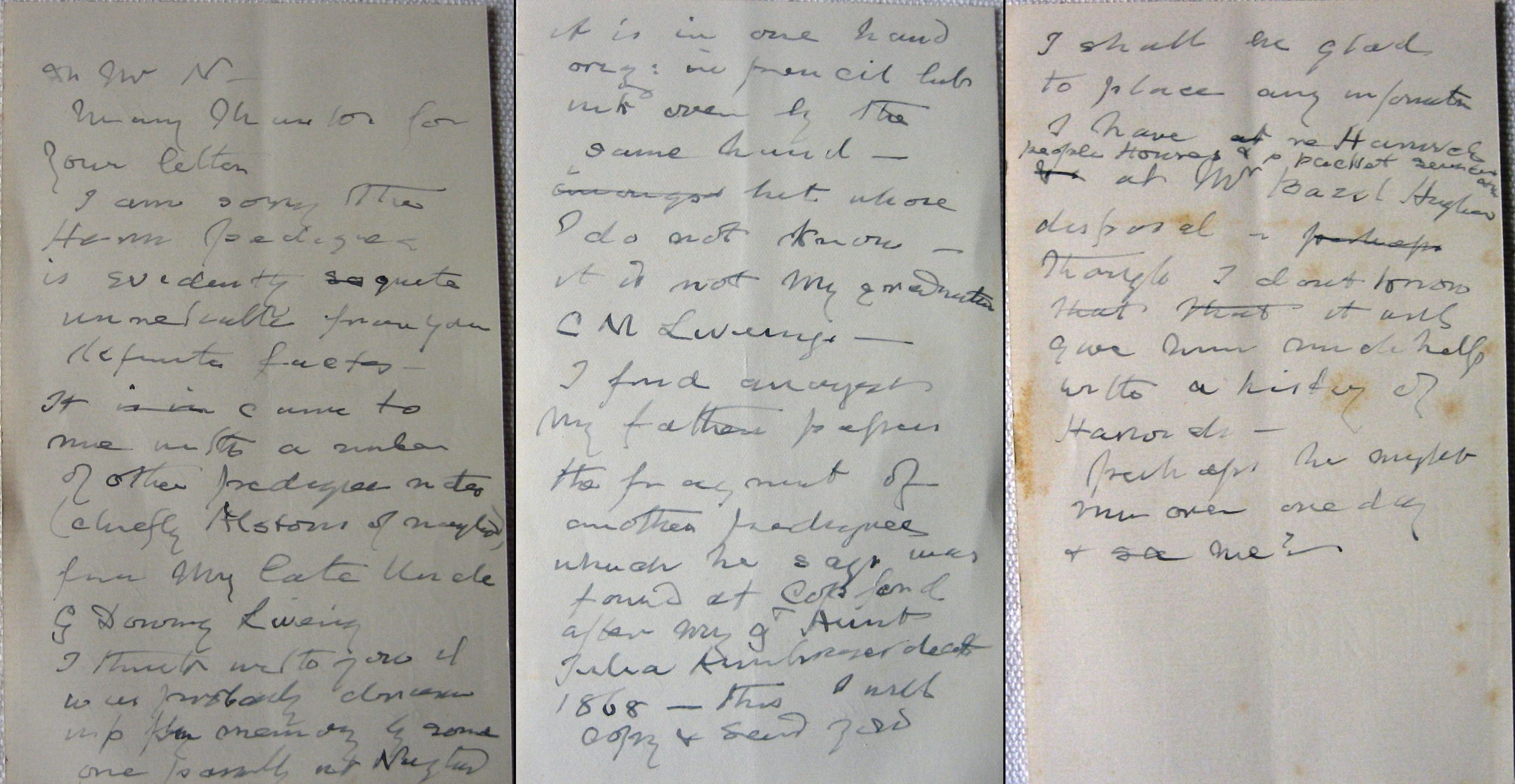
30. Letter from Edward: To Hope-Nicholson, 1928.
Liveing Archive: Images 3690 - 3693
Copy of letter.
Dear Mr N
Many thanks for your letter I am sorry the Hearn pedigree is evidently quite unreliable from your definite facts it came to me with a number of other pedigree notes (chiefly Alston's of Nayland) from my late Uncle G. Downing Liveing I think . . . . . it was probably drawn up from memory by someone possibly at Nayland
Page
it is in one hand . . . . . in pencil but ink over by the same hand - but whose I do not know - it is not my grandmother C M Liveing's . . . . . I found amongst my father's papers the fragment of another pedigree which he says was found at Copford after my great aunt Julia Ambrose's death 1868 this I will copy and send you
Page
I shall be glad to place any information I have re Harwich people houses and packet services at Mr Basil Hughes disposal though I don't know that it will give him much help with a history of Harwich. Perhaps he might come over one day and see me?

31. Letter from Edward: To his brother Henry, 21 Jan 1928.
Liveing Family Archive Image IMG 3859 - 3867
Copy of a letter E H T Liveing to (probably) his brother Henry
21 Jan 1928
My dear Harry
Many thanks for your notes an particulars I will put in Richard Dixon as you suggest. I also have the fathers note re Richard Dickson of the Haberdashery Co and Denmark Street St Giles having had plague and recovering from it also that Dickson Downing lived in Denmark Street St Giles and died from effects of a fall in his own drawing room caused by catching his foot in the carpet.
I also remember our grandmother CML telling me both these stories when she showed me relics and letters in the cabinet drawers. I enclose a copy of 2 notes by Uncle George re Richard Dixon his wife and daughters. Mrs Sarah Dixon who died 20 October 1709 was evidently the wife of Richard Dixon and mother of Elizabeth Downing who died January 18, 1713. Her son Dickson Downing being then only 12 years old he inherited from his mother a considerable fortune (doubtless made by old Dixon in his clothing business) but being ill advised lent it out on some French . . . . . and before his death in 1745 he had lost most of it, it is evident from the letters of G Downing to his sister Bridget that she and her Mother were not too well off, and that Aunt Skrine widow of Richard Skrine (Dixon's half brother) wanted Bridget to come and live with her at Cobham (sic) this G.D. opposes and urges her to remain? with her mother and hopes to be able to provide for her on leaving college, subsequently her mother married again some man in the city, a match not approved by the family (according to Aunt Knottesford - G.D.L.) I do not know the man's name but only that she is buried at St Aldermanbury Church in the City. It is of course impossible to print particulars of people into the pedigree for want of space my intention is the pedigrees shall indicate who the people were and to add figures and separate notes about each person of whom I have relics or know facts regarding their lives.
The pedigree dated 1787 which I have shows the 3 children of Dickson Downing who died infants however I did not put them in the pedigree for want of space. The 1st wife of Nathaniel Chambers (Sarah Boucher) by whom he had one child who died an infant is also omitted for the same reason.
With regard to the Chambers they certainly came from Westmorland possibly from Kendal, the father was a yeoman farmer and the 3 sons were doubtless educated at Kendal Grammar School. Zachary and Nathanial both became Attorneys in London and Ephraim the youngest was apprenticed to (Sennex) a globemaker (some type of instrument maker of today). There is an interesting account of him in the Penny Encyclopedia according to G.D.L. he of course compiled the 1st encyclopaedia 3 large volumes and back? in 1728 an immense labour for one man to have accomplished, he died at the early age of 44 and is buried in the cloister of Westminster Abbey, in the tomb on the wall.
Nathanial was of Grays Inn but lived at Hackney which as the letter of his which I have dated 2 August 1750 speaks of peaches and nectarines in his garden was then a country place he died there 9 Dec 1755 aged 66 (mem Ring number 7) his burial there is recorded in the Hackney register. Zachary lived at Wimbledon
(Vide G.D. letter to sister. Died December 1773). . . . . .
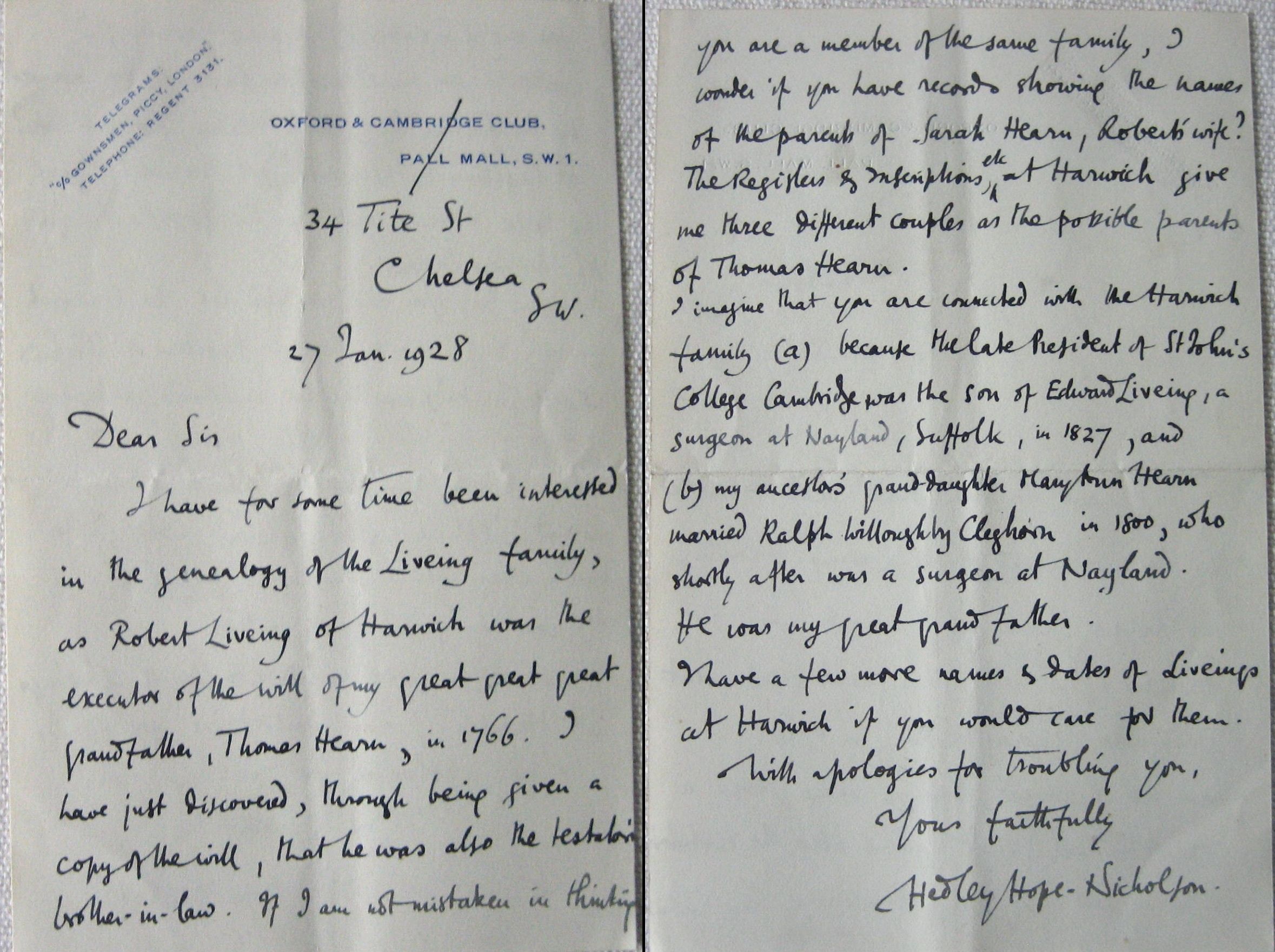
32. Letter from Hope-Nicholson: To Edward H T Liveing, 27 Jan 1928, Re old Harwich families.
Correspondance between Edward & Hedley Hope-Nicholson regarding the early family in Harwich. See also letters on searches of Hadleigh etc by Edwards brother William.
Liveing Archive: Images 3805 - 3806
On headed paper, Oxford & Cambridge Club, Pall Mall SW1, but crossed through
34 Tite Street
Chelsea SW
27 Jan 1928
Dear Sir
I have for some time been interested in the genealogy of the Liveing family, as Robert Liveing of Harwich was the executor of the will of my great great great grandfather, Thomas Hearn in 1776. I have just discovered, through being given a copy of the will, that he was also the testator's brother-in-law. If I am not mistaken in thinking
Page
you are a member of the same family, I wonder if you have records showing the names of the parents of Sarah Hearn, Robert's wife? The Registers & inscriptions etc at Harwich give me three different couples as the possible parents of Thomas Hearn. I imagine that you are connected with the Harwich family (a) because the late President of St John's College Cambridge was the son of Edward Liveing, a surgeon of Nayland, Suffolk, in 1827, and (b) my ancestor's grand daughter Mary Ann Hearn married Ralph Willoughby Cleghorn in 1800, who shortly after was a surgeon at Nayland. He was my great grandfather. I have had few more names & dates of Liveings at Harwich if you would care for them.
With apologies for troubling you,
Yours faithfully
Hedley Hope-Nicholson

33. Letter from Hope-Nicholson: To Edward H T Liveing, 31 Jan 1928, Re old Harwich families.
Liveing Archive: Images 3673 - 3674
Letters to Edward enquiring of the family.
Oxford and Cambridge Club
Pall Mall SW1
34 Tite st
Chelsea SW
31 Jan 1928
Dear Sir
Your nephew, Mr E. G. D Liveing, will no doubt have written to you, mentioning my enquiry about the Liveings of Harwich.
I am specially anxious to know if you have any details about Sarah, wife of Robert Liveing, who must have been the sister of my great great great grandfather, Captain Thomas Hearn, R.N. She died in
Page
1772, aged 49. There is some doubt as to which of three couples were the parents of Thomas Hearn, & perhaps the Liveing pedigree may settle this. His wife was an Ann, daughter of James Clements. I have notes as to Robert Liveing's parents, if you by any chance have not got them.
I may be going to Harwich on Friday, to stay with the Carlyon-Hughes, who are a great genealogists. I might be able to look up some point for you in the Registers, if you desire? My wife tells me that a cousin of hers, Archie Napier, married a Miss Liveing, perhaps she is a relation of yours?
Yours faithfully
Hedley Hope-Nicholson

34. Letter from Edward: To Hope-Nicholson, Feb 1928.
Liveing Archive: Image 3694
Dear Mr Nicholson
My nephew forwarded me your letter of 27 June and I now have yours of 31st. so I must say that it has given me much pleasure to hear from a distant cousin and one who like myself is interested in records of the past. I am sending you per parcel post a Liveing pedigree drawn up by me in 1921 and lithographed - if it is of any interest to you please keep it (I have spare copies). I include also a rough copy of the Herne pedigree found amongst my old papers & notes re Harwich. It clearly shows that George Herne was the father of
Page
Sarah who married Robert Liveing ( the 2nd.) and also of Thomas Hearn your ancestor, unfortunately it gives no dates and is imperfect I don't know who drew it up. I have a number of notes re Harwich etc and memoranda taken down by my late father Dr Edward Liveing (ob 1919) from the memoirs of his uncle Capt William Liveing (died 1871) & the Rev H T Liveing (died 1884) I have also a large number of letters by my great grandmother Harriet Liveing (wife of Capt Thomas Liveing) from Harwich between 1820 to 1837 the year of her death also a few earlier. I will look through these notes and letters and see if I can find anything of interest re Herne Cleghorn etc and make copies for you
1920 - I went through the register of St Nicholas Harwich with Job Brewster ? the old clerk but not thoroughly .as I was short of time any dates you can add to the Liveing pedigree I shall be glad of.
Yours very sincerely
E H Liveing

35. Letter from Hope-Nicholson: To Edward H T Liveing, 2 Feb 1928, Re old Harwich families.
Liveing Archive: 3677 - 3680
Oxford and Cambridge Club
Pall Mall SW1
34 Tite st
Chelsea SW
2 Feb 1928
Dear Mr Liveing
It is most kind of you to give me the copy of the splendid Liveing pedigree. Your nephew also suggested that I should write to his father, who has sent me his copy to look at. It is gratifying to find kinsman who are interested in genealogy, and able as well as willing to help. My great uncle Ralph Cleghorn seized and lost a book containing the Hearn pedigree, which I am reconstructing from family papers, tradition, and the registers. My mother would have been very much interested in your researches, had she been alive - she was the youngest daughter of Thomas Cleghorn, and a fourth cousin of yours. I add a little information for the Liveing pedigree. I have only met the Archie Napier's a few times, but I had no idea that the giants Charles and Sandy were my 5th
Page 2
cousins! The "Herne" pedigree, I am afraid, is rather in a tangle! Is it all in one script? It looks to me as if it were compiled at Nayland - the compiler knows all about my great aunts - not so much about the two elder brothers. Now my great grandmother, Mary Ann (Hearn) Cleghorn died, I think at Nayland, in 1840: I don't think Eliz. Hearn Cleghorn married Aggio (not Aggis) before 1846 - and Phillis married James Bruce in June 1856. Could it have been compiled by the widow (Cath Mary) of Edw Liveing, who was 2nd cousin of my great grandmother, and who lived, I believe, at Nayland? It looks to me as if it were confused family tradition - Thomas H. the I married and Ann Clements:
Thomas II married Eleanor (Townsend?)
George Ward married Elizabeth Hearn, 1751.
Joseph Deane married Eleanor Hearn, 1750, & had son William.
(no Sophia appears in Mr Carlyon-Hughes ' very big Deane pedigree)
Mary Hearn married Edmund Hunt, 1763
William Hearn married Susanna Annis, 1756
William Hearn & Elizabeth were the parents of George Poulson H born 1775, and of Maddison Hunt H born in 1777.
George Hearn was brother probably, not father, to most of the above (bap 1735,? buried 1785)
Page 3
I knew that Oliver Williams was a cousin of my grandfather's (he belonged to the same stock as Oliver Cromwell) but the pedigree shows me how, if it is to be relied on. My grandfather Cleghorn married Sarah Chisnall of Hadleigh: I wonder if the Chisnall's, or Orford's, come into your Hadleigh notes at all? Your collection of Harwich letters, etc sounds most interesting, and I shall look forward to any scraps of information. Some of it may not be very edifying perhaps - Thomas Hearn III was a terrible fellow, and a great trial to all his relations. "Aunt White" had to retire to Coggeshall to get away from him! When I return from Harwich, I will send you any thing I may happen to find, with the latest accounts of the seven pretenders to be the parents of Sarah wife of Robert Liveing! Mrs Carlyon-Hughes (The Chaseway, Dovercourt) with whom I am
Page 4
going to stay, is connected with the Deanes. Her son Basil is writing a history of Harwich, and I am sure he would be most grateful for anything bearing on the subject - social or topographical - especially owners and situation of houses, etc.
I am glad to hear that Bob Brewster is still alive - he was most helpful to me when I was there some years ago.
With many thanks
Yours sincerely
Hedley Hope- Nicholson

36. Letter from Hope-Nicholson: To Edward H T Liveing, 7 Feb 1928, Re old Harwich families.
Liveing Archive: Images 3675 - 3676
Oxford and Cambridge Club
Pall Mall SW1
34 Tite st
Chelsea SW
7 Feb 1928
Dear Mr Liveing
Your letter was forwarded to me from Dovercourt, where I found a few fresh facts, but not so much as I expected. The registers are so voluminous that I had not time to do all I wanted, & unfortunately forgot that Betts was one of your names - I remember that they came frequently. I enclose sheets of facts which you may not have. I am beginning to think that the traditional ancestors, William & Sarah Hearn, are right:
Page 2
and that she was a Simkin , Sarah Simkin's birthdate fits Mrs Sarah Hearn, & two of her grandchildren (by different children) were named Simkin. It is kind of you to promise me a copy of the other Hearn pedigree. It is possible that the Oliver Williams family have a pedigree? Perhaps you could tell me who is the present representative of the family. I have sent on your promise of help to Mr Carlyon-Hughes. If ever you come to London, it would be so pleasant to make your acquaintance. I met some other cousins at Dovercourt - Major and Miss Graves: they are descended from the Deanes, & share a Clements ancestor with me.
Yours sincerely
Hedley Hope-Nicholson.

37. Letter from Edward: To Hope-Nicholson, 13 Feb 1928.
Liveing Archive: Images 3681 - 3687
13 Feb 1928
Dear Mr Nicholson
Many thanks for your letter and the extracts from the Harwich Registers which are of such interest to me and will enable me to add some dates to my Liveing pedigree.
Page 2
I am seldom in London now but it would be a pleasure to me to meet you and have a chat and I will let you know beforehand the next time I am coming up and should it happen to be convenient to you I would call on you.
Your Herne pedigree showing the Simking (sic) connection is very interesting and certainly looks as if it was correct the reusing of the name in the next generation being good evidence -
Page 3
I enclose you the torn fragment of Pedigree of Copford I mentioned - it however seems to be the same sort of mixup from someone's imperfect memory that the former one was - George Hearn is again put in as father of Sarah Thomas etc . . . . . and a daughter of grandmother Peppers put in as his possible wife - who was grandmother Pepper? My father's notes on Liveings Harwich mostly in pencil on sheets of notepaper . . . . .
Page 4
taken down when staying with his Uncle Rev H. T. Liveing at Tansor Rectory at various dates some also from when staying with his Aunt Ambrose (Julia Liveing ob 1868) agd 80. I am making copies in ink of all these and when finished will send you for perusal and you can send on to Mr Basil Hughes if you think they would interest him -
Page 5
with regard to the Williams family I don't think they have any pedigree that would help you I called on Oliver Williams about 1920 to get any information he might have but he knew nothing but what I already knew.
Edmund the eldest son died a good many years ago Oliver died a year or two since. I believe the youngest son the Rev H. William
Page 6
is still alive he was Vicar of Duston Northampton have few years ago he however left that place for some church in Leicester but his present address I do not know. I will however find out from my Sister Mrs Rands of Northampton. It might perhaps be worth your while to write to him I remember staying with the Williams in Harwich when a boy some time in the sixties and being shown the old home in King Street where my great grandfather lived and died and also his father . . . . . there is a water colour drawing for this house made by my Aunt Mary about 1860 a photo of which I will send with copies of my father's notes . . . . .
E H L

38. Edward Henry T Liveing: List of family recipients Edward sent Torlesse Pedigree's to.
Liveing Archive

39. Letter from Mr Greenfield: To Mrs Atkinson, Undated, Cromby Terrace Southampton.
Liveing Archive: Image 3880 - 3882
This matter is attributed to Prof. Edward Henry T Liveing with no certainty (2011)
Copy of Mr Greenfield's letter to Mrs Atkinson
I fear Professor Liveing will find it a difficult matter to show his descent from Sir G. Downing of East Hatley the founder of Downing College or from his first cousin and heir to the baronetcy Sir Jacob Garrard Downing the last Bt who died without issue, 6th of February 1764, when the Downing estates reverted according to the disposition under the will of his cousin and predecessor Sir George who died 10th of June 1749, which will was confirmed by decree of the Lord Chancellor Camden 17th of June 1768. The charter for incorporation of the college having been approved by the Privy Council was confirmed by the King and passed the Great Seal under Lord Chancellor Loughborough 22 September 1800, when your grandfather's (E.B.T) Uncle Francis Annesley M.D. of Reading was appointed the first Master of the College. This Francis Annesley was shown to be the nearest male representative of the Founder - being son and heir of Mary Hanbury the eldest daughter and heiress of Frances Cotton, only daughter of John Cotton Esq and his wife Frances Downing eldest daughter of Sir George Downing 1st Bart, and eldest aunt of Sir G Downing the founder (who was 3rd Bart). It appears that the Founder died leaving a daughter, who seven months after her father's death married 23 February 1750 John Bagnall Esq and brought L.20,000 into settlement, but she does not appear to have been included in the entale created by her father's will which was made in 1717 (32 years before his death) at which time I fancy she was not born. There was a Rev George Downing a Prebendary of Ely. He was living in 1802 and had an only son, George Downing barrister at law of Lincoln's Inn who died S.P. 10 October 1800 to the great grief of his parents; but I cannot discover that the Prebendary of Ely was in any way related to the East Hatley family. I cannot find a Dixon Downing. The Founder was an only son. His father Sir George 2nd Bart was the eldest of three brothers William the second brother died S.P. Charles the third brother was father of Sir Jacob Garrard Downing 4th and last Bart.
Crombury Tce
Southampton.
Letter without envelope on file E L Fenn 2007.

40. Letter from Hope-Nicholson: To Edward H T Liveing, 16 Feb 1928, Re old Harwich families.
Liveing Archive: Images 3807 - 3808
On headed paper Oxford & Cambridge Club crossed through.
34 Tite Street
Chelsea SW
16 Feb 1928
Dear Mr Liveing
Very many thanks for the extra Hearn pedigree which you so kindly copied out for me, & for the promise of a photograph of the Liveing house in Harwich. I can't think who grandmother (or Godmother?) Pepper was. George Herne was of a later generation than Sarah Liveing's father. I will look up the Rev H. Williams in Crockford. He might possibly have some
Page 2
papers which might help. Your anecdote about the names of the officers on the packet is very amusing. I have just had a letter from Mrs Wetherall, the last of Captain George Deane's daughter's (aged 98) who has asked me to see her, at Pangbourne. She once saw Sarah Liveing's niece, Mrs White, (who was born in 1753) and says she kept a china bowl full of sovereigns over a door! Although she died in 1846, she seems quite real to me, as I have furniture, china, & letters of hers, and have always heard of her as "Aunt White". Mrs Wetherall said my letter was like a voice from the dead! It seems I am only just in time to rescue these scraps of family history.
Yours sincerely
Hedley Hope-Nicholson

41. Letter from Hope-Nicholson: To Edward H T Liveing, 18 Mar 1928, Re old Harwich families.
Liveing Archive: Images 3717 - 3719
More House
34 Tite Street
Chelsea
18 March 1928
Telephone
Kensington 1599
Dear Mr Liveing
I am returning your notes on Harwich & the Liveings with the two prints of the silhouettes, and the copies of the two letters. It is most kind of you to have sent them to me, and I enjoyed reading them immensely. They have made that period at Harwich, of which I knew a little, seem so much more real. The two letters are delightful. I had no idea
Page 2
that the Packet Commanders were so well off. But I'm afraid some of them at least knew how to spend! A great deal of the Hearn money went at the "Three Cups" - which made their refusal to give me luncheon the other day doubly annoying!
I imagine the Hope family that so elated Capt Bridge were our Dutch cousins, the bankers of Amsterdam. Old Mr Hopkins was the male witness at the marriage of my great grandmother Mary Ann Hearn to Ralph Cleghorn. There is a portrait of Capt. Thomas Hearn II (her father) in South Africa - but the owner of it says it is too dark to distinguish anything, but
Page 3
will not have it photographed - even at my expense! Mrs Wetherall (the youngest of Capt. George Deane's daughters) is a wonderful old lady, in spite of her 98 years and has various quaint anecdotes of the relations at Harwich. She has a young grandson, Robin Baillie, who is interested in genealogy, luckily. I send you a little reminiscence of hers which may amuse you! I am sending on my copy of your notes to B Carlyon-Hughes at Dovercourt, in case there is
Page 4
anything for his book. I am hoping to go to Coggeshall soon to search the registers there, as I am trying to find out who the wife of Capt Thomas Hearn II was - Eleanor was her Christian name: she may have been a Townsend of Coggeshall.
With many thanks for the loan of your papers,
Yours sincerely
Hedley Hope-Nicholson.

42. Edward Henry Torlesse Liveing: Letter from Thom E Austin Gardner, 24 Jun (19)28.
This person is not identified, Edward was Professor of Mining at Leeds 1898 - 1900

43. Letter from Edward: To Mrs E L Fenn, 22 May 1934, Longstanton CAM.
Brookfield House
Longstanton
Cambridgeshire
22 May 1934
My dear Mrs Fenn
As promised I now enclose you six prints from old negatives taken by my father and myself of the old house in 1874, they show well in what a dilapidated condition it was before cousin Edward had it so beautifully restored.
I also enclose a photo copy of a watercolour sketch by James Boggis of Nayland Street in 1838 the fine old redbrick vicarage on the right was pulled down before I can remember.
It was a great pleasure to me to see you and Adria the other day and I hope to be able to get over to Stoke and Nayland again sometime this summer.
Yours very sincerely
Edward H. Liveing
Letter without envelope to Edith Fenn, on file E L Fenn 2007.

44. Letter from Edward: To Dr E W Ainely-Walker author of "Skrine of Warleigh", 4 Oct 1935, Longstanton CAM.
Liveing Family Archive Images IMG 3913-3914
Brookfield House
Longstanton
Camb
4 October 1935
Dear Dr Walker
My brother Rev H.G.D. Liveing has sent me your letter and enclosure re R Dickinson. I am much interested and should like if it is not too late to be a subscriber to your book on the Skrine family I therefore enclose a cheque for 25/-.
A few years ago I drew up a combined pedigree of the Downing Baldwin Chamberlain and Woolley families with connections to help explain the large number of family relics now in my possession consisting of miniatures memorial rings Books pictures + many old letters I am sending you a photograph of the pedigree as I think it may interest you - you need a mnagnifier to read it as it is greatly reduced from the original - you were asking about Sarah Skrine (sister of Richard) who married 1st Zachary Brandon and 2nd Hon: Walter Molesworth - Curiously enough I have amongst a large number of memorial rings...
Memorial rings one which does not appear to be a death ring. It has a cross of 5 diamonds and one ruby in centre inside it is engraved Sir George Molesworth with no date and outside in blue enamel is
ABSENTIS PIGNUS AMICITAE
he was the 2nd son of Sarah Skrine who married W Molesworth
Yours very sincerely,
Edward H Liveing.
I well remember Mr H Duncan Skrine coming to see my Father at 52 Queen Anne St about 1870 (I was then 15) I have a letter of his (superscribed Warleigh Manor) dated 25th Jun 1870 written to my Father re family history and enclosing a rough copy of the Skrine Pedigree which I have -
I remember that one of his sons named Sholto had a gun accident + seriously damaged his hand-
Note: None of the memorial rings described as being part of the Liveing Archive then are now in the archive - 2023
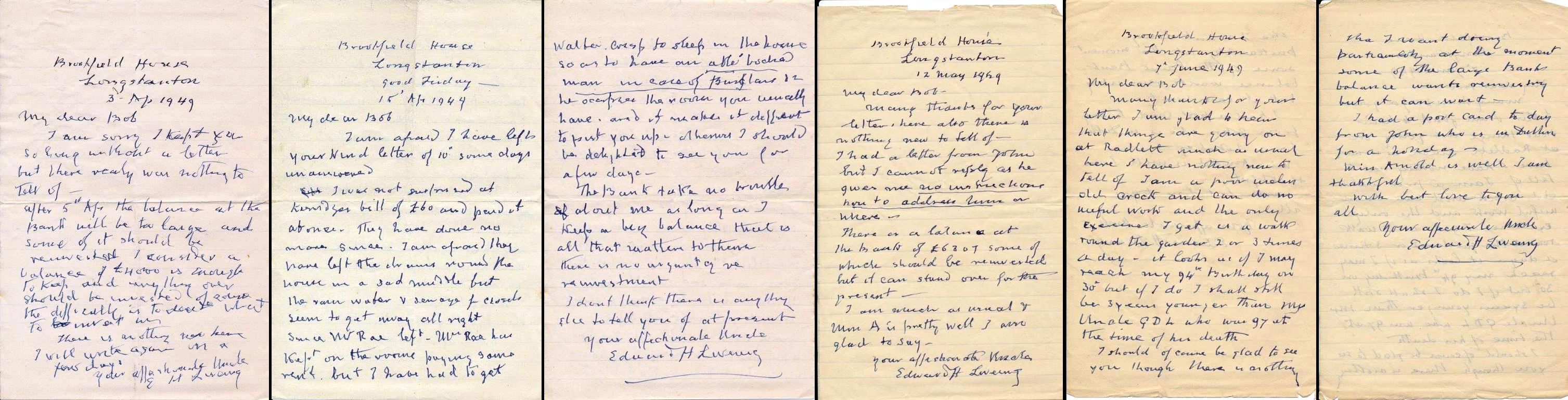
45. Letters 3 Apr 1949, 15 Apr 1949, 12 May 1949, 7 Jun 1949: Edward to Robert his nephew, 3 Apr 1949, Brookfield House Longstanton CAM.
Liveing Archive 05 EHL
Brookfield House
Longstanton
3 April 1949
My dear Bob
I am sorry I kept you so long without a letter but there really was nothing to tell of.
After 5th of April the balance at the Bank will be too large and some of it should be reinvested I consider a balance of L4000 is enough to keep and anything over should be invested of course the difficulty is to decide what to invest in.
There is nothing new here I will write again in a few days.
Your affectionate Uncle
E H Liveing
Liveing Archive 01a EHL
Brookfield House
Longstanton
Good Friday
15 April 1949.
My dear Bob,
I am afraid I have left your kind letter of 10 some days unanswered.
I was not surprised at Kerridges bill of L60 and paid it at once. They have done no more since. I am afraid I may have left the drains round the house in a sad muddle but the rain water and sewerage fr closets seem to get away all right.
Since Mr Rae left - Mrs Rae has kept on the room paying some rent, but I have had to get
Page 2
Walter Crisp to sleep in my house so as to have an able-bodied man in case of burglars etc he occupies the room you usually have, and it makes it difficult to put you up at home I should be delighted to see you for a few days.
The Bank take no trouble about me as long as I keep a big balance that is all that matters to them there is no urgency re reinvestment.
I don't think there is anything else to tell you of at present.
Your affectionate uncle
Edward H Liveing.
Liveing Archive 04 EHL
Brookfield House
Longstanton
12 May 1949
My dear Bob
Many thanks for your letter, here also there is nothing new to tell of - I had a letter from John but I couldn't reply as he gives me no instructions how to address him or where - there is a balance at the Bank of L6307 some of which should be reinvested but it can stand over for the present -
I am much as usual and Miss A is pretty well I am glad to say.
Your affectionate Uncle
Edward H Liveing
Liveing Archive 06a EHL
Brookfield House
Longstanton
7 June 1949
My dear Bob
Many thanks for your letter I am glad to hear that things are going on at Radlett much as usual here I have nothing much to tell of - I am a poor useless old crock and can do no useful work and the only exercise I get is a walk round the garden 2 or 3 times a day - it looks as if I may reach my 94th birthday on the 30th but if I do I shall still be 3 years younger than my Uncle G D L who was 97 at the time of his death. I should of course be glad to see you though there is nothing
Page 2
that I want doing particularly at the moment some of the large bank balance wants reinvesting but it can wait -
I had a postcard today from John who is in Dublin for a holiday -
Miss Arnold is well I am thankful
With best love to you all
Your affectionate Uncle
Edward H Liveing

46. Letters 17 Jul 1949, 13 Aug 1949, 20 Sep 1949: Edward & his houskeeper to Robert his nephew, 17 Jul 1949, Brookfield House Longstanton CAM.
Liveing Archive 02a EHL.
Brookfield House
Longstanton.
17 July 1949.
My dear Bob,
I will be glad to hear you had got home I hope the short change at Brighton has done Josephine some good?
Here I have a good many changes to tell of the Turners are going but I have got a nice young man and wife to take the sheds on the same terms he had been RAF man but is now studying for a Camb degree.
The Rae's our house lodgers
Page 2
are also going and I must find someone to take their place, on 25 July Miss A is going for her two-week holiday to rest at her sister in London and I shall have to do with Alice who will sleep in the house as she did last year.
A new up-to-date list of my securities ought to be made out and checked by the Bank but I feel quite incapable of doing this alone I shall need your help and I hope you will come down
Page 3
for a few days after Miss Arnold returns from her holiday.
I am a poor useless crock.
Your affectionate uncle
E H Liveing
Liveing Archive 03 EHL
Brookfield House
Longstanton
13 August 1949
My Dear Bob,
I badly need your help my mental powers seem failing and I cannot keep in touch with my cash and securities, a new list of the securities once making out with present valuations to replace the old one of May 1948 and I am quite incapable of doing this.
When can you come down and help me?
Your affectionate Uncle
E H Liveing
Liveing Archive 18b EHL.
Brookfield House
Longstanton
Cambs
Tuesday 20 Sep 1949 (date from postmark)
Dear Mr Liveing
Dr Cain came in this morning and thought your uncle a bad colour and told me to let him know at once if I saw any change in him, I reminded him to communicate with you, he said he would write to you. As far as I can see, he is just the same as when you were here, very peaceful eating his food quite as well as usual.
Page 2
I told Dr Cain, he was sleeping a good deal, his remark was, very merciful, I will write to keep you acquainted with how he is. I don't want him to sense that we are anxious about him.
Just keeping the atmosphere round him very quiet and peaceful.
Mrs (Catherine) Butters has written to say she would like him to come in for an hour or two tomorrow Wednesday, he got all irritable and fussed and said he had no wish to see her, and then left it to me to do as I liked
Page 3
I Have arranged for a Taxi to meet her at Cambridge Station and will warn her not to excite him because the doctor says his heart is not too good.
Alice and I will have both our bedroom doors open during the night and I am letting Walter, do all the Cambridge shopping, he has not liked me going to Cambs for some time, you will know at once, if things get worse. I am keeping the bed is made up in the spare room.
From
Yours Sincerely
D Arnold

47. Letters 23 Sep 1949, 23 Oct 1949, 24 Oct 1949: Edward & his houskeeper to Robert his nephew, 23 Sep 1949, Brookfield House Longstanton CAM.
Liveing Archive 11b EHL
Brookfield House
Longstanton
Sept 23 1949 (taken from the postmark)
My dear Bob
I am afraid Barr has made a mistake to put the Family Relics into the will - it will cause very heavy death duty - I really cannot deal with this matter and think you better come down and straighten things out while I can still alter my will.
Your affectionate Uncle
E H Liveing.
Liveing Archive 08b EHL
Brookfield House
Oct 23 1949
Dear Bob
Many thanks for your letter telling me of Norah's engagement I wish her every happiness and good luck in the matter you must let me know when the marriage is to take place so that I can send her a wedding present -
There is nothing new to report here.
I get more and more useless as time goes on but can only expect this
Page 2
I hear from no one but you and St John what the rest of the family are doing I have no information -
Your affectionate Uncle
Edward H Liveing
Liveing Archive 19b EHL.
Brookfield House
Longstanton
Cambs
24 Oct 1949 (from postmark)
Dear Mr Liveing
Many times I have been going to write you a few lines, I have no doubt as I have not written, you know everything is going on all right your Uncle is about the same as when you were here, varies a little, from day-to-day, eating his foods as well as usual, I don't think he is
Page 2
sleeping quite as well, but he is going along very quiet and happily. I went down to Mr Wrights to get some oil for the Atco, and he mentioned, to me, his son would very much like to live on the lawn.
I said I would speak to your Uncle about it, which I did he said then, he had no objections, if they got in you would not be able, to get them out, because he works for his father, all the people, that have lived there have been temporary.
Walter took a big Hamper of Apples
Page 3
down to them, they were very pleased. I hope you are all keeping well my Best Wishes for your Daughters Happiness.
Yours Sincerely
D Arnold

48. Letters 3 Nov 1949 -16 Nov 1949: Edward & his housekeeper to Robert Liveing, 3 Nov 1949, Brookfield House Longstanton CAM.
Liveing Archive 17b EHL.
Brookfield House
Longstanton
Cambs
3 November 1949 (postmark)
Dear Mr Liveing
Your Uncle is fairly well about the same as when you were here, he was interested and pleased to receive Norah's letter, and also news of her engagement.
At the moment he is rather unhappy about, cigarettes, he tells me he has dipped heavily into his reserves,
Page 2
he knows that I am writing to ask if you are able to collect some for him, last night, he said I was not to write and worry you, but he agreed to let me write this morning.
I also asked Alice to get some, (she will).
He upsets himself if I go to Cambridge, sometimes I have to go, I am always back into a half hours, it does not give me any time to scrunge(?) apart from Matthew
Page 3
Alice says there was a man in the middle of the drive when she came in the other night, several times there has been someone down by the gates, Mrs Turner told me the same, last evening I spoke to Mr Baguely he said he had turfed, one or two out, sometimes when he has come home 11 o'clock at night. Your uncle does not know about this, I wondered if you would write to the Police about it, I think they would take notice of view when they might not me. Best Wishes to You All
Yours Sincerely
D Arnold.
Liveing Archive 07b EHL
Brookfield House
Longstanton
Nov 16, 1949
My dear Bob
Many thanks for the 500 Craven A received this morning it will make an ample addition to my reserve.
I enclose 17/6 X 5 = . . . . . 1/6 postage = L4 9s 0d if postage was more let me know and I will put it right.
There is nothing new here to report.
Your affectionate Uncle
E H Liveing

49. Letters 8 Dec 1949-23 Dec 1949: Edward to Robert his nephew, 8 Dec 1949, Brookfield House Longstanton CAM.
Liveing Archive 12b EHL.
Brookfield House
Longstanton
Dec 8 1949
My dear Bob
I am afraid I have left your last letter some time unanswered but there is nothing to tell of here the Adyias (?) do not go away until 16th and return 2nd of Jan they are putting no one to sleep in the sheds which I think unwise as burglars may break in and take anything they can find.
I am having an able-bodied man to sleep here while they are away.
Page 2
I enclose a L5 cheque for Norah as a wedding present I send to you as I don't know her fresh address.
I am much as usual and Miss A is pretty well I'm glad to say I am glad you have got over your bad colds.
I don't think I have anything to tell you.
Your affectionate Uncle
Edward H Liveing
Liveing Archive 20b EHL.
Brookfield House
Longstanton
Cambs
Dec 23/49
Dear Mr and Mrs Liveing
Thank you both very much, for the very pretty present and your kind remembrance of me. Your Uncle is fairly well and it has cheered him up because everybody have (sic) remembered him. Marjorie and Ted wrote him nice long letters and asked if he would like, to see them, he advised them to come for a day when the days were longer,
Page 2
It does seem a pity that they don't write him a letter at regular intervals, he enjoys that more than anything else. It is weeks now since he was able to go in to the garden.
Baguelys have gone to Africa, for once we are lucky, the best pair are left to occupy the huts, I believe the man is clever he is at Trinity College, and if he is successful, is going in for research on Atomic energy. I was very glad to see him cementing up the cracks, he took the mower to pieces and got it going. Quite the best pair, we have had there
Page3
they have gone away for a fortnight Xmas holiday, we have got Will the head batmen, sleeping in (Alice's Friend) while they are away will stop I hope you have all recovered from your colds and be able to enjoy the Xmas Fare.
Thank Norah, and Millie, for their kind remembrance.
wishing you all a very Happy Xmas.
From
Yours Sincerely
Daisie Arnold.

50. Letters 30 Dec 1949, 9 Jan 1950, 20 Mar 1950: Edward to Robert his nephew, 30 Dec1949, Brookfield House Longstanton CAM.
Liveing Archive 15b EHL
Brookfield House
Dec 30 1949
Dear Bob
I am in a hopeless muddle about I (sic) Tax returns and wish you would come down and try and straighten things out - I have become quite incapable - the bank would help but want papers I can't find
Your affect Uncle
E H Liveing
Liveing Archive 14b EHL
Brookfield House
Longstanton
9 Jan 1950
My dear Bob
Many thanks for your kind letter of 7th inst.
The Bank have taken over the income Tax business and although I could not supply all the papers they asked for will I hope manage to carry on
I don't think there is any need for you to come down here at present but I will write if it seems desirable - take care of yourself and don't try to do too much -
Your affectionate Uncle
E H Liveing
Liveing Archive 13a EHL
Brookfield House
March 20, 1950.
Dear Bob
Many thanks for letter giving particulars of Norah's wedding - don't trouble about me I shall not need your help in any case until after you return from Ireland - there is nothing new to tell of here - and things are going on as usual.
Your affectionate Uncle
Edward H Liveing

51. Letters: Edward to Robert his nephew, 1 May 1950, 2 May 1950, 26 Jun 1950, Brookfield House Longstanton CAM.
Liveing Archive 16b EHL
Brookfield House
1 May 1950
Dear Bob
Many thanks for your last letter telling me of your return home after Norah's wedding.
You don't say anything about your own health but I hope that . . . . . not suffered from . . . . . any exertions you must have had while away - there is nothing new here to tell of things are going much as usual - let me hear how you are.
Your affectionate Uncle
E H Liveing
PS I will let you know when in May it will be
Page 2
convenient for you to come for a couple of days as you propose.
Your affectionate Uncle
E H Liveing
Liveing Archive 10b EHL
Brookfield House
2 May 1950
Dear Bob
I can now put you up for 2 nights any date you wish to fix so choose your date and let me know when I may expect you
Your affectionate Uncle
E H Liveing
Liveing Archive 09b EHL
Brookfield House
Longstanton
Jun 26 1950.
Dear Bob
I was glad of your letter of 22 June and to hear you can now tackle garden work without overdoing yourself.
Here there is no news to give it looks as if I shall reach my 95th birthday on 30th. Miss A and I are both fairly well and things going on as usual.
Your affectionate Uncle
E H Liveing

52. Edward H T Liveing: Will & Probate, 1949.
Liveing Archive 06052020_1P2 Will of EHT Liveing 445.
I EDWARD HENRY LIVEING of Brookfield House Longstanton inthe County of Cambridge late Professor of Mining in the University of Leeds hereby revoke all former Wills and Codicils made by me and declare that this is my last Will
1: I appoint my nephew Robert Henry Torlesse Liveing and his daughter Norah Liveing both of 18 Hillside Road Radlett in the County of Hertford to be Executors and Trustees of this my Will and I declare that in the interpretation of this my Will the expression "My Trustee" shall (where the context permits) mean and include the Trustees or Trustee for the time being hereof whether original or substituted I desire that the Solicitors to be employed in connection with my estate shall if possible be Barr & Co. of Guildhall Chambers, Cambridge
2. I bequeath to my nephew the said Robert Henry Torlesse Liveing free of legacy duty all my family relics miniatures trinkets books pictures prints cabinets and old letters (as more particdlarly described in my two green note books)
3. I bequeath to my housekeeper Daisy Arnold free of legacy duty if she shall be in my service at my death the sum of Three thousand Pounds to be paid to her as soon as possible after my death
4. I devise and bequeath all my real and personal estate whatsoever and wheresoever not hereby or by any Codicil hereto otherwise specifically disposed of (including any real or personal property over which I may have any general power of appointment and of which I have power to dispose by Will) unto my Trustees Upon Trust to sell call in and convert the same into money with power in their discretion to postpone such sale calling in and conversion and after payment out of the money arising thereby or out of my ready money of my debts funeral and testamentary expenses and legacies to pay and divide the residue of such moneys among my Nephews and Nieces Edward George Downing Liveing Marjorie Liveing Catherine Butters Frances Liveing the said Robert Henry Torlesse Liveing St. John Rands Evelyn Holland and Dorothy Smith or the survivor of them in equal shares Provided nevertheless that in case any nephew or niece of mine shall die in my lifetime leaving issue living at my death who being male attain the age of twenty one or being female attain that age or previously marry such issue shall stand in the place of such deceased nephew or niece and take per stirpes and equally between them if more than one the share of my residuary estate which such deceased nephew or niece would have taken if he or she had survived me and had attained a vested interest IN WITNESS whereof I have hereunto set my hand this 15 day of September One thousand nine hundred and forty nine
SIGNED by the said EDWARD HENRY LIVEING as his last Will in the joint presence of himself and us who at his request and in such joint presence have hereunto subscribed our names as witnesses. )
Liveing Edward Henry of Brookfield House Longstanton Cambridgeshire died 14 Dec 1950 Probate London 29 March 1951 to Robert Henry Torlesse Liveing retired Capt HM Army. Effects £44357 11s 0d
National Probate Calendar

53. Edward H T Liveing.
Edward had a widely varying life, an invitation to a concert at Buckinham Palace, his card for an Eastern Europe minerals company, a collection of his scientific papers sold in Edinburgh 2014

54. Edward H L Liveing: Notes on the Knottesford Family Of Alveston WAR.

55. Sale of Brookfield House: Pt 1, 27 Apr 1951, Longstanton CAM.
Liveing Archive 3529 - 3537

56. Sale of Brookfield House: Pt 2, 27 Apr 1951, Longstanton CAM.
Liveing Archive 3529 - 3537
Edward married Ida ERDEBJI [26928] [MRIN: 9677] before 1890. (Ida ERDEBJI [26928] was born circa 1866.)
Edward next married Emily Sarah JONES [446] [MRIN: 126], daughter of Joseph Gray JONES [11203] and Unknown, on 17 Nov 1904 in Emmanual West Dulwich Lambeth London. (Emily Sarah JONES [446] was born on 12 Nov 1862 in Finsbury London, died on 7 Feb 1939 in Longstanton CAM and was buried on 13 Feb 1939 in Stoke By Nayland SFK.)
|

