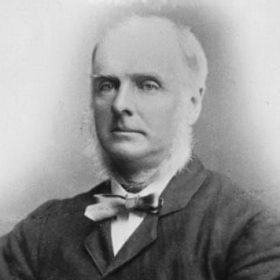
William John Warburton HAMILTON [10702]
- Born: 1825, Little Chart KEN
- Marriage (1): Frances N TOWNSEND [33170] on 6 Nov 1855 in Canterbury NZ
- Died: 6 Dec 1883, Christchurch NZ aged 58
- Buried: Barbadoes St Cemetery ChCh. NZ

 General Notes: General Notes:
William John Warburton Hamilton (April 1825 \endash 6 December 1883), who generally signed as J. W. Hamilton, was an administrator, explorer, and politician in New Zealand.
Hamilton was born in 1825 at Little Chart, Kent, England. His father was Rev John Vesey Hamilton, and Richard Vesey Hamilton was his younger brother. He was educated in England, Paris, Brussels, and at Harrow School. He emigrated aged 18 on the Bangalore with Sydney in Australia as his destination, but he met Robert FitzRoy on the journey and became his private secretary; FitzRoy was travelling to take up the role of Governor of New Zealand.
Early time in New Zealand
Hamilton served for FitzRoy until the latter was recalled, and then worked under the next governor, George Grey. Hamilton returned to England in 1846. He returned on HMS Acheron in 1848 as a survey officer. From inland explorations, geographic features were named for him, including Hamilton Plains (now known as Hanmer Plain) on the Waiau River, and the nearby Mount Hamilton. In 1849, he attempted the first known ascent of Mount Tapuaenuku in the Kaikoura Ranges. He was with Edward John Eyre, Lieutenant-Governor of New Munster, and seven Maori. They came within a short distance of the summit but were forced to turn back.
In 1850, Governor Grey appointed Hamilton resident magistrate for Wanganui, which was a significant responsibility for a person aged 25.
Life in Canterbury
Hamilton held the post in Wanganui for about half a year only before he took on another role at Port Cooper (now known as Lyttelton). At Lyttelton, he was appointed collector of customs for Canterbury in August 1853.
On 6 November 1855, Hamilton married Frances Townsend, daughter of James Townsend of Ferrymead. She was the eldest sister of the artist Mary Townsend.
In the first elections for the Canterbury Provincial Council on 31 August 1853, five people contested the three available positions in the Town of Lyttelton electorate. Hamilton came a close second, and was thus returned; the other successful candidates were Isaac Cookson and Christopher Edward Dampier (the solicitor of the Canterbury Association. In November 1853, he was appointed onto the first Executive Council (comparable to a cabinet) as Provincial Auditor under Henry Tancred. During a day of low attendance in October 1854, Richard Packer secured a suspension of the council's standing orders, which allowed him to have the first two readings of a bill to enlarge the council's membership by 12 additional members passed. Whilst there was justification for such a measure due to the long session lengths, the Executive Council consisting of Tancred, Henry Godfrey Gouland, Charles Simeon, and Hamilton regarded the matter as a vote of no confidence and resigned. He was a member of Tancred's second Executive Council (July 1855 \endash February 1857) and on the Executive led by Packer (February \endash June 1857).
He retired at the end of his term as provincial councillor in July 1857 and did not seek re-election.
He was appointed resident magistrate of Christchurch in February 1856. When he left the customs service, he became receiver of land revenue. He retired in 1874. For some time, he was manager of the Union Bank in Lyttelton. In 1861, Charles Bowen sold his interest in the Lyttelton Times to William Reeves and Hamilton. He was a governor of Christ's College, and was on the board of Canterbury College (1875\endash 1883).
As a resident magistrate, he was widely respected for his fair dealings. His contribution to the provincial government was regarded as valuable, especially his understanding of finances. As a government official, he was perceived by William Ellison Burke, the avid recorder of Canterbury personalities in the 1850s and 1860s, as "crotchety official - a wearisome magistrate". Burke wrote:
Mr. H. was notoriously the most perfect embodiment of red tape who ever held office in Canterbury. His memos and questions upon documents were masterpieces and calculated to try the patience of the most saintly. As a magistrate he was a drawler and doubter and questioner who ever sat on the Bench of Christchurch. He had a supercilious style when he chose to be offensive and was very inquisitive.
Hamilton died on 6 December 1883 at his home in Latimer Square. Colleagues from the Lyttelton Times were pall bearers and carried the coffin from his home to Barbadoes Street Cemetery. His wife died in 1889.
HAMILTON, William John Warburton
(1825\endash 83).
Explorer, civil servant.
W. J. W. Hamilton was born at Little Chart Rectory, Kent, the eldest son of the Rev. John Vesey Hamilton, and was educated at Harrow, Brussels, and Paris. At the age of 18 he left for Sydney in the Bangalore with £50 in his pocket, which was all he ever received from his father. Among the passengers was Captain FitzRoy on the way out to take up the appointment of Governor of New Zealand. The Wairau affray had just taken place. His private secretary having resigned on account of ill health, FitzRoy offered the post to Hamilton, who accepted it. He now entered upon a period of extreme activity, drafting dispatches and entertaining guests for the Governor. He visited settlements and native strongholds, and saw fighting during Hone Heke's rebellion as a member of the Auckland Militia. When FitzRoy was recalled late in 1845 he continued for a time to serve Sir George Grey, and then sailed for England in 1846. Two years later he returned to New Zealand as a survey officer in the survey ship HMS Acheron. In 1849 he made an inland exploration of North Canterbury, climbed Mt. Grey and made a plan showing the open country visible up the Hurunui and Waiau Rivers. When the Acheron was in Foveaux Strait, he explored far to the westward and he and Captain Stokes ascended the Oreti and Makarewa Rivers in the ship's jolly boat. He visited the site of Invercargill and in May 1850, with Lieutenant Spencer, made the first overland expedition from Invercargill to Dunedin. Later he thoroughly examined the coastline from Banks Peninsula to Cape Campbell.
In August 1850 he was appointed Resident Magistrate at Wanganui and during this time made journeys far inland, increasing thereby his already considerable knowledge of the Maoris and their way of life. They loved and respected him and he left the district a model of orderliness.
In 1853 he settled in Canterbury, having been appointed Collector of Customs at Lyttelton; and in November 1855 he married Frances, eldest daughter of James Townsend. He made his home in Dampier Bay and his family were born there. He was Provincial Auditor in the first Provincial Government. Sewell said, "He has all the brains of the Government at present, and is the sole authority on finance". He completed the purchase by the Crown of the Maori lands in Banks Peninsula. In 1866 he left the Customs and became Sub-Treasurer in Christchurch. He bought a share in the Lyttelton Times and took an active part in the conduct of the paper. When he died, men from the Times office carried the coffin in relays all the way from his house in Latimer Square to Barbadoes Street Cemetery. The pall bearers were H. J. Tancred, C. C. Bowen, T. W. Maude, R. J. S. Harman, the Rev. Croasdaile Bowen, and the Hon. William Reeves. He was a man of the highest principles and of an integrity hardly understandable by men of commoner clay. But C. C. Bowen said of him that his great fault was obstructiveness, and E. J. Bourke described him as "a crotchety official \endash a wearisome Magistrate". He died on 6 December 1883, aged 58.
https://teara.govt.nz/en/1966/hamilton-william-john-warburton
William spouse unknown Frances N TOWNSEND [33170] [MRIN: 3572], daughter of James TOWNSEND of Ferrymead Christchurch NZ [33171] and Alicia BURGESS [33172], on 6 Nov 1855 in Canterbury NZ. (Frances N TOWNSEND [33170] was born on 11 Apr 1820 in Surrey and died on 20 Dec 1889 in Christchurch NZ.)
|