Mary Kathleen "Kath" GERAHTY [21231]
- Born: 15 Jan 1919, Charters Towers QLD
- Marriage (1): William "Nugget" STANLEY [21232] on 19 Dec 1938 in St Barnabas Julia Creek QLD
- Died: 18 May 2006, Queensland aged 87

 General Notes: General Notes:
Kath Gerahty - Memories of her family and life in Northern Queensland.
I was born in Charters Towers in 1919. Three of my family were born in Charters Towers: my brother Ces, he was the oldest; then two years later there was me, Mary Kathleen (but I was known as Kath); then my sister Lily. Mum and Grandma taught us school. We had chairs and a little table and we had school at Manfred.
When Mum finished her boarding school education she went back to Manfred and worked at the hotel for her father. Dad was a fencing contractor working on stations around Manfred, and that's where he met Mum and that's where they got married. When Grandfather was killed, around 1916, the hotel passed to my parents. I lived there until I was nearly 7.
There was no town at Manfred, just the hotel. Our companions were mostly picaninnies. The dark lady who looked after us, Mary was her name, she lived at the Aboriginal camp on the river bank in a shanty made of timber and tin. "Black Mary" had two little girls. I think she had a little boy too, but I can't remember much about him. The black kids never wore a lot of clothes and Grandma reckoned it wasn't right that little girls, or little boys, didn't put clothes on. Nothing for little picaninnies to have no clothes. So when the Afghan came on his camel, she'd buy a roll of floral material, cretonne they used to call it, and she'd make dresses for me and my sister and Mary's two little picaninnies; all the same, the four of us. Mary used to walk us to the river - we didn't live far from the Flinders - and Grandma would make out that she couldn't tell us apart because of the dresses, each with a frill around the neck and a sash around the middle. She'd shake her head: "Oh, those four little girls. I can't tell the difference". And two as black as ink and two little white ones. Black Mary had a store of native folklore.
Whirlywinds were common at Manfred. They'd swirl and roll, move around and go anywhere, picking up grass, leaves and dust. They could be huge. Mary told me to point a finger at it if I saw one coming towards me and it would veer away. I'd see the Aboriginal kids squealing and running about, pointing their fingers at a whirlywind so that it wouldn't hit their shanties - or them. The Afghan and his camel train used to come to Manfred regularly. He'd have all these goodies on the back of his camels in big cane baskets. Lots of people came in from the properties to have a look at what the Afghan had. Word of mouth it was, that the Afghan was at Manfred. I still remember him wearing his turban and his long shirt, I used to call it his nightshirt, Mum would be there, buying whatever she needed for herself or the hotel, and anything she thought would be okay for a Christmas lolly stocking. We always got a book for Christmas and it was usually The Girls Own Annual, and it was thick. But we never got much else, other than a lolly stocking with toys and games in the top part, and in the foot, lollies. One Christmas morning we gets up. Lily had a stocking with an umbrella in it. I spotted the umbrella and I claimed it - my lolly stocking. Lily put up a fight. It was her lolly stocking and her umbrella.
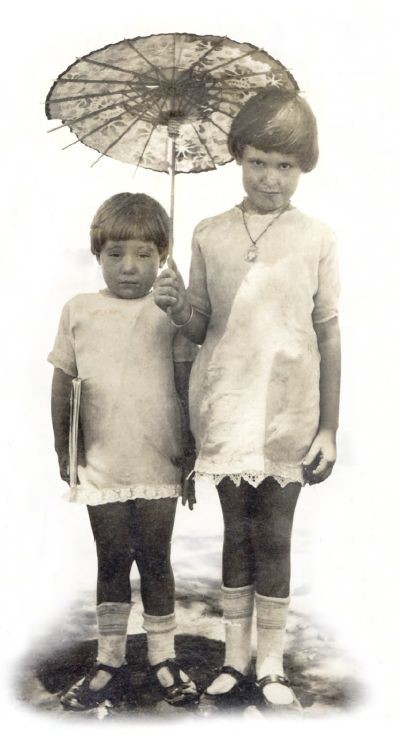
One of my aunties told me years later that I should have had a hiding every day, that I always wanted what somebody else had. Well, Lily and I fought over the umbrella until one side was ripped. It was made from Japanese plastic-paper-looking stuff; paper that had been waxed over. Very pretty, but you can't tell that from the photo. Mum said to share it, but neither of us wanted to share that umbrella. She took a photo. We're both standing there; Lily holding her Christmas book, and me holding this darn umbrella that's ripped on one side
When Dad got a big fencing job on Fort Constantine, he decided to sell the hotel and move to Cloncurry so that his three children could go to a proper school.
I was happy amongst the dark children at Manfred. They were our companions and we played with them - and wonderful people, too, the blacks - but when I went to school in Cloncurry and saw all these white children, I felt uncomfortable and created a stir. I clung to the bannister, screaming and kicking, and they couldn't get me up or down the stairs. They told Mum to go home and leave me to the teachers. Miss Calem, she came and told me I could sit near her and I could help her teach. All the baloney. But still and all, it worked. I quietened down. I was the teacher's pet, or so I thought.
In 1928 my mother was having another baby - brother Bill - but he was only a couple of weeks old when Mum got septicaemia and died. She left four little kids; the oldest was 10 and the youngest was a baby of a couple of weeks. My brother Bill - an aunt came and took him. She said she would take the new baby and rear him. That left Dad with three children, and if he'd moved into Cloncurry to look after us he would have had no money coming in. His job was on Fort Constantine, yard building, fencing, fixing windmills, things like that. He spoke to his sister, Hilda Winton, about what to do. She was a stepsister really, a child from a second marriage. Auntie Hilda had five children of her own, but she decided that she would take the three of us. So, in 1928 we went to Julia Creek to be with Auntie Hilda.
Dad stayed working on Fort Constantine and other stations. He supported us and came to see us, but he never lived or worked in Julia Creek, he was backwards and forwards from Cloncurry. I left Julia Creek in 1950, that's how long I stayed. It was a wonderful little town and I still have only fond memories of living there. Well, there were eight children in the Winton house in Coyne St. It was a special house, two houses built as one. What happened: there was a mining town called Kuridala out towards Mount Isa, and when they closed the mine all the houses were put up for sale. Grandfather Hornung (Auntie Hilda's father), he went out and bought two houses, put them end to end and added a verandah on three sides. The house was quite large. We used to sleep . . . . . there was my sister and me and Mary Winton, the three of us slept in a double bed; the boys were on the verandah; and the baby slept in the cot. Grandfather Hornung had a room to himself, as did Auntie Hilda and Uncle Bill, though Uncle Bill was hardly ever home, he was a drover. The dinner table in the Winton household was nearly as long as this dining room and kitchen combined. It had to be, to fit everyone in. Grandfather Hornung sat at the head, and the children all sat round. You never spoke a word - only to ask if you wanted something. If you wanted the salt and the pepper you'd say: "Salt and pepper please" and someone would pass it. No jumping up from the table, no talking out of turn; nothing like that. As regimented and reserved as mealtimes were, they lost some of their formality - and we thought we were made - when Auntie Hilda brought home a tablecloth printed with pink roses. Auntie Hilda bought bread from Bally Kaeser if she had enough money, and if she didn't, she'd make it. And she'd make jam. I longed for the day when I could have bread and butter and jam, because we were allowed bread and butter, or bread and jam, or bread and syrup, but you couldn't have two spreads together. We didn't even ask, we knew we couldn't have it. Things were rather tough. We never had meat other than goat, and we never had milk other than goat; yet we always had food - we had lots of goats. Even now I imagine that I can smell goat when I see goat's milk. Butter came in a tin about so high, a 7-pound tin. By the time you got near the bottom it was smelly, there was no way of keeping it properly. Auntie Hilda had a hole dug in the shade under the house. She'd put the tin of butter in the hole and then bits of charcoal all around it. Then she'd cover it with a wet bag. It was remarkable how cool it kept. Eventually, of course, it got smelly (that's why she kept it outside in the hole) and she'd use it to make brownies, a cake with sultanas and currants and spices in it. We used to think brownies were marvellous.
Grandfather Hornung worked at the woolscour. He was a windmill expert too; he'd go out and fix windmills. And to earn extra money at home he made iceboxes and sold them to the town people. Around the outside of the iceboxes he put charcoal, held in place with wire netting covered by hessian. He'd go over to the coalstage with a bag, picking up pieces of charcoal of the right size. The inside of the iceboxes he lined with tin. Wasn't like a refrigerator, it wouldn't freeze, but you could put things in it and they'd keep lovely and cool. He was a stern old man, very strict about children behaving themselves, and we were frightened of him. There was no such a thing as playing up because he'd put a stop to it straight away. And if you wanted to have a fight you did it when he wasn't watching. But I can remember once being very sick and I went to his bedroom where he was lying down reading. I stood in the doorway so he'd notice me, and he said: What do you want, love? I feel sick. He got up and came over. He was kindness itself.
There was a family at the back of us called Murrays. Mrs Murray, Auntie Hilda and Auntie Emily (that's Albie Wilder's mother), they'd put chairs in the laneway between the two houses and they'd sit and gossip after tea, while all their kids, and there were plenty of us kids, played rounders. Rounders was a bit like baseball - three bases and you hit a ball with a bat. When it got too dark for rounders we sat in a ring and the bigger boys told ghost stories. I'd be too frightened to get up and move by the time they'd finished: "And the dead men will come and get you if you play up". They'd frighten us to pieces, all in good fun. Then when it started to get real dark Auntie Hilda would say: "C'mon kids, home to bed", and we all went home. Every Saturday we hoped that Auntie Hilda had enough money to send us to the pictures so that we could see what happened to Rin Tin Tin and the woman he saved from being run over by the train. Rin Tin Tin - the dog who could do anything. We sat in the front on forms; girls one side, boys the other. Why, I don't know. We were more interested in Rin Tin Tin, the darn dog, than trying to have a romance with a boy. That came later on when we were allowed to sit in the canvas seats. Up the back was where the Aborigines had to stand. They didn't congregate with us - or weren't allowed to. And really, they had the best position in the house. When I left school, after Scholarship, the headmaster tried to help Dad get me into St Gabriels in Charters Towers as a boarder. He suggested that I be a working pupil. Some of my jobs would have been to wait on the tables and help wash up. But Dad objected; he wouldn't entertain the idea. So then I had to find a job. They had what they called the Cottage Hospital in Julia Creek. It was a house that they'd turned into a hospital. It had two rooms upstairs, one for the men and one for the women, with two beds in each. Downstairs was the quarters for Sister Needham. Doctor Hogg was the name of the doctor. Sister Needham wanted someone who was interested in a nursing profession. I wanted to be a school teacher, really, but that went by the board, and at 14 I went to work for Sister Needham. She was a tough lady too; she worked me really hard for the 10 shillings a week I earned. One day we had a falling out and I decided that I wasn't going to be there any longer. She came round to the house that night and said she wanted me to stay till I was 17 and then I could go to Charters Towers for training to be a nurse. I refused. She'd got my back up. I had no job then until I went nannying. There were people in Julia Creek by the name of Davis. He was a teamster, Bill Davis. He had one of the loveliest homes in Julia Creek. His daughter Tibby had a little boy and she wanted someone to mind him because she used to dressmake. I applied for the job and I got it. Malcolm, I have to say, was allowed to do pretty much anything he liked and I wasn't allowed to chastise him. I used to bath him, dress him, comb his hair - he had lovely light brown curls - and take him for a walk every afternoon in the pram. Well, then the fun would begin. He'd pull his hat off and throw it on the ground. Tibby told me he wasn't to take his hat off outside, so I'd bend down, put it on his head, go to push the pram - and the next thing the hat's on the ground again. He'd be kicking his legs and carrying on. It all got too much. I wanted a job that paid better and that maybe I could advance with.
Bill Gannon was looking for a waitress. I went to see him and told him I'd never been a waitress. He said that was okay and gave me the job. I still remember how much he paid me - L3/6/4 a fortnight - and I had my own quarters. I was branching on 17. I worked at Gannon's Hotel for ages, all through the war. Sunday was our day off. If anyone had a truck - there was a bloke called George Regan and he had a truck - we'd go for a picnic out to Eddington. We'd bring along the food and the homemade ginger beer. We'd eat, talk, and everyone would go for a swim. Some of the boys might go fishing. Every Sunday something was on. We always went somewhere.
The dances and balls were everything. Girls got a new dress for a ball. After the races, all we could talk about was going to the ball that night. They were big time and everybody went. You missed out on something if you didn't go to the balls. You danced till 3 o'clock. Many a time I went home to the quarters, changed out of my dance clothes, got into my work clothes, and started work at Gannons at 5 o'clock in the morning. You just danced. You didn't ever want it to finish. For my deb I asked Mrs Wilkins to make a new dress for me. She owned a little dress shop and I was friendly with her. I said to Wilkie: My deb's coming up, Wilkie, and I need a dress. Well, you buy the material and I'll make it. She decided she'd make it a bit different from the normal dresses. It had a cape collar with frills on it. Didn't charge me anything either, which was good because I never had a lot of money. Three people judged the Belle of the Ball at my deb. You didn't have to raise any money; they judged it on how you behaved, how you were dressed, who looked the nicest. And they chose me. I didn't get a tiara or anything like that, just a sash they pinned on. Then I took the floor with my partner. We danced and everyone joined in. And that's all it was. It was no big deal being Belle of the Ball, yet it was an honour.
When I first saw Nugget at a dance in Eckford's Hall I thought he was the biggest lair that ever had two legs given to him. He could dance, there was no doubt about that, but he used to lair too; he'd show off. That's how I felt about it. In spite of that, I was hoping he'd ask me to dance. You sat along the wall and you had to wait for the boys to come along and say: "May I have this dance, please". That's how they asked you. I was hoping he'd come over and ask me, but he didn't until the dance was nearly over. He had manners and he spoke nicely. We danced. I thought to myself: He can show off as much as he likes (I didn't change my view that he was a show-off), but underneath it all he's a good bloke. Bill was his name, Bill Stanley, but they called him Nugget. There was a chap named Dick Magoffin and he used to play the saxophone at the dances. And he could play it. One night we were doing the Pride of Erin. Nugget kicked his leg in the air, lairising again I reckon, and came down with a crash and a big white patch on his back. They used to put boracic acid, or boracic something on the floor, and it was white. He's lying on the floor with the wind knocked out of him, and this mad Dick Magoffin comes over, lays next to him, and continues to play the saxophone while everyone dances around them. I didn't think it was funny. Didn't think it was funny at all: Are you going to get up? I'm too winded. I'll stay here a bit. Dick Magoffin only encouraged him: "Don't get up Nugget. I'll lie here with you and play". Never missed a beat either. So I had to turn on my heel and walk over and sit on the side. Somebody said to me: "I don't blame you Kathleen. He was drunk and couldn't even stand up". But Nugget never drank. Lairised, but never drank. In those days, a boy would come over and ask you for a dance, and if he said: "Will you save the medley for me?" (that was the formal asking), you knew that he wanted to walk out with you to take you home. I was at a dance and Nugget came over. By now I'd seen him a couple of times at dances. I was friendly with his sister and she was always singing his praises, telling me what a wonderful man he was, and telling him what a lovely girl I was. Our romance was half her doing, I think. We had a dance and then Nugg said: "Will you save the medley for me?" He walked me home to Gannon's Hotel. Bill Gannon told all his girls that he didn't want any men hanging round the quarters. If they walked you home that was all right, but there was no hanging around. You said goodnight and went into your quarters. And you didn't dare disobey Bill Gannon, I can tell you that. Nugget said goodnight and gave me a peck on the cheek. He went home and I went into my room. Another dance came up and he asked me if I'd go with him. He asked me to go to the pictures. It just sort of blossomed from there. I was only 19 when I got married, a month off being 20. Really, you could say I was 20. I was married in 1938. Nugg bought me a lovely engagement ring. We had to send away for it because there was no jeweller in Julia Creek. We had a catalogue that had pictures of engagement rings and a card with holes in it. You measured your finger in the holes. We picked out a ring that had two hearts and a diamond in the middle. It didn't cost a lot of money, but it was a lovely ring, really nice. So we announced our engagement. The Younger Set of the CWA gave us a little party. You had to bring something to the party (everyone used to buck in ) because well, nobody had a lot of money, let's put it that way. We decided we'd get married at the end of the year, in the December. I said: "It's no good us getting married if we've got nothing". And Nugg said: "Well, I've got 50 in the bank". Fifty pounds was considered a fair amount of money, without being rich, and I had 25 myself, but we didn't think it was enough. We'd have to wait till Nugg started in the shearing industry the next year. We both wanted to get married, but it was sensible, y'know, that we not rush into it. Nugget loved a horse. He loved racehorses. Come Melbourne Cup day he said to me: "There's a horse I like in the Melbourne Cup, Kath, and it's at long odds. If I put a pound on it I can win a hundred."I told him to back it to come last, because if it was 100:1 it wouldn't have much of a chance. Lo and behold if it didn't bob up 3. We married in Julia Creek on the 19th of December at St Barnabas, the Church of England, thanks to the money the horse won for us. We held the reception at home. Nugget in his youth was a butcher. He served his apprenticeship in Richmond with old George Jaques. George's son, also called George, had a butcher shop in Julia Creek till just after the war when he moved back to Richmond. Sometime during 1950 young George decided to sell out of his Richmond business and he asked Nugget would he like to buy in. Nugg was pressing at the scour and we didn't have much money. George offered us good terms: whatever money we had plus so much a week. He had a liking for Nugget. My husband was no angel - he liked to gamble, he liked a racehorse - but he didn't drink and he didn't smoke. He was a clean living fellow, really, and George liked him. We talked it over and decided to give it a go; to leave Julia Creek and move to Richmond. The best part of Julia Creek as far as I was concerned was the companionship. Everybody seemed to be your friend. The Kaesers (Bally Kaeser was the baker), they had all these children, yet Mrs Kaeser was ready to do anything for you. And if you wanted to go somewhere, there was always someone who would help. My memory may be dim about a few of them, but I've never forgotten the people who lived in Julia Creek. If you wanted a friend, well, there was always one waiting around the corner. That's my fondest recollection of the Creek.
Ref: This delightfull reminiscence by Kath Gerahty is from "Tank Sinker" by Guy Burns Published. 2009 - This magnum opus by Guy on his grandfather Max Burns and the people of Julia Creek Northern Queensland is a fascinating look at 20th C. life in the Queensland Bush.
See https://sites.google.com/site/tanksinker/Home/max-burns-tanksinker
Research Notes:
Image Courtesy "Tank Sinker" by Guy Burns Published. 2009 Pg. 368.
https://sites.google.com/site/tanksinker/Home/max-burns-tanksinker
Kath married William "Nugget" STANLEY [21232] [MRIN: 7626] on 19 Dec 1938 in St Barnabas Julia Creek QLD.
|