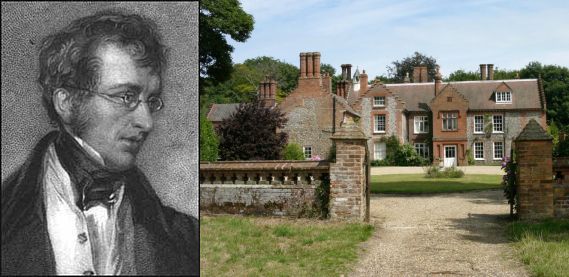
Sir Thomas Fowell BUXTON 1st Bart. [34815]
- Born: 1 Apr 1786, Castle Hedingham ESS
- Marriage (1): Hannah GURNEY [34814] on 13 May 1807 in Meeting House Tasborough NFK
- Died: 19 Feb 1845, Earlham Hall St Clement Earlham NFK aged 58

 General Notes: General Notes:
BUXTON, Thomas Fowell (1786-1845), of Cromer Hall; Northrepps Hall, Norf. and 54 Devonshire Street, Portland Place, Mdx.
Posted 21 Sep 2017 by David M Fox
Family and Education
b. 1 Apr. 1786,1 1st s. of Thomas Fowell Buxton of Earls Colne, Essex and Anna, da. of Osgood Hanbury of Holfield Grange, Essex. educ. Kingston-upon-Thames; Dr. Charles Burney's sch. at Greenwich; Trinity, Dublin 1803; L. Inn 1805. m. 13 May 1807, Hannah, da. of John Gurney of Earlham Hall, Norf., 5s. (2 d.v.p.) 5da. (3 d.v.p.). suc. fa. 1793; cr. bt. 30 July 1840. d. 19 Feb. 1845.
Offices Held
Dir. Alliance Assurance Co. 1829.
Biography
Buxton, who was descended from a long-established Essex family, had great moral and physical courage, was a leading Evangelical and, after William Wilberforce*, played the most prominent part in the anti-slavery movement. A tall man, known to his school-friends as 'Elephant Buxton', he had a 'kind and gentle nature', a calmness and persuasiveness of manner in his private and public endeavours, and beneath it all an unshakeable sense of spiritual mission.2 He became an active partner in the successful family brewing firm of Truman, Hanbury and Company, and although after 1820 he held only a supervisory role, he still sometimes lodged at the premises in Brick Lane, Spitalfields, where he gained a reputation for philanthropy. Strongly influenced by his mother's Quaker relations, his devout Anglican faith led him to take a profound interest in social questions and, like his sister-in-law Elizabeth Fry, he was a noted prison reformer.3 He was related by marriage to the Henning family of Weymouth, and owned a seat at nearby Belfield.4 Introduced on the independent town interest by the radical William Williams*, he was returned with him after a contest at the general election of 1818. Initially claimed as a Tory, he occasionally voted with Lord Liverpool's government in the House and failed to side with opposition on Peterloo.5 Yet in May 1820 his mother was reported to have said that another colleague, Thomas Wallace, the vice-president of the board of trade, 'could not bring him to be a ministerial man'.6 Buxton himself took the stance of an independent, writing in April 1819 that
my line is distinctly drawn. I care little about party politics. I vote as I like; sometimes pro, sometimes con ... I am not a Whig. I am one of those amphibious nondescripts called neutrals: but how can I be any thing else? I cannot reconcile to myself the doctrine of going with a party right or wrong. I feel ... that my objects would prosper much better if I sat behind the treasury bench, but then I must often vote against my convictions; i.e. do wrong, that right may come, and I do not feel this to be my duty even for prisons and criminal law.7
He never joined Brooks's and presumably continued to divide sometimes with ministers, at least in the early 1820s, but his crusading spirit increasingly brought him within the opposition Whig fold.8 He had a limited view of his own abilities, preferring to trust to sheer application and hard work in his field of social reforms, confiding to a friend that
I am, I believe, rather absurd; but I hold a doctrine, to which I owe - not much, indeed, but all the little success I ever had - viz. that with ordinary talents and extraordinary perseverance, all things are attainable.9
Underlining his dogged determination, he once recorded that 'the maxim that I quote in our [anti-slavery] deliberations is that of the navy in the last war, "Always fight".'10 Acknowledging, of Commons debates, that 'the speaking required is of a very peculiar kind: the House loves good sense and joking, and nothing else, and the object of its utter aversion is that species of eloquence which may be called philippian', he brought to his speeches (several of which were separately printed) a detailed array of facts, presented in a clear and lively style.11 Very active in Parliament, where he was a constant committeeman and frequently presented petitions, he intervened on a wide range of issues and often moved for official papers and correspondence, particularly on colonial slavery.
In a letter to his sister Hannah, 29 Feb. 1820, Joseph John Gurney of Earlham Hall commented on Buxton's wish to retire from Parliament at the impending general election:
I am of course much interested about thy dear husband and heartily wish him in again, from a belief that his parliamentary career is of real importance to the cause of humanity and Christianity. At the same time, we are, even the wisest of us, miserable judges and counsellors; and it ought to be our chief, our only, desire that the government may be upon the shoulders of him, who is worthy to reign over us, and who will arrange all things for the ultimate good and those who love and fear him. I rejoice in my confidence that Fowell is one of these and that neither disappointment nor success will be permitted to harm him, if he do but abide in his Saviour.12
Gurney observed, in a letter to Lord Calthorpe, 4 Mar., that ministers' opposition to Buxton at Weymouth indicated that they had 'but little taste for virtuous and independent Members of Parliament; and for those, whose talents and zeal are likely to be effectual to the overturn of old abuses'.13 In the event, he was returned unopposed on his self-proclaimed principles of 'the utmost fidelity and independence'.14 Buxton, who had been ill early that year, lost his eldest son Fowell (28 Mar.) and his daughters Hannah (17 Apr.), Rachel (27 Apr.) and Louisa (1 May) to whooping cough and measles.15 As a result, the family left Hampstead and took up residence at Cromer Hall in Norfolk, from where they moved to Northrepps in the late 1820s. These domestic tragedies also probably explain his inactivity during the 1820 session.16 Alarmed at the probable consequences of the Commons inquiry into Queen Caroline's conduct, he called Wilberforce out of the House, 7 June, and, as he informed his wife the following day
I persuaded him to move for a delay of two days for the purpose of preventing the necessity of such painful and disgraceful disclosures, which motion I seconded in a short, warm, decided and well applauded speech. And the whole House were so much with us that the ministers were obliged to give way. I have been most warmly thanked by both sides. Brougham said, 'You may live 50 years and do good every day, but you will never do as much as you have done this night'. In short the effort succeeded beyond expectation.17
He presumably divided with ministers for Wilberforce's compromise motion, 22 June. He sided with opposition against the barrack bill, 17 July 1820.
Keen to undertake first-hand investigations, Buxton spent the night of 5-6 Dec. 1820 going through 'all the receptacles of vice in the East End'. He spoke for criminal law reform at a meeting in Weymouth, 20 Jan. 1821, and on the 30th urged the rejuvenation of the African Institution, of which he was a member.18 He voted for reinstating Caroline's name in the liturgy, 23, 26 Jan., but, according to Henry Grey Bennet*, divided with ministers in defence of their conduct towards her, 6 Feb.19 He rebutted Matthew Wood's criticisms of Ilchester gaol, 9 Mar., claiming that he 'had never seen any place of confinement under such excellent regulation'. Of this speech, he reported to his wife, 12 Mar., when he again disagreed with Wood in the House, that 'there was nothing writ, but words came very glib, which is comfortable'. He added that
I am working very very hard, sit up generally till one or later when not in the House, and am lost in admiration at the force of my productions, but the case is sadly reversed when I look them over, a few days later.20
Determined that the allegations should be gone into, he seconded Wood's motion for inquiry into Ilchester gaol, 11 Apr. He voted to reduce the army by 10,000 men, 14 Mar., to repeal the additional malt duty, 21 Mar., 3 Apr., to equalize the timber duties, 5 Apr., and to make other military economies, 11 Apr., 4, 11, 14 May. He divided for repeal of the Blasphemous and Seditious Libels Act, 8 May, and parliamentary reform, 9 May. Making what was judged the best speech in the debate, 23 May, he advocated the forgery punishment mitigation bill on moral grounds and demonstrated that a lesser penalty would increase the number of convictions.21 In the House, Sir James Mackintosh described his performance as 'luminous and able', and Wilberforce privately noted 'Buxton's capital speech ... two hours and forty minutes - nobody tired - all information and sense'.22 As he had been on the second reading, 23 May, he was a teller for the majority for the third reading of the bill, 4 June. Although Wilberforce wrote to him, 24 May, asking, as he had long intended to do, that he become his successor as champion of the anti-slavery cause in Parliament, Buxton prevaricated and for the following 18 months gave only limited assistance.23 He divided for inquiry into the conduct of Sir Thomas Maitland† in the Ionian Islands, 7 June. He urged that the bounty given on the capture of slave ships should be divided among all the seamen not just the officers, 13 June. Having busied himself on the matter during the session, he made an impassioned speech against the practice of suttee, 20 June, and secured a select committee on it, to which he was appointed, 29 June 1821.24
Buxton was among those who Hudson Gurney* observed had been 'similarly converted' to voting against government on Sir Robert Wilson's* removal from the army, 13 Feb. 1822.25 He voted for abolition of one of the joint-postmasterships, 13 Mar., when he acknowledged that he had been mistaken in his exoneration of Ilchester gaol the previous year. He praised the India board's repudiation of the dispatch of the directors of the East India Company on Hindu widows, 14 Mar. He promised that brewers would lower their prices once they had reduced the stocks of malt on which they had paid tax, 18 Mar., stated his opposition to the opening of the beer trade, 24 Apr., and, under considerable pressure, sought to vindicate his own position on this matter, 6 May.26 He urged equalization of the sugar duties and the amelioration of slavery, 1 Apr., 17 May. He voted for the remission of Henry Hunt's* prison sentence, 24 Apr., and parliamentary reform, 25 Apr. He was a teller for the majority for considering criminal law reform, 4 June, and moved that this be gone into early in the following session. He divided against the Irish constables bill, 7 June, and for inquiry into the conduct of the lord advocate relative to the press in Scotland, 25 June. He voted in the majority for John Bennet's public houses licensing bill, 27 June, and spoke against Brougham's beer bill, because of the harm it would do to publicans' trade, 7, 10, 18 July.27 He strongly supported Wilberforce's motion to prevent the establishment of slavery at the Cape, 25 July 1822.
From the autumn of 1822 Buxton accepted a much larger commitment to the anti-slavery cause, consulting frequently with Wilberforce, Brougham and others, for example in the so-called 'secret cabinet council' which met to discuss tactics before the following session.28 He may have been the 'J.F. Buxton' who was listed as voting against Hume's amendments on the sinking fund, 3, 13 Mar., but for reducing the grant for the director-general of the medical establishment, 17 Mar. 1823. He objected to the beer duties bill, 21, 24 Mar. He was granted one week's sick leave, 16 Apr. He urged that relief be granted to Spitalfields silk manufacturers, 9 May, and asked for a select committee on this, 12 May. Having put off his anti-slavery motion, he rearranged it, 7 May, and refused to postpone it again, 12 May.29 On the 15th he privately observed that 'I hope to begin at five o'clock. I am in good health, in excellent spirits, with a noble cause and without a fear. If I am only given a nimble tongue, we shall do'. Explaining that he was assuming Wilberforce's mantle at his request, he introduced resolutions in favour of the eventual emancipation of the slaves and made many suggestions (which he had already communicated to ministers) for the gradual amelioration of their condition. His principal concern, on which he several times pressed Canning, the foreign secretary, was to secure a natural diminution in the number of slaves by allowing their new-born children to be made free.30 Wilberforce, who accepted Canning's compromise amendment promising government action if colonial legislatures failed to introduce their own voluntary measures, recorded that 'Buxton's opening speech was not so good as his openings have been before. His reply, however, though short, was, not sweet indeed, but excellent'.31 He wrote an article on 'Captain Manby's Apparatus for Wrecks'.32 He spoke for abolition of the death penalty for larceny, 21 May, 25 June. He acted frequently as a teller, including for the minorities for his attempt to recommit the silk bill, 9 June, and his motion to refer the papers relating to the capture of the ship Requin to a select committee, 2 July. He voted for reform of the Scottish representative system, 2 June, inquiry into the disturbances in Dublin, 24 June, and to refer the Catholic petition against the administration of justice in Ireland to the grand committee for the courts of justice, 26 June. He played a major part in the foundation that year of the Anti-Slavery Society, of which he became a vice-president, and was thereafter a frequent speaker at its public meetings. He accepted Wilberforce's advice not to visit the West Indies that winter, which was prudent given the planters' hostility to him. Lord Clive, Member for Ludlow, wrote to Lord Palmerston*, the secretary at war, 30 Dec. 1823, that he wished 'that a portion of Mr. Buxton's brewery profits were commuted for the losses of the West India proprietors into assets for their relief' from what he termed his 'pseudo-philanthropy'.33
Charles Williams Wynn*, the president of the India board, informed the duke of Buckingham, 31 Jan. 1824, that 'the principal battle will be on Buxton's motion for declaring all persons born after a certain day to be free, which he declares his determination to bring forward'.34 Buxton's resolve was strengthened on 14 Feb., when his delegation were told by Canning that ministers would not act decisively against slavery.35 He voted for information on Catholic burials, 6 Feb., to abolish flogging in the army, 5 Mar., against the Welsh judicature bill, 11 Mar., to refer the reports of the inquiry into the Scottish courts of justice to a committee of the whole House, 30 Mar., and for allowing defence by counsel in cases of felony, 6 Apr.; he enquired how the beer duty would be levied, 6 Apr., and disagreed with the prevailing nostrum that free trade was invariably beneficial, 22 Mar. With much difficulty, he persuaded his friends not merely to receive Canning's disappointing statement on slavery in silence, and himself led the attack against it, 16 Mar., when his speech was described by Wilberforce as 'strong, above concert pitch'.36 Insisting that the colonies had made no improvements, for instance, by banning the cart-whipping of female slaves, and condemning ministers for failing to honour the pledge made by Canning the previous year, he took a characteristically high moral tone. He divided for inquiry into the state of Ireland, 11 May, but sided with ministers for the Irish insurrection bill, 14 June. He supported the case for restoring the level of official salaries, 13 May, 17, 21 June, and voted to consider the evils of naval impressment, 10 June. He introduced a marine insurance bill to end the chartered companies' monopoly on insuring ships, 17 May, argued its case on the second reading, 28 May, and was a teller for majorities in its favour, 28 May, 3, 11, 14 June; it became law on 24 June. He was teller for the minority condemning the trial of the Methodist missionary John Smith in Demerara, 11 June, and again advocated the abolition of slavery, 15 June. He chaired a meeting in London, 16 June 1824, when it was agreed to establish the Society for the Prevention of Cruelty to Animals.37
On Wilberforce's retirement from the Commons at the start of the 1825 session, Buxton was initially given the honour of moving the writ for Bramber, in consequence, as Wilberforce recorded in his diary, 20 Feb., of 'my having devolved on him two years ago my advocateship of negro slaves, when it would have been wrong to have appointed an oppositionist to accept the struggle'. In fact, Brougham felt slighted, and James Stephen† even told Buxton that he was an inappropriate choice, being 'unpopular in the House ... on account of the beer bill, silk bill, etc.' A compromise was therefore reached, whereby the task was left to Canning.38 Buxton moved for leave to introduce the Alliance Assurance Company bill, the London Water Company bill and the Mexico Mining Company bill, 10 Feb., and was active in support of them during the session, though only the first was given royal assent (on 6 July).39 He came to the rescue of the bear-baiting bill (and was a teller for the majority in its favour), 24 Feb., when, as he commented to his wife
I evidently saw that there was so much disposition to sneer at and make game of [Richard] Martin, that the bears and dogs would suffer. Up I got, and when I found myself on my legs I asked myself this cutting question: Have you anything to say? 'Not a syllable,' was the answer from within; but necessity has no law; speak I must, and so I did.40
He apparently divided with ministers for the Irish unlawful societies bill, 25 Feb., although, according to one contemporary source, he 'attended frequently, and usually voted with the opposition' that year.41 He complained about other countries violating anti-slavery treaties, 11 Mar., criticized high sugar prices, 18 Mar., and moved to wreck the West India Company bill because 'its object was to deal in men', 29 Mar.42 The following day he denied an allegation that he was a champion of joint-stock companies. He voted for taking the corn laws into consideration, 28 Apr. He spoke and was a teller for the minority against the third reading of the West India Company bill, 16 May. He voted against the grant for the duke of Cumberland, 30 May, 6 June, when he divided in favour of the St. Olave tithe bill. On 23 June he moved for an address to the king for papers on the expulsion of the Wesleyan missionary Shrewsbury from Barbados and the failure of the colonial legislature to defend his church and property there. Having raised the case, he accepted Canning's support for an amended motion, and afterwards reported privately that
at first the usual fate of the West India questions attended me: a great indisposition to hear anything; but I gradually won their attention and gave my narrative fully. No very lively interest betrayed itself, but they listened like persons who wished to learn ... I am prepared for a poor report in the newspapers, for even the reporters sympathize with the House in detestation of slavery questions ... However, I did my duty, and that is all I care much about. As for popularity and fame, whoever undertakes slavery, and such foolish, methodistical questions, bids farewell to these; and I would rather take such causes in hand, than have all the applause in the world, for questions purely political.43
He duly corrected the false impression of his speech given in the morning papers, 24 June, when he presented the Wallingford reform petition.44 He was satisfied with the debate, but in a letter to Joseph John Gurney, 9 July, he criticized his colleagues and complained that
I have been served in the same way four or five times. In council and after a few glasses of champagne, we are all the bravest of the brave and scorn all cautious counsels, but our courage evaporates as fast as the liquor, and in point of fact we do nothing. For example, you heard the discussion that night [at Buxton's house]. I prepared for battle ... Brougham told me, that he thought it would be exceedingly wrong to have a formal debate and that he had determined to do nothing this session. I begged him to take up Shrewsbury's case. He declared he had no time, but that he would assist to the utmost, if I would. Knowing well that, if I delayed the notice, we should lose that case too, I directly fixed the day. No sooner was this done than a panic seized us. [Zachary] Macaulay had very grave doubts. Wilberforce was employed to write to me, urging strongly that under all the circumstances I should postpone the case. And I left town determined to go on with it my own way and without further consultation. I returned the day before the motion, and was greeted by a letter from Brougham saying it must be put off and that he could not attend. I did not chose to yield to this and I got him down, by the middle of my speech.45
Having signed the requisition, he spoke for the abolition of slavery at the Norfolk county meeting, 20 Oct. 1825.46 William Cobbett† afterwards expressed the radicals' despair at his hypocrisy and short-sightedness, complaining that 'this same Mr. Buxton opposed the bill intended to relieve the poor in England by breaking a little into the brewers' monopoly'.47
Buxton voted in the minority for Hudson Gurney's amendment to omit the Bank of England from the proposed restriction of small notes, 13 Feb. 1826. He divided for a select committee on the importation of foreign silks, 24 Feb. He presented and endorsed the monster London anti-slavery petition, 1 Mar., when he expressed his disappointment at government's failure to act. He praised Denman's motion condemning the Jamaican slave trials that day, and voted in its favour, 2 Mar. He voted to abolish flogging in the army, 10 Mar., reform the representation of Edinburgh, 13 Apr., and revise the corn laws, 18 Apr. He divided for inquiry into the petition of James Silk Buckingham† relative to the liberty of the press in India, 9 May, and was a teller for the minority condemning ministers for having failed to honour Canning's pledge to ensure the amelioration of the condition of the slaves, 19 May. In obtaining a select committee on the slave trade at Mauritius, 9 May, he had what his wife described as a 'capital success', making 'a delightful, clear, powerful speech; [there was] not a movement or a word in the House, but perfect attention to him and a complete victory'.48 He was, however, vehemently opposed by the former governor of the island, Sir Robert Townsend Farquhar, and by ministers. Robert Wilmot Horton* later reported to Lord Bathurst, his superior at the colonial office, that
Buxton is very deeply implicated in this business and so are his party; and I am sure that it is not too much to prophesy that much of the future power and popularity of that party will depend on the issue of this question. He has taken the highest tone that can be taken.49
Buxton chaired the committee's sittings on six occasions and presented its report, 31 May.50 He voted for Russell's resolutions to curb electoral bribery, 26 May. Popular for his conduct in Parliament and his independent stance, Buxton, who rebutted an allegation that he was anti-Catholic and advocated his favourite causes, largely avoided the quarrels that attended the general election at Weymouth in June 1826, when he was returned at the head of the poll.51 He divided in favour of Catholic relief, 6 Mar. 1827. He voted against increased protection for barley, 12 Mar., and for inquiries into the allegations against the corporation of Leicester, 15 Mar., the mutiny at Barrackpoor, 22 Mar., and the Orange procession and Lisburn magistrates, 29 Mar. He attempted to press for the reappointment of the select committee on the Mauritius slave trade, 21 Feb., asked ministers what their intentions were, 21 Mar., 5 Apr., and answered Townsend Farquhar's recriminations, 15 May.52 He devoted so much time and effort to the two issues of suttee and Mauritius, for which he had given notice of (several times postponed) motions for 24 and 26 May respectively, that he worked himself into a state of nervous tension in which he could neither rest nor work on his elaborate materials. He finally suffered a severe apoplectic fit on the 20th, and was mortified to discover, on regaining consciousness, that he had missed the debates, which were allowed to lapse.53 He spent the following months of recuperation in deepening his religious faith and constructing a vast and complicated filing system for his slavery papers. That autumn he secured an interview with Lord William Cavendish Bentinck*, on his appointment as governor-general of Bengal, and was delighted to discover that he was determined to suppress suttee.54
Buxton urged Brougham to continue the anti-slavery struggle, 3 Oct. 1827, arguing that
we are then arrived at the point at which contumacy is proved, and at which we have a right to call upon government to redeem Canning's pledge. Such an inquiry as is now proposed may be dragged on for any period which may suit the convenience of the West Indians, and thus the pledge of compulsion in case of contumacy may be virtually evaded.
However, he admitted to him, 12 Feb. 1828, that 'I cannot get well. My power of assisting you, little at all times, is less now'.55 He voted for repeal of the Test Acts, 16 Feb. He had no intention to speak, being unwell and unprepared, but finding only one other anti-slavery colleague in the House, he was forced to put his friends' case on the Berbice papers, 6 Mar., when his family trembled for the effect on his health. He had an interview with Huskisson, the colonial secretary, 20 Mar., but failed to persuade him to take over the Mauritius inquiry, which he no longer had the strength to handle.56 He divided against throwing East Retford into the hundred of Bassetlaw, 21 Mar. He voted for Catholic relief, 12 May. He urged the case for ending slavery, 9 June, 12, 25 July, and divided against the grant for North American fortifications, 7 July. He succeeded in moving for an address to the king to guarantee the free status of the Hottentots in South Africa, 15 July 1828, having shrewdly noted that 'government will probably give way to my motion, on condition that I abstain from speaking. Terms not to be rejected, I think'.57
He was listed by Planta, the Wellington ministry's patronage secretary, as 'doubtful' on Catholic emancipation, but had overcome his hesitations by 5 Mar. 1829, when he informed a friend that 'I really must vote, the peace and safety of Ireland depend on our vote'. To this he added that he was 'full of business, but not overwhelmed; this is just as I like'.58 He duly voted for emancipation, 6, 30 Mar. He presented a Spitalfields silk weavers' petition for relief, 13 Apr., and the following day pressed the case for a select committee on the distress in the silk trade. He voted for allowing Daniel O'Connell to take his seat without swearing the oath of supremacy, 18 May. In reply to Townsend Farquhar, 25 May, 3 June, he apologized that he had been unable to pursue his motion about Mauritius because of ill health and other practical considerations; by the beginning of the following year ministers had acquiesced in his demand for the extirpation of the slave trade there.59 He divided for Lord Blandford's parliamentary reform motion and against issuing the writ for East Retford, 2 June. He presented petitions against suttee, 3 June, and explained that he had not brought forward any resolution on the subject because of his confidence in the plans of the governor-general, 5 June 1829, when he also moved for an address of thanks for the decision to free the Hottentots.
Buxton divided with several other Whigs against Knatchbull's amendment to the address on distress, 4 Feb., and with ministers against Blandford's reform scheme, 18 Feb. 1830. He voted for various economies, 19, 22 Feb., 29 Mar., 7 June. He gave evidence to the select committee on the beer trade, 10 Mar., arguing that there should be no government interference with the existing monopolies or complete free trade, and that 'we are only afraid of half measures'; he repeated this argument in the House, 11 Mar.60 He paired for transferring East Retford's seats to Birmingham, 5 Mar., and voted against the disfranchisement bill, 15 Mar. On 19 Mar. he wrote to Joseph John Gurney that he was 'far from being dissatisfied with the beer revolution', stating, 'I do not know how to be so; I have always voted for free trade, when the interests of others were concerned, and it would be awkward to change when my own are in jeopardy'. He added that 'I am now attending ... a debate on the distress of the nation, meaning to vote against the conspiracy of high Tories and radical Whigs, and in favour of government'.61 He presumably voted with ministers against inquiry into the state of the nation at the conclusion of the debate, 23 Mar. He again defended the position of the brewers on the beer bill, 8 Apr., 4, 21 May, when, according to John Cam Hobhouse*, he and Charles Barclay 'voted against ministers and against their conscience, as I know'.62 On 3 June he denied that they wanted compensation and only suggested that there be a prohibition on the sale of beer for on-consumption; he duly voted, 21 June, and paired, 1 July, for amendments to this effect. He voted for Jewish emancipation, 5 Apr., 17 May. He divided for abolition of the Irish lord lieutenancy, 11 May. He expressed gratitude for ministers' vindication of his conduct on Mauritius, 13 May, and congratulated them on the suppression of suttee, 4 June. He praised the legal reforms of Peel, the home secretary, 1 Apr., but strongly urged abolition of the death penalty for forgery, 8 Apr., 4, 12, 13, 24 May (when he voted for this), 7 June (when he acted as a teller in its favour), and 20 July (when he divided against Lords' amendments to the forgery punishment bill). He brought a new impetus to his favourite campaign, 15 May, when he urged a meeting of the Anti-Slavery Society at the Freemasons' Tavern to pursue the cause with unrelenting vigour, though, like Brougham, he was initially disconcerted by the prevailing mood in favour of immediate, not gradual, emancipation.63 In the House, 20 July 1830, he presented the anti-slavery petition of the graduates and undergraduates of Oxford, explained that domestic circumstances had caused him to miss the debate on Brougham's motion a week earlier and reiterated his desire to press forward or to abandon the attempt altogether. Anxious, as were the trustees of the Johnstone family interest, to avoid a contest at Weymouth, he came to a compromise with them and was duly returned unopposed at the general election that summer. In proposing him, Williams declared that Buxton 'voted as often for the ministry as for the opposition, and therefore, in every sense of the word, he was an independent Member'.64
Buxton was prevented from attending Parliament, despite having over a hundred anti-slavery petitions to present, by the illness of his son John Henry (Harry), who died on 18 Nov. 1830.65 Listed by ministers among their 'foes', he was for this reason absent from the division on the civil list, 15 Nov., that led to their resignation. He felt impelled to speak against the petition of the West India planters and merchants, 13 Dec. 1830, insisting that abolition take place, but not ruling out some form of compensation. It was only with difficulty that Lord Althorp, the chancellor of the exchequer in the Grey ministry, persuaded Buxton to defer his intended motion on slavery from 1 Mar. 1831, when it would have clashed with Russell's reform statement. Under considerable pressure from various sources, Buxton several times postponed the motion, which was said to have created alarm in the City. Thomas Gladstone, Member for Queenborough, who was monitoring the situation on behalf of his father John Gladstone*, a West India merchant, found him 'extremely civil and communicative; he promises to inform me as soon as he knows himself whether it will positively come on'.66 Buxton presented a Weymouth reform petition, 21 Mar., when he spoke against the town's anti-reform petition, and he voted for the second reading of the reform bill, 22 Mar., and against Gascoyne's wrecking amendment, 19 Apr. He brought up several hundred anti-slavery petitions, 29 Mar., and finally moved for the complete extinction of slavery, 15 Apr., when he declared that
my case is this: that the whole slave population is in misery, that the negroes are physically and morally wretched, that slavery, as it exists in our time, is a system baneful to man, his happiness, welfare and moral advancement, and that slavery ought, therefore, to be abolished as soon as it can be done with safety.
He was careful not to express overt hostility to the West India interest and avoided emotive language, and his speech, although as usual replete with factual information, reduced the argument to one dispassionate statistical index. Working on the premise that population increase was the clearest indicator of prosperity, he showed that the slave populations of the colonies were in severe decline in comparison with those of the free inhabitants of the Caribbean. Thomas Gladstone reported to his father the following day that
I really was agreeably surprised at the moderation of Buxton's tone. His resolution however is very inconsistent with his speech, although even that was for him moderate or rather I should say candid, and I suppose with a view to gaining over the less violent.67
Buxton certainly received support in the debate that followed, after which O'Connell came up to him to say, 'Mr. Buxton, I see land'; but the question was lost at the dissolution.68 He moved for the abolition of slavery at the Society's meeting on 23 Apr. 1831.69
Joseph John Gurney offered to pay Buxton's expenses at Weymouth during the subsequent general election, on the ground that 'thy return to Parliament was never more important than it is now that thou hast, so satisfactorily to everybody, taken the lead in the slavery question'.70 In fact he was returned after a merely token contest, during which he stressed his credentials as a supporter of the reform bill, economies and the abolition of slavery.71 He voted for the reformers Edward Portman II* and John Calcraft* in the Dorset contest.72 On 4 June he entertained Grey and Brougham to a high-spirited 'cabinet dinner' at his firm's brewery.73 He apparently had no wish to take a prominent part on reform, and he divided silently for the second reading of the reintroduced bill, 6 July, and steadily for its details, although he voted against the division of counties, 11 Aug. He voted with ministers for prosecution of those guilty of bribery at the Dublin election, but to condemn the undue influence of the Irish government, 23 Aug. He spoke for the continuance of the Sugar Refinery Act for another year, 12 Sept. He voted for the passage of the reform bill, 21 Sept., but was not listed in the majority for Lord Ebrington's confidence motion, 10 Oct. He voted for the reformer William Ponsonby* in the Dorset by-election that autumn.74 He recorded in his diary, 26 Oct., that 'storms seem gathering in every direction, and the tempest may soon break upon my own house', but added that 'it has pleased God to place some duties upon me with regard to the poor slaves, and those duties I must not abandon'.75 He divided for the second reading of the revised reform bill, 17 Dec. 1831, the partial disfranchisement of 30 boroughs in schedule B, 23 Jan., the total disfranchisement of Appleby, 21 Feb., and the enfranchisement of Tower Hamlets, 21 Feb. 1832. He voted against the production of information on Portugal, 9 Feb., and for the navy civil departments bill, 6 Apr. He divided for the third reading of the reform bill, 22 Mar., and Ebrington's motion for an address calling on the king to appoint only ministers who would carry it unimpaired, 10 May. He paired against increasing the county representation of Scotland, 1 June. He advocated mitigation of the punishment for forgery, 30 May, and his only other known votes that year were with ministers for the Russian-Dutch loan, 26 Jan., 12, 16 July 1832.
As in previous sessions, Buxton's principal preoccupation was with slavery. He spoke against an increase in the sugar duties as likely to add to the burdens on slaves, 7 Mar., and intervened against this in an acrimonious debate, 23 Mar. 1832. He continued to press his case in private, among his indecisive anti-slavery colleagues, in the newspapers and in the Lords, where he gave evidence to a select committee.76 Yet he was, as his daughter Priscilla described, 'cruelly beset' by ministers, who, with the exception of the prime minister's heir Lord Howick*, wished to keep the question at arm's length.77 On the morning of the debate, 24 May, Priscilla recorded:
My father and I went out on horseback directly after breakfast, and a memorable ride we had. He began by saying that he had stood so far, but that divide he could not. He said I could not conceive the pain of it, that almost numberless ties and interests were concerned, that his friends would be driven to vote against him, and thus their seats would be endangered. But then his mind turned to the sufferings of the missionaries and of the slaves, and he said after all he must weigh the real amount of suffering, and not think only of that which came under his sight; and that if he were in the West Indies, he should feel that the advocate in England ought to go straight on and despise those considerations. In short, by degrees, his mind was made up. When we got near the House every minute we met somebody or other, who just hastily rode up to us. 'Come on tonight?' 'Yes'. 'Positively?' 'Positively'; and with a blank countenance, the inquirer turned his horse's head and rode away. I do not know how many times this occurred.78
In a note to Althorp that day, just before a fruitless meeting with him, Buxton expressed the deep sense of duty which compelled him to persevere, concluding that 'therefore I am necessitated to say candidly that I cannot either postpone it or substitute for it anything short of abolition. To say I do most reluctantly anything that can possibly inconvenience the present ministry, is needless and useless'.79 Although initially sidetracked by having to justify his contention that slaves were deprived of the right of freedom of worship, he duly moved for a select committee to investigate the abolition of slavery 'at the earliest period compatible with the safety of all classes in the colonies'. His daughter, who witnessed the debate from the ventilator, noted that he 'spoke very well indeed, and they listened to him far better than last year; in short, the subject obviously carried much greater weight with it, and the effect of the speech last year on population was manifest'. Althorp moved an amendment to add, in words suggested by Grey, that consideration by the committee should be in accordance with the resolutions passed in 1823, but Buxton declined to accept this compromise, stating that he would divide the House even 'if I stand alone'.80 Priscilla's narrative continued:
Then came the trial: they (privately) besought my father to give way, and not to press them to a division. 'They hated,' they said, 'dividing against him when their hearts were all for him; it was merely a nominal difference, why should he split hairs? He was sure to be beaten, where was the use of bringing them all into difficulty, and making them vote against him?' He told us that he thought he had a hundred applications of this kind in the course of the evening; in short nearly every friend he had in the House came to him, and by all considerations of reason and friendship, besought him to give way ... I watched my father with indescribable anxiety, seeing the Members, one after the other, come and sit down beside him, and judging but too well from their gestures, what their errand was ... What a trial it was. He said afterwards, that he could compare it to nothing but a continual tooth-drawing, the whole evening. At length he rose to reply, and very touchingly alluded to the effort he had to make, but said, he was bound in conscience to do it and that he would divide the House.81
He was teller for the minority of 90 (to 136) in favour of his motion, and on 30 May (under the amended motion) was named to the committee, which sat inconclusively for the remainder of the session. As his wife reported to her other daughter, Richenda, later in May 1832:
There was a total change in the tone of the House ... Fowell was attentively listened to ... His arguments sunk deep, were unanswerable and will produce real consequence so that he thinks and feels that emancipation is set on foot and must proceed. He says he no longer cares if he is thrown out of Parliament.82
Indeed, although Buxton was cut by many of his friends after the debate, he was correct to comment later that 'the cause made a seven league stride' that night. Althorp soon afterwards remarked privately to Tom Macaulay* that
that division of Buxton's has settled the slavery question. If he can get 90 to vote with him when he is wrong, and when most of those really interested in the subject vote against him, he can command a majority when he is right. The question is settled: government see it, and they will take it up.83
Not without further prompting, emancipation legislation was introduced the following year. By this, the enslaved were turned into 'apprentices' from 1 Aug. 1834, only finally becoming free four years later.
Buxton himself attributed his success not to any wisdom or resolution of his own, but to his faith. As he wrote to Priscilla:
If ever there was a subject which occupied our prayers, it was this. Do you remember how we desired that God would give me His Spirit in that emergency, that He would rise up as the champion of the oppressed? How we quoted the promise, 'He that lacketh wisdom, let him ask it of the Lord, and it shall be given him'? And how I kept open that passage in the Old Testament, in which it is said ... 'We have no might against this great company that cometh against us: neither know we what to do, but our eyes are upon thee', the Spirit of the Lord replying, 'Be not afraid nor dismayed by reason of this great multitude, for the battle is not yours, but God's'. If you want to see the passage, open my Bible, it will turn of itself to the place. I sincerely believe that prayer was the cause of that division.84
However his future son-in-law Andrew Johnston*, who was one of the members of the little prayer group that met daily at Parliament and for which Buxton acted as chaplain, emphasized his dedication:
I was soon strongly impressed by seeing his almost exclusive devotedness to the object he had in hand at any given time; he spared no pains to achieve his purpose, he was constantly on the watch, and by his tact and perseverance frequently succeeded in obtaining documents, which would otherwise have remained in obscurity. Often did he wait to the end of the usually long debates for the small chance of success in a motion for papers; often did one tiresome opponent, in particular, who seemed to make it his peculiar vocation to hinder his progress, succeed in frustrating his endeavours, after he had remained until 2 or 3 o'clock in the morning. Then did Mr. Buxton, night after night, postpone the motion till a favourable opportunity should arrive, and in our refreshing walks home, in the early cool morning, after the heat, glare and fatigue of the House, he betrayed no impatience, but showed himself content to labour on, accepting with thankfulness every little success which he was permitted to enjoy, in his harassing but most necessary portion of his duty. He was very often at the foreign office, and at the colonial office he was, during the sitting of Parliament, almost a daily visitor. Though his proceedings called forth bitter opposition from some quarters, and though the government generally resisted his proposals, at least for a time, I soon saw that his honesty and singleness of purpose, his manly understanding, and the weight of his character, commanded a decided and increasing influence in Downing Street. He was thoroughly liked and respected in the House, and yet his urbanity and kind feeling, even towards his bitterest opponents, ought to have disarmed them more than it seemed to do. His firmness was sometimes exposed to severe trials.85
He did have his detractors, especially among radicals such as Bronterre O'Brien, who condemned him for being indifferent to the sufferings of the labouring classes, as 'one of those erratic philanthropists for whom emancipation has no charms, unless the slave happens to live some thousand miles off, with the additional recommendation of a black hide'.86 His leadership made him the butt of jokes, but they merely emphasized his pre-eminence. In one debate O'Connell broke into a mock lament: 'Oh! I wish we were blacks! If the Irish people were but black, we should have the honourable Member for Weymouth coming down as large as life, supported by all "the friends of humanity" in the back rows, to advocate their cause'.87 Buxton declined requisitions from several constituencies at the general election of 1832, when, despite a quarrel with the young patron of Weymouth, Sir George Frederic Johnstone, who came in for the other remaining seat, he was elected as a Liberal after a contest.88 He retired from Parliament on being defeated five years later, and although his later philanthropic ventures in Africa collapsed in failure, his career was held up as a model of religious and philanthropic excellence.89 He died in February 1845, his estates and baronetcy being inherited by his eldest surviving son Edward North (1812-58), Liberal Member for Essex South, 1847-52, and Norfolk East, 1857-8.90 His youngest son Charles (1822-71), the author of his Memoirs (1848), was Liberal Member for Newport, Isle of Wight, 1857-9, Maidstone, 1865-9, and Surrey East, 1865-71.
Ref Volumes: 1820-1832Author: Stephen FarrellNotes
Based on C. Buxton, Mems. of Sir T.F. Buxton, of which R.H. Mottram, Buxton the Liberator is merely a redaction. For a short life, see O. Barclay, Buxton and Liberation of Slaves (2001).
1. Not 7 Apr. 1786, as given in HP Commons, 1790-1820, iii. 352.
2. C.L. Buxton, Buxtons of Coggeshall, 108-9; Buxton Mems. 33-34, 169-71, 401-14.
3. Buxton Mems. 2-13, 34-35, 39-41, 43-56, 59-65, 72-75, 99.
4. G.D. Squibb, Belfield and Buxtons, 6.
5. Buxton Mems. 65, 81-83; HP Commons, 1790-1820, iii. 352-3.
6. Northumb. RO, Middleton mss ZMI/S76/40/19, 20.
7. Buxton Mems. 90-91.
8. Some of the pro-ministerial votes of John Jacob Buxton, Member for Great Bedwyn, should perhaps be attributed to him.
9. Buxton Mems. 82.
10. Ibid. 154-5.
11. Ibid. 86-87, 89.
12. Mems. of J.J. Gurney ed. J.B. Braithwaite, i. 182.
13. Hants RO, Calthorpe mss 26M62/F/C 219.
14. Western Flying Post, 6, 13 Mar. 1820.
15. Bodl. (Rhodes House), Buxton mss, ms. Emp. s. 444, vol. 4, f. 31; Buxton Mems. 93-99.
16. Buxton Mems. 99, 200-1.
17. Buxton mss, ms. Emp. s. 444, vol. 1, p. 247.
18. Buxton Mems. 101, 104-5; Salisbury Jnl. 29 Jan. 1821.
19. HLRO, Hist. Coll. 379, Grey Bennet diary, 15.
20. The Times, 13 Mar. 1821; Buxton mss, ms. Emp. s. 444, vol. 1, pp. 287, 291, 311.
21. Dorset RO, Bankes mss D/BKL, Bankes jnl. 128; Add. 51659, Whishaw to Lady Holland, 30 May 1821.
22. Life of Wilberforce, v. 100.
23. Ibid. v. 122-3; Buxton Mems. 117-23; R. Coupland, Wilberforce, 390-2.
24. The Times, 14, 30 June 1821.
25. Gurney diary.
26. The Times, 25 Apr. 1822.
27. Ibid. 8, 11 July 1822.
28. Buxton Mems. 124-8; Life of Wilberforce, v. 129, 158; C. New, Brougham, 296-7; E.M. Howse, Saints in Politics, 152-3.
29. The Times, 8, 13 May 1823.
30. Buxton Mems. 128-33.
31. Wilberforce Priv. Pprs. 208-9.
32. Edinburgh Rev. xxxviii (1823), 332-49; Life of Wilberforce, v. 199.
33. Southampton Univ. Lib. Broadlands mss.
34. Buckingham, Mems. Geo. IV, ii. 40.
35. Buxton Mems. 141-4.
36. Ibid. 144-50; Life of Wilberforce, v. 216.
37. The Times, 17 June 1824.
38. Bodl. ms. Wilberforce. d. 55; Life of Wilberforce, v. 238-9; Buxton Mems. 151-2.
39. The Times, 11, 15, 16 Feb., 12, 16 Mar. 1825; CJ, lxxx. 21-22, 37, 44, 101, 139, 190.
40. Buxton Mems. 176.
41. Session of Parl. 1825, p. 454.
42. The Times, 12 Mar. 1825.
43. Buxton Mems. 157.
44. The Times, 25 June 1825.
45. Buxton mss, ms. Emp. s. 444, vol. 2, p. 111.
46. Norf. Chron. 8, 22 Oct. 1825.
47. Cobbett's Rural Rides ed. G.D.H. and M. Cole, ii. 305, 330.
48. Buxton mss, ms. Emp. s. 444, vol. 2, p. 239.
49. HMC Bathurst, 607-12.
50. PP (1826-7), vi. 289-375.
51. Western Flying Post, 3 Apr.; Dorset Co. Chron. 15 June, 6 July 1826; Buxton Mems. 186-9.
52. The Times, 22 Mar., 6 Apr. 1827.
53. Buxton Mems. 189-94.
54. Ibid. 195-7, 199-200, 399-400; P. M. Pugh, Cal. of Pprs. of Sir T.F. Buxton (List and Index Soc. special ser. vol. xiii), pp. ii-iii.
55. Brougham mss.
56. Buxton Mems. 201-6; Buxton mss, ms. Emp. s. 444, vol. 2, p. 11.
57. Buxton Mems. 208-12.
58. Ibid. 220.
59. Ibid. 222-9.
60. PP (1830), x. 18-26.
61. Buxton Mems. 234-5.
62. Add. 56554, f. 102.
63. Buxton Mems. 242-9; The Times, 17 May 1830; R. Blackburn, Overthrow of Colonial Slavery, 436, 438.
64. Dorset Co. Chron. 22 July, 5 Aug. 1830.
65. Buxton Mems. 237-41.
66. St. Deiniol's Lib. Glynne-Gladstone mss 197, T. to J. Gladstone, 7 Feb., 22 Mar.; 244, Grant to same, 29 Mar. 1831.
67. Ibid. 198.
68. Buxton Mems. 261.
69. The Times, 25 Apr. 1831.
70. Mems. of J.J. Gurney, i. 475.
71. Dorset Co. Chron. 28 Apr., 5 May 1831.
72. Dorset Pollbook (1831), 34.
73. Buxton Mems. 264-8; Greville Mems. ii. 150.
74. Dorset Pollbook (Sept.-Oct. 1831), 55.
75. Blackburn, 451.
76. Buxton Mems. 278, 280-2; The Times, 28 Mar., 14 May 1832.
77. Buxton Mems. 282-90; Grey mss GRE/B126/4A, Howick to Althorp, 23 May 1832.
78. Buxton Mems. 289.
79. Buxton mss, ms. Emp. s. 444, vol. 3, p. 29; D. Turley, Culture of English Anti-Slavery, 71-72.
80. Grey mss B126/4A, Althorp to Howick [?24 May 1832].
81. Buxton Mems. 290-1.
82. Buxton mss, ms. Emp. s. 444, vol. 2, p. 251.
83. Buxton Mems. 292, 296.
84. Ibid. 296-7.
85. Ibid. 384-6.
86. Poor Man's Guardian, 17 Nov. 1832.
87. Buxton Mems. 386.
88. Ibid. 300; Dorset Co. Chron. 13 Dec.; The Times, 15 Dec. 1832.
89. Buxton Mems. 165-9, 592-8; T. Binney, Sir T.F. Buxton, Bart., A Study for Young Men (1853); DNB; Oxford DNB.
90. The Times, 22 Feb., 28 Mar. 1845; Gent. Mag. (1845), i. 543-6.
of 154
Thomas Fowell Buxton - a British philanthropist and mission theorist
Posted 21 Sep 2017 by David M Fox
Thomas Fowell Buxton was a British philanthropist and mission theorist. He was born in Castle Hedinghan, Essex, England, and educated at Trinity College, Dublin. The Anglican and Quaker traditions within his family both affected him, and following an evangelical conversion in 1813 he was much influenced by Josiah Pratt of the Church Missionary Society. From 1818 to 1837 he served as a member of Parliament, nominally as a Whig, in practice as an independent. He specialized in penal and prison reform, working to reduce the incidence of capital punishment, until in 1821 William Wilberforce asked him to take over leadership of the parliamentary campaign of slavery. Thereafter his immediate concern was for the emancipation of all slaves in the British dominions, eventually achieved by legislation in 1833. He was created baronet in 1840.
Buxton's concerns extended over the whole field of "aborigine's rights"-that is, colonial issues and the effect of white settlement on indigenous peoples. He was president of the Aborigines Protection Society, set up for "protecting the defenseless and promoting the advancement of uncivilized tribes": and he chaired and largely drafted the report of a parliamentary committee that highlighted colonial abuses and the unjust seizure of land and demoralization inflicted by British settlers. Witnesses called by the committee included the secretaries of the Church, London and Wesleyan Methodist Missionary Societies. Buxton also supported John Philip in his stand against settler interests in South Africa over the status of the Cape Xhoi and the Xhosa frontier War of 1835.
After emancipation Buxton's main preoccupation became the continuing resilience of the Atlantic slave trade and its desolation and depopulation of Africa. After losing his parliamentary seat, he concentrated on research, issuing a book The African Slave Trade and Its Remedy. This argued that Britain and other "Christian" nations were responsible for the systematic pillage of Africa by the slave trade, producing dependence and barbarism for Africa; that Africa's redemption lay in calling forth its own potentially rich resources, both natural and human (the latter exemplified in the Christian communities in the Caribbean and Sierra Leone); and that Africa's development as an equal trading partner could stifle the slave trade at its source. The interests of genuine commerce, he argued, thus intersected with those of Christianity and the human development usually called "civilization"; in his view, each made conditions favorable for the other. In 1841 Buxton persuaded the British government to underwrite an expedition up the Niger as a pilot project. J. F. Schön and Samuel Adjai Crowther participated on behalf of the missions. The project failed disastrously, with the loss of forty lives, and Buxton died distressed and discredited. His principles, however, deeply influenced British mission thinking. Henry Venn's ideas of indigenous leadership and evangelization by native agency, and his skillful use of cotton production as an adjunct to the Yoruba mission, owe much to Buxton. The Scottish Calabar mission (1846) arose directly from the impact on churches in the Caribbean of Buxton's books, and the whole career of David Livingstone exemplified Buxton's vision and convictions.
From the same family came Barclay Buxton and Alfred Buxton and other distinguished missionaries, as well as several representatives of his humanitarian concerns in public life.
Andrew F. Walls
Bibliography:
T. F. Buxton, The African Slave Trade and Its Remedy (1839, 1840, repr. 1967) and Report of the Parliamentary Committee on Aboriginal Tribes (repr. with additions by the Aboriginal Protection Society, 1837). Charles Buxton, Memoirs of Sir Thomas Fowell Buxton (1848); Seymour Drescher, Econocide: British Slavery and the Slave Trade in the Era of Abolition (1977); A. F. Walls, "Thomas Fowell Buxton," in Gerald H. Anderson et al., eds., Mission Legacies (1994), pp. 11-18.
Helped found Anti-Slavery Society
Posted 21 Sep 2017 by David M Fox
Early life
In 1808, Buxton's Hanbury family connections led to an appointment to work at the brewery of Truman, Hanbury & Company, in Brick Lane, Spitalfields, London. In 1811, he was appointed a partner in the business, now renamed Truman, Hanbury, Buxton & Co; he later became sole owner of the company.
Although he was a member of the Church of England, Buxton attended Friends meetings with the Gurneys and became involved in the social reform movement being led by Friends. He helped raise money for the weavers of London who were forced into poverty by the factory system. He provided financial support for Elizabeth Fry's prison reform work and became a member of her Association for the Improvement of the Female Prisoners in Newgate.
Buxton was elected as a Member of Parliament for Weymouth and Melcombe Regis in 1818. As an MP he worked for changes in prison conditions and criminal law and for the abolition of slavery. He also opposed capital punishment and pushed for its abolition. Although he never accomplished this last goal during his lifetime, he did help to reduce the number of crimes punishable by death from more than two hundred to eight.
Thomas and Hannah Buxton had eight children. Four of them died of whooping cough during a five-week period around April 1820. Another one died of consumption some time later.
Abolitionism
The slave trade had been abolished in 1807, but Buxton began to work for the abolishment of slavery itself. He helped found the Society for the Mitigation and Gradual Abolition of Slavery (later the Anti-Slavery Society) in 1823. He took over as leader of the abolition movement in the British House of Commons after William Wilberforce retired in 1825. His efforts paid off in 1833 when slavery was officially abolished in the British Empire. Buxton held his seat in Parliament until 1837.
In 1839 Buxton urged the British government to make treaties with African leaders to abolish the slave trade. They sent a team (not including Buxton) to the Niger River Delta in 1841 that set up a headquarters and began negotiations. The party suffered so many deaths from disease that the government called them back.
David Livingstone was strongly influenced by Buxton's arguments that the African slave trade might be destroyed through the influence of "legitimate trade" and the spread of Christianity, which helped inspire him to become a missionary in Africa and to fight the slave trade all his life.
In 1840 Buxton was created a baronet. His health failed gradually, which some believed was caused by the disappointment over the failed mission to Africa. He died a few years later. There is a monument to him in Westminster Abbey, and a memorial to the emancipation of slaves and dedicated to Buxton in Victoria Tower Gardens (commissioned by his son Charles Buxton MP, the Buxton Memorial Fountain, designed by Samuel Sanders Teulon, was initially erected in Parliament Square, but was removed in 1940 and moved to its current location in 1957). Fowell Close in Earlham, Norwich, is named after him.
Recent memorials
A representation of Buxton can be also seen on the current English five pound note. He is the figure wearing glasses in the group on the left-hand side of Elizabeth Fry
In February 2007 a plaque was attached in his memory to the Norwich Friends Meeting House in Upper Goat Lane.
Buxton Road, part of the main route between Weymouth and the Isle of Portland is named after Sir Thomas Buxton, where he was Member of Parliament for 19 years. The road runs past Bellfield Park, his former home in Wyke Regis.
Writings
An Enquiry, Whether Crime and Misery are produced or prevented by our present system of Prison Discipline (1818)
The African Slave Trade and Its Remedy (London: J. Murray, 1839)
of 1
Hannah Gurney and Thomas Fowell Buxton
Posted 24 Sep 2017 by David M Fox
Hannah Gurney, Lady and Thomas Fowell Buxton, Baronet
- David Fox 2017
Hannah Gurney was born on 15 Sep 1783 at Brammerton, Norfolk, England, the daughter of John Gurney Esq Banker of Norwich (1749\endash 1809) and Catherine Barclay Bell (1754\endash 1792)
Marriage
Hannah Gurney was married on 13 May 1807 at Tasborough, Norfolk, England to Thomas Fowell Buxton
Thomas Fowell Buxton was born on 1 Apr 1786 at Castle Hedingham, Earls Colne, Essex. England
Hannah Gurney, at the age of 28, was baptised on 31 Jul 1812 at St Mary, Spital Square or at Wheeler Chapel, Spitalfields, London, England
Thomas Fowell Buxton was a British philanthropist. He was educated at Trinity College, Dublin. Following an evangelical conversion in 1813 he was much influenced by Josiah Pratt of the Church Missionary Society.
From 1818 to 1837 he served as a member of Parliament, nominally as a Whig, in practice as an independent.
He specialized in penal and prison reform, working to reduce the incidence of capital punishment, until in 1821 William Wilberforce asked him to take over leadership of the parliamentary campaign of slavery. Thereafter his immediate concern was for the emancipation of all slaves in the British dominions, eventually achieved by legislation in 1833.
He was created baronet in 1840.
Buxton's concerns extended over the whole field of "aborigine's rights"-that is, colonial issues and the effect of white settlement on indigenous peoples. He was president of the Aborigines Protection Society, set up for "protecting the defenseless and promoting the advancement of uncivilized tribes", and he chaired and largely drafted the report of a parliamentary committee that highlighted colonial abuses and the unjust seizure of land and demoralization inflicted by British settlers. Witnesses called by the committee included the secretaries of the Church, London and Wesleyan Methodist Missionary Societies. Buxton also supported John Philip in his stand against settler interests in South Africa over the status of the Cape Xhoi and the Xhosa frontier War of 1835.
After emancipation Buxton's main preoccupation became the continuing resilience of the Atlantic slave trade and its desolation and depopulation of Africa. After losing his parliamentary seat, he concentrated on research, issuing a book The African Slave Trade and Its Remedy. This argued that Britain and other "Christian" nations were responsible for the systematic pillage of Africa by the slave trade, producing dependence and barbarism for Africa; that Africa's redemption lay in calling forth its own potentially rich resources, both natural and human (the latter exemplified in the Christian communities in the Caribbean and Sierra Leone); and that Africa's development as an equal trading partner could stifle the slave trade at its source. The interests of genuine commerce, he argued, thus intersected with those of Christianity and the human development usually called "civilization"; in his view, each made conditions favorable for the other. In 1841 Buxton persuaded the British government to underwrite an expedition up the Niger as a pilot project. J. F. Schön and Samuel Adjai Crowther participated on behalf of the missions. The project failed disastrously, with the loss of forty lives, and Buxton died distressed and discredited. His principles, however, deeply influenced British mission thinking. Henry Venn's ideas of indigenous leadership and evangelization by native agency, and his skillful use of cotton production as an adjunct to the Yoruba mission, owe much to Buxton. The Scottish Calabar mission (1846) arose directly from the impact on churches in the Caribbean of Buxton's books, and the whole career of David Livingstone exemplified Buxton's vision and convictions.
References:
[1] T. F. Buxton, The African Slave Trade and Its Remedy (1839, 1840, repr. 1967) and Report of the Parliamentary Committee on Aboriginal Tribes (repr. with additions by the Aboriginal Protection Society, 1837).
[2] Charles Buxton, Memoirs of Sir Thomas Fowell Buxton (1848);
[3] Seymour Drescher, Econocide: British Slavery and the Slave Trade in the Era of Abolition (1977);
[4] A. F. Walls, "Thomas Fowell Buxton," in Gerald H. Anderson et al., eds., Mission Legacies (1994), pp. 11-18.
Death
Thomas Fowell Buxton died on 19 Feb 1845 at Earlham Hall, Saint Clement, Earlham, Norfolk, England reg Erpingham.
Hannah Buxton, nee Gurney, died in 1872
Wiki Bio
Posted 01 May 2018 by David M Fox
Sir Thomas Fowell Buxton, 1st Baronet (7 April 1786 \endash 19 February 1845) was an English Member of Parliament, brewer, abolitionist and social reformer.[1]
Buxton was born at Castle Hedingham, Essex. His father was also named Thomas Fowell Buxton. His mother's maiden name was Anna Hanbury. Through the influence of his mother, who was a Quaker, Buxton became a close friend of Joseph John Gurney and his sister Elizabeth Fry, who were both prominent Quakers. Buxton married their sister Hannah Gurney, of Earlham Hall, Norwich in May 1807. He lived at Northrepps Hall in Norfolk.[2]
Early life
In 1808, Buxton's Hanbury family connections led to an appointment to work at the brewery of Truman, Hanbury & Company, in Brick Lane, Spitalfields, London. In 1811 he was made a partner in the business, renamed Truman, Hanbury, Buxton & Co. Later he became sole owner.
Although he was a member of the Church of England, Buxton attended Friends meetings with members of the Gurneys and became involved in the social reform movement, in which Friends were prominent. He helped raise money for the weavers of London, who were being forced into poverty by the factory system. He provided financial support for Elizabeth Fry's prison reform work and joined her Association for the Improvement of the Female Prisoners in Newgate.
Buxton was elected to Parliament for Weymouth and Melcombe Regis in 1818. As an MP he worked for changes in prison conditions and criminal law and for the abolition of slavery, in which he was helped by his sister-in-law Louisa Gurney Hoare.[3] He also opposed capital punishment and pushed for its abolition. Although he never accomplished this last goal during his lifetime, he assisted a process by which the number of crimes punishable by death fell from more than two hundred to eight.
Thomas and Hannah Buxton had eight children. Four of them died of whooping cough over a five-week period around April 1820. Another one died of consumption some time later.
Abolitionism
The slave trade had been abolished in 1807, but Buxton began to work for the abolishment of slavery itself. He helped found the Society for the Mitigation and Gradual Abolition of Slavery (later the Anti-Slavery Society) in 1823. He took over as leader of the abolition movement in the British House of Commons after William Wilberforce retired in 1825. His efforts paid off in 1833, when slavery was officially abolished in the British Empire. Buxton held his seat in Parliament until 1837.
Buxton is on the left edge in this painting which is of the 1840 World Anti-Slavery Convention.[4] Move your cursor to identify him or click icon to enlarge
In 1839 Buxton urged the British government to make treaties with African leaders to abolish the slave trade. The government in turn backed the Niger expedition of 1841 (not including Buxton) put together by missionary organizations. It began negotiations in the Niger Delta, but suffered many deaths from disease and cut short its mission.
David Livingstone was strongly influenced by Buxton's arguments that the African slave trade might be destroyed through the influence of "legitimate trade" and the spread of Christianity, which helped inspire him to become a missionary in Africa and to fight the slave trade all his life.
In 1840 Buxton was created a baronet. His health failed gradually \endash according to some due to disappointment over the failed mission to Africa. He died five years later. There is a monument to him in Westminster Abbey, and a memorial to the emancipation of slaves, dedicated to Buxton, in Victoria Tower Gardens. Commissioned by his son Charles Buxton MP, the Buxton Memorial Fountain designed by Samuel Sanders Teulon stood initially inParliament Square, but was removed in 1940 and taken to its present location in 1957. Also named after him is Fowell Close in Earlham, Norwich.
Founding chairman of RSPCA
On 16 June 1824 a meeting was held at Old Slaughter's Coffee House, St. Martin's Lane, London that created the Society for the Prevention of Cruelty to Animals. (It became the RSPCA when Queen Victoria gave royal assent in 1840.)[5] The 22 founding members included William Wilberforce, Richard Martin (M.P.), Sir James Mackintosh, Basil Montagu, and Rev. Arthur Broome. Buxton was appointed chairman for the year 1824.[6]
Recent memorials
A representation of Buxton can be seen on the current English five-pound note. He is the figure wearing glasses in the group on the left-hand side of Elizabeth Fry. In February 2007 a plaque was attached in his memory at the Norwich Friends Meeting House in Upper Goat Lane. In Weymouth, Dorset, which he served for 19 years as MP, the main route to the Isle of Portland is named Buxton Road. It runs past Bellfield Park, his former home in Wyke Regis. There are plans to erect a permanent memorial to him in Weymouth.[7]
Descendants
This section does not cite any references or sources. Please help improve this section by adding citations to reliable sources. Unsourced material may be challenged and removed. (September 2012)
Buxton had a number of notable descendants:
Sir Edward North Buxton, 2nd Baronet (1812\endash 1858): married Catherine Gurney
Sir Thomas Fowell Buxton, 3rd Baronet (1837\endash 1915): married Lady Victoria Noel
Sir Thomas Fowell Victor Buxton, 4th Baronet (1865\endash 1919)
Noel Edward Noel-Buxton, 1st Baron Noel-Buxton (1869\endash 1948)
Charles Roden Buxton (1875\endash 1942)
Harold Jocelyn Buxton (1880\endash ?)
Leland William Wilberforce Buxton (1884\endash 1967)
Samuel Gurney Buxton (1838\endash Feb 1909)
Edward North Buxton (1840\endash 1924)
Henry Edmund Buxton (1844\endash 1905)
Charles Louis Buxton (1846\endash 1906)
Francis William Buxton (1847\endash 1911)
Thomas Fowell Buxton (1822\endash 1908): Married Rachel Gurney
Elizabeth Ellen Buxton (later Barclay) (1848-1919)
John Henry Buxton (1849\endash 1934): director of Truman, Hanbury, Buxton Brewery, chairman of the London Hospital
Geoffrey Fowell Buxton (1852\endash 1929): director of Barclays Bank
Alfred Fowell Buxton (1854\endash 1952): chairman of London County Council
Barclay Fowell Buxton (1860\endash 1946): missionary
Murray Barclay Buxton (1889\endash 1940)
Alfred Barclay Buxton (1891\endash 1940)
George Barclay Buxton (1892\endash 1917)
Barclay Godfrey Buxton (1895\endash 1986)
Charles Buxton (1823\endash 1871): married Emily Mary Holland
Bertram Henry Buxton (1852\endash 1934)
Sydney Buxton, 1st Earl Buxton (1853\endash 1934)
Writings
An Enquiry, Whether Crime and Misery are produced or prevented by our present system of Prison Discipline (1818)
The African Slave Trade and Its Remedy (London: J. Murray, 1839)
Sr Thomas Fowell Buxton, 1st Baronet
Posted 01 May 2018 by David M Fox
Sir Thomas Buxton, 1st Baronet
From Wikipedia, the free encyclopedia
Sir Thomas Fowell Buxton, 1st Baronet (7 April 1786 \endash 19 February 1845) was an English Member of Parliament, brewer, abolitionist and social reformer.[1]
Buxton was born at Castle Hedingham, Essex, England. His father was also named Thomas Fowell Buxton. His mother's maiden name was Anna Hanbury. She was a Quaker (member of the Religious Society of Friends). Through the influence of his mother, Buxton became a close friend of Joseph John Gurney and his sister, Elizabeth Fry, who were both prominent Quakers. Buxton married their sister Hannah Gurney, of Earlham Hall, Norwich in May 1807. He lived at Northrepps Hall in Norfolk.[2]
Early life
In 1808, Buxton's Hanbury family connections led to an appointment to work at the brewery of Truman, Hanbury & Company, in Brick Lane, Spitalfields, London. In 1811, he was appointed a partner in the business, now renamed Truman, Hanbury, Buxton & Co; he later became sole owner of the company.
Although he was a member of the Church of England, Buxton attended Friends meetings with the and a member of the Gurneys and became involved in the social reform movement being led by Friends. He helped raise money for the weavers of London who were forced into poverty by the factory system. He provided financial support for Elizabeth Fry's prison reform work and became a member of her Association for the Improvement of the Female Prisoners in Newgate.
Buxton was elected as a Member of Parliament for Weymouth and Melcombe Regis in 1818. As an MP he worked for changes in prison conditions and criminal law and for the abolition of slavery, in which he was helped by his sister-in-law Louisa Gurney Hoare.[3] He also opposed capital punishment and pushed for its abolition. Although he never accomplished this last goal during his lifetime, he did help to reduce the number of crimes punishable by death from more than two hundred to eight.
Thomas and Hannah Buxton had eight children. Four of them died of whooping cough during a five-week period around April 1820. Another one died of consumption some time later.
Abolitionism
The slave trade had been abolished in 1807, but Buxton began to work for the abolishment of slavery itself. He helped found the Society for the Mitigation and Gradual Abolition of Slavery (later the Anti-Slavery Society) in 1823. He took over as leader of the abolition movement in the British House of Commons after William Wilberforce retired in 1825. His efforts paid off in 1833 when slavery was officially abolished in the British Empire. Buxton held his seat in Parliament until 1837.
Buxton is on the left edge in this painting which is of the 1840 Anti-Slavery Convention.[4] Move your cursor to identify him or click icon to enlarge
In 1839 Buxton urged the British government to make treaties with African leaders to abolish the slave trade. The government in turn backed the Niger expedition of 1841 (not including Buxton) put together by missionary organisations: it travelled to the Niger River Delta in 1841 and began negotiations, but suffered many deaths from disease, and cut short its mission.
David Livingstone was strongly influenced by Buxton's arguments that the African slave trade might be destroyed through the influence of "legitimate trade" and the spread of Christianity, which helped inspire him to become a missionary in Africa and to fight the slave trade all his life.
In 1840 Buxton was created a baronet. His health failed gradually, which some believed was caused by the disappointment over the failed mission to Africa. He died a few years later. There is a monument to him in Westminster Abbey, and a memorial to the emancipation of slaves and dedicated to Buxton in Victoria Tower Gardens (commissioned by his son Charles Buxton MP, the Buxton Memorial Fountain, designed by Samuel Sanders Teulon, was initially erected in Parliament Square, but was removed in 1940 and moved to its current location in 1957). Fowell Close in Earlham, Norwich, is named after him.
Recent memorials
A representation of Buxton can be also seen on the current English five pound note. He is the figure wearing glasses in the group on the left-hand side of Elizabeth Fry.
In February 2007 a plaque was attached in his memory to the Norwich Friends Meeting House in Upper Goat Lane.
Buxton Road, part of the main route between Weymouth and the Isle of Portland is named after Sir Thomas Buxton, where he was Member of Parliament for 19 years. The road runs past Bellfield Park, his former home in Wyke Regis.
There are plans to erect a permanent memorial to Buxton in Weymouth.[5]
Descendants of Sir Thomas BuxtonThis section does not cite any references or sources. (September 2012)
Buxton had a number of notable descendants, and the table below is intended to show the relationships between them.
Sir Edward North Buxton, 2nd Baronet (1812\endash 1858): married Catherine Gurney
Sir Thomas Fowell Buxton, 3rd Baronet(1837\endash 1915): married Lady Victoria Noel
Sir Thomas Fowell Victor Buxton, 4th Baronet (1865\endash 1919)
Noel Edward Noel-Buxton, 1st Baron Noel-Buxton (1869\endash 1948)
Charles Roden Buxton (1875\endash 1942)
Harold Jocelyn Buxton (1880\endash ?)
Leland William Wilberforce Buxton (1884\endash 1967)
Samuel Gurney Buxton (1838\endash Feb 1909)
Edward North Buxton (1840\endash 1924)
Henry Edmund Buxton (1844\endash 1905)
Charles Louis Buxton (1846\endash 1906)
Francis William Buxton (1847\endash 1911)
Thomas Fowell Buxton (1822\endash 1908): Married Rachel Gurney
Elizabeth Ellen Buxton (later Barclay) (1848-1919)
John Henry Buxton (1849\endash 1934): Director of Truman, Hanbury, Buxton Brewery, Chairman of the London Hospital
Geoffrey Fowell Buxton (1852\endash 1929): Director of Barclays Bank
Alfred Fowell Buxton (1854\endash 1952): Chairman of London County Council
Barclay Fowell Buxton(1860\endash 1946): Missionary
Murray Barclay Buxton (1889\endash 1940)
Alfred Barclay Buxton (1891\endash 1940)
George Barclay Buxton (1892\endash 1917)
Barclay Godfrey Buxton (1895\endash 1986)
Charles Buxton (1823\endash 1871): married Emily Mary Holland
Bertram Henry Buxton (1852\endash 1934)
Sydney Buxton, 1st Earl Buxton (1853\endash 1934)
Streets of Cromer
Upton House:
At this point - Flint House - Church Street ends, and Upton House is the first house in Norwich Road, as it was called after Turnpike Road. However as this house has some points of interest I am including it, as the reminder of Norwich Road is comparatively new, having been erected around the end of the 19th century.
Originally, the first Upton House was a large, oblong building, boardering right on the road, with the front door opening directly on to it. This belonged to Mr Thomas Fowell Buxton of Ware, in Hertfordshire. Mr T.F. Buxton was a younger son of the original Sir Thomas Buxton, of Northrepps Hall, and this was purchased as his summer residence. His brother, the eldest son of Sir T.F. Buxton, had already purchased Colne House some years before, for the same purpose, to have a summer residence, near his parents at Northrepps Hall, but where it was impossible to stay, due to the large number of children in the family. Thus as one time there Was two Fowell Buxton's in Cromer, one at Upton House and his nephew at Colne Cottage & Colne House. Cromer and the surrounding area was full of their relatives and friends. For many years it was a joke amongst the residents that the first sign of habitation in Cromer on entering down the hill was Mr Fowell Buxton's toilet which had been added to the house on the first floor and was supported by two pillars all of which being on the south side of the house was very noticeable. In 1883 he had the old Upton House pulled down and the Present House built, standing further back from the road.
After his death, the house reverted to his son, John Henry Buxton, then the grandson, the Rev. Arthur Buxton. He later turned the house into a Private Hotel, and lived mainly in London, coming to Cromer only on special occasions. After his death, the private Hotel was run by Mr and Mrs Watson for a while, and then it was sold in 1963 to be a home for old people.
the Liberator of the slaves
Posted 01 May 2018 by David M Fox
In her journal, Ellen Buxton wrote on Tuesday 15th September 1963 that 'Grandpapa Buxton, whom I never saw, died only 15 days after my Father and Mother were married and they were called back from their wedding journey in Devonshire because he was so very ill, he was 58 years old and died on the 19th of February 1845.'
from ERO
Posted 01 May 2018 by David M Fox
The Buxton family was descended from William Buxton of Coggeshall, who died in 1625, but had earlier connections with Sudbury (co. Suffolk).
The first baronet Sir Thomas Fowell Buxton of Bellfield (co.Dorset) and Runton (co. Norfolk), 1786-1845, was the son of Thomas Fowell Buxton of Earls Colne and his wife Anna, eldest daughter of Osgood Hanbury of Holfield Grange. He married Hannah Gurney of Earlham Hall (co.Norfolk), a sister of Mrs Elizabeth Fry and a member of the Society of Friends, in 1807, and joined the firm of Truman, Hanbury and Co., brewers, of Spitalfields in 1808. He was M.P. for Weymouth from 1818 to 1837. He had many philanthropic interests, including prison reform, but his chief work was in connection with the Anti-Slavery movement in company with William Wilberforce, Sir James Mckintosh and Zachary Macualay. He became leader of the movement after the death of Wilberforce. From 1843, after his health failed, he devoted himself to his estates, establishing model farms at Runton and Trimingham near Cromer.
His son, Sir Edward North Buxton, 2nd Bart (1812-1858) M.P. for South Essex, 1847, married Catherine Gurney, daughter of Samuel Gurney of Upton, 1836.
Sir Thomas Fowell Buxton, 3rd Bart., of Warlies, Waltham Abbey and Colne House, Cromer (1837-1915) eldest son of Sir Edward North Buxton was educated at Harrow and Trinity College, Cambridge. He married Lady Victoria Noel, youngest daughter of the first Earl of Gainsborough, in 1862. They had five sons: Thomas Fowell Victor (4th Bart), Noel Edward (later Baron Noel-Buxton), Charles Roden, Harold Joceylyn and Leland William Wilberforce, and five daughters: Edith Frances, Mary Catherine, Constance Victoria, Victoria Alexandrina and Mabel Frances Evelyn. Sir Thomas was M.P. for Kings Lynn, 1865-1868 and for many years was Deputy Lieutenant of both Essex and Norfolk, a magistrate in both counties (he was Chariman of the Epping for 40 years) High Sheriff of Essex and one of the first Essex County Coucillors. In 1895 he became Governor of South Australia, retiring form office in 1898. In 1899 he was created G.C.M.G. in recognition of his services.
From 1866 he was closely associated with the movement for saving Epping Forest for the public, and with his brother, Edward North Buxton, joined the Commons Preservation Society to oppose enclosures of forest land. He was elected Verderer for the Forest in 1880, 1887, 1894 and 1901.
He took an active part in the firm of Truman Hanbury and Buxton which his grandfather had joined.
HIs philanthropic interests were many and varied and included the British and Foreign Anti-slavery Society (President 1899), the Aborigines Protection Society, the Welfare of African Natives, the betterment of Elementary Schools, the Church Missionary Society, Missions to Seamen (Charirman) and to the British and Foreign Bible Society. He was also an enthusiastic member of the Volunteer Movement, holding the rank of Colonel Commanding the Tower Hamlets Volunteers for twenty-five years, and served as President of the Essex Chamber of Agriculture, the Agricultural Society and the County Cycling and Athletic Association.
His successor, Sir Thomas Fowell Victor Buxton 4th Bart (1865- 1919) of Woodredon, Waltham Abbey married Anne Louisa Mathilda, daughter of Revd. Henry Thomas O`Rorke, Rector of Feltwell, in 1888.
See also C. Buxton, Memoirs of Sir Thomas Fowell Buxton, Bt. ; D.B. Barclay `Sir Thomas Fowell Buxton, Bart` Essex Review LIV 69,113; W.W. Wright, `Sir Fowell and Lady Victoria Buxton' The Woman at Home , 1896, G.W.E. Russell Lady Victoria Buxton: A memoir with some account of her husband , 1918; Obituary of Sir Thomas Fowell Buxton, Essex Review , XXV, 38; D.N.B.
BUXTON, Thomas Fowell (1786-1845), of Cromer Hall; Northrepps Hall, Norf. and 54 Devonshire Street, Portland Place, Mdx.
RogerSharland
Thomas married Hannah GURNEY [34814] [MRIN: 12548], daughter of John GURNEY of Earlham [1992] and Catherine BELL [1991], on 13 May 1807 in Meeting House Tasborough NFK. (Hannah GURNEY [34814] was born on 15 Sep 1783 in Bramerton NFK and died on 20 Mar 1782 in Northrepps Hall Norwich NFK.)
|