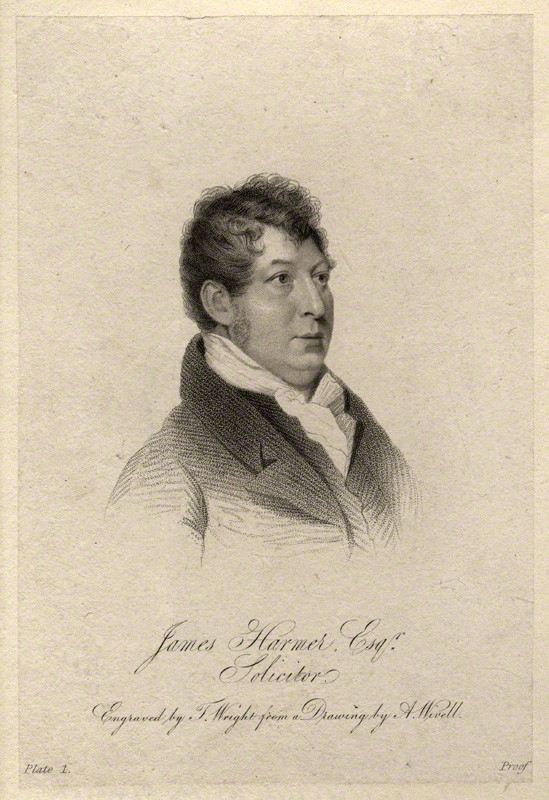
James HARMER [33667]
- Born: 1777
- Marriage (1): Henrietta Cowley TALBOYS [33677] in 1798 in St Botolph Aldgate LND
- Died: 12 Jun 1853, Ingress Abbey Greenhithe Swanscombe KEN aged 76
- Buried: 18 Jun 1853, All Souls Kensal Green Cemetery (Established by the General Cemetery Coy)

 General Notes: General Notes:
James Harmer
Record Type: Banns (Bann)
Marriage Banns Date: 14 Jan 1798
Marriage Banns Place: Saint Botolph Aldersgate, City of London, England
Spouse: Henrietta Cowley
James Harmer
Age: 76
Record Type: Burial
Birth Date: abt 1777
Abode Cricklewood MDX, Ingress Abbey Kent
Death Date: abt 1853
Burial Date: 18 Jun 1853
Burial Place: All Souls, Kensal Green, Kensington and Chelsea, England1
Register Type: Bishop's Transcript
1. James expressed a wish not to be buried in consecrated ground.
Harmer James (1777 \endash 1853) Alderman of London, was son of a Spitalfields weaver. Left an orphan at the age of 10 years, he was articled to an attorney in 1792, but left his office on making an early marriage. He was afterwards. transferred to Messrs. Fletcher & Wright of Bloomsbury, and practised for himself in 1799. His practice was chiefly in the criminal courts, and the . experience there gained made him strong advocate of reform in criminal procedure. His evidence before the committee for the reformation of the criminal law was declared by Sir James, Mackintosh to be unequalled in its effect. He exposed the delinquency of witnesses, and especially the mode of obtaining evidence against Holloway and Haggerty, who were executed in 1807 for the murder of Mr Steele. He also took an active part in procuring the abolition of the blood-money system. He took. much trouble in, investigating cases where he considered the prisoners had been wrongly committed. He wrote pamphlets on behalf of Holloway and Haggerty in 1807, on the case of George Matthews in 1819, and in 1825 on behalf of Edward Harris.
In 1833 he was elected alderman of the ward of Farringdon Without, which he had represented since 1826 in the common council and gave up his legal practice, which is said to have been worth £4,000 a year. He was sheriff of London and Middlesex in 1834. He resigned his Alderman's gown in 1840, when his eleetion to the mayoralty was successfully opposed on the ground of his being proprietor of the Weekly Dispatch, which then advocated very advanced religious and political views. Harmer took a leading part in establishing the Royal Free Hospital He lived at Greenhithe, Kent where he built a mansion, Ingress Abbey chiefly of stone procured from old London Bridge on its demolition. He died on 12,June 1888 and was buried on the 16th in Kensal Green cemetery. He left a large fortune to his grand-daughter. There is an engraved portrait by Wivell (Evans, Catalogue 16870). (Illustrated London News, 25 June 1853.xxii 507, Copied by the Gentleman, Magazine, 1853, pt.ii pp 201-2; Times (advt. of death), 13 June 1863; Annual Register, 1819, v61 359-63; Grants History of the Newspaper Press. iii. 41-2.1) .
Alderman Harmer, the attorney, who sits on the London bench to punish petty larceny, gets £3,000 or £4,000 a year by being proprietor of the Weekly Dispatch, a paper which thrives on the worst of all crimes, the destruction of private and public character.
https://www.british-history.ac.uk/no-series/london-aldermen/hen3-1912/pp195-211
See Also http://www.harmer.org/Alderman_James_Harmer.pdf
Other Records
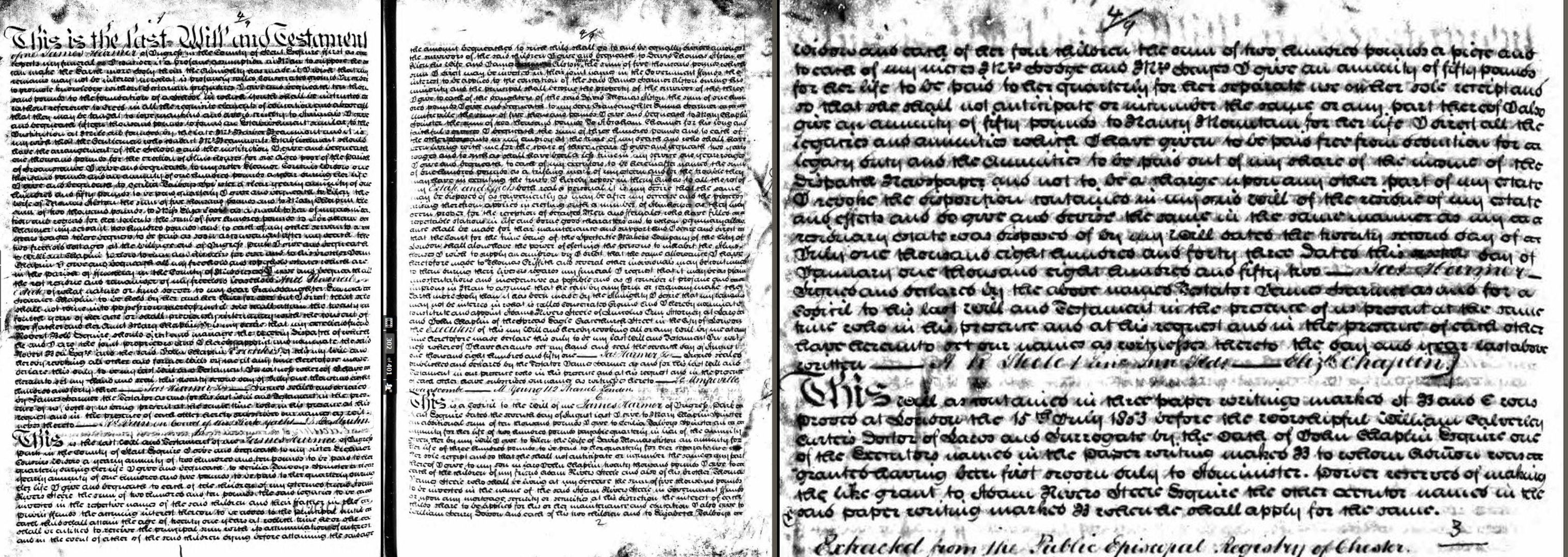
1. James Harmer: Will & Codicils, 1852.
To be transcribed
James married Henrietta Cowley TALBOYS [33677] [MRIN: 12043], daughter of Thomas TALBOYS [33678] and Henrietta Lodge COWLEY [33679], in 1798 in St Botolph Aldgate LND. (Henrietta Cowley TALBOYS [33677] was born in 1776 and died in 1834.)
|