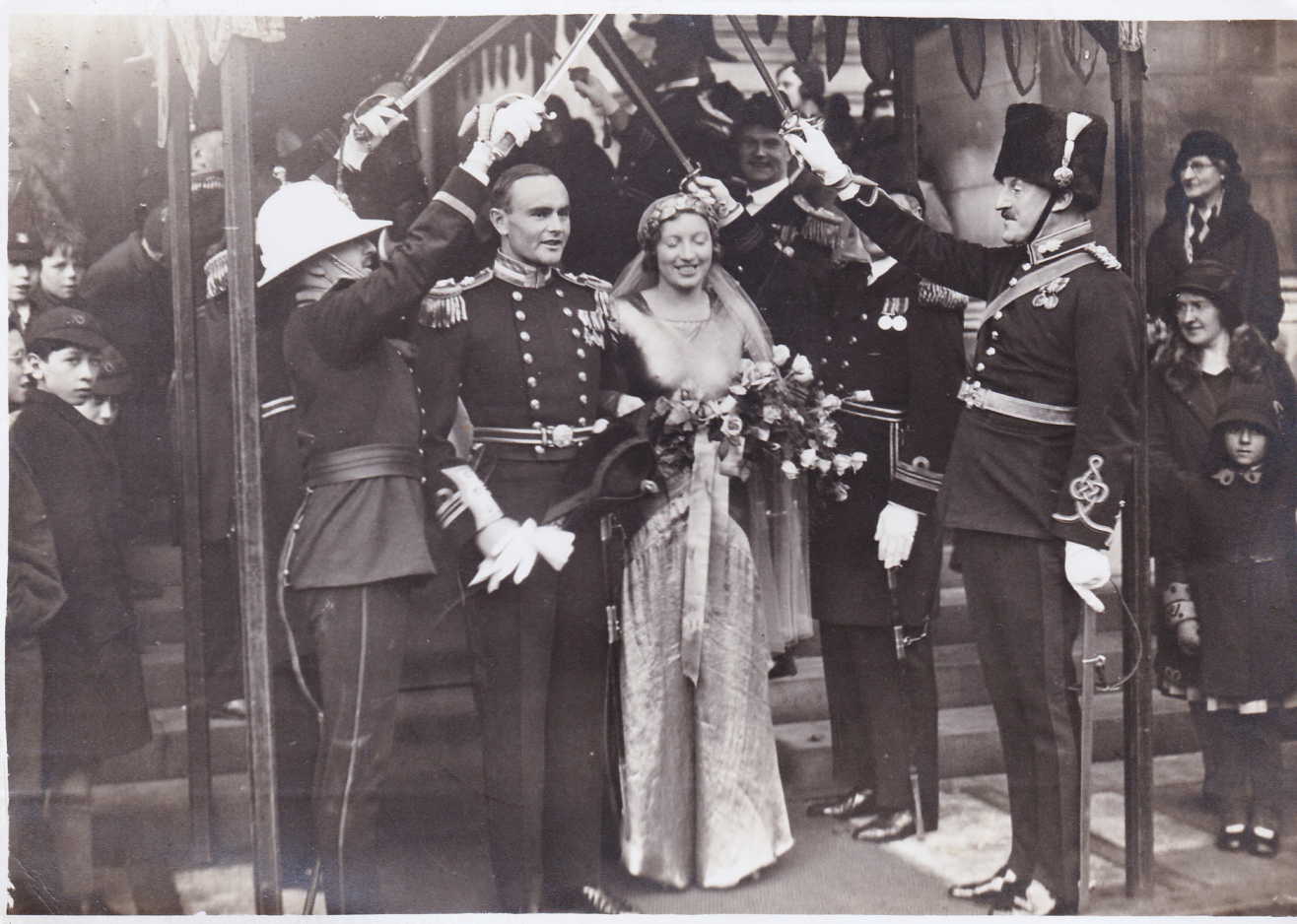
Arthur Frank Capel LAYARD DSO DSC RN [33606]
- Born: 28 Nov 1899, Southwick SSX
- Marriage (1): Joan Blythe BINNING [33613] in 1932 in Brompton Oratory Kensington.
- Died: 1999, Chichester SSX aged 100

 General Notes: General Notes:
The compiler of this site can report the great good fortune of having A R Layard a son of A F C Layard make contact (2020).
Raymond Layard says of his father:
My Father joined RN College Osborne (on the Isle of Wight) in 1912. He went on to BRNC Dartmouth in 1914 and joined HMS Indomitable at Rosyth on the Firth of Clyde in time to be present in Admiral Beatty's Battlecruisers at Jutland. He was aloft in the foretop of the ship. I have his account of the battle.
He kept a diary from 1912 until about 1990. The years covering his naval life are in the RN Museum in Portsmouth. He wrote a comprehensive precis of the diary and then had the "civilian" volumes destroyed.
During WW2 in 1942 he commanded HMS Broke, a destroyer, on Operation Torch. As a result of breaking into Algiers by ramming the boom, he was awarded the DSO. Sadly the ship was badly damaged and sank after she had left the Harbour. He was seconded to the Royal Canadian Navy in 1943 and commanded an Escort Group in the North Atlantic. His diaries were edited and published after his death by Michael Whitby the official RCN historian. A review on the book "Commanding Canadians" is in the next link. <https://www.h-net.org/reviews/showrev.php?id=11736> (See below)
My father died 5 days before his 100th birthday aged 99. I will dig out his Daily Telegraph obituary.
Commanding Canadians.
The Ordinary Man in Command.
In his diary entry for Wednesday, March 7, 1945, Londonderry, Comdr. Arthur Frank Capel Layard, Royal Navy, noted, after completing some paperwork, "I then walked out into the town and had a hair cut. On my way home I met a Canadian sailor in a narrow part of the pavement who made no effort to move, and so I stopped and said, 'Who is going to get out of the way - you or I ? He said, 'Well, as you are carrying a cane I guess perhaps I'd better.' Christ, there are times when I never want to see another Canadian" (p. 295 Diary).
As Michael Whitby, Senior Naval Historian with the Department of National Defence, notes in his introduction to this book, Comdr. A. F. C. Layard, kept a "detailed personal diary" from his joining the Royal Navy in 1913 until his retirement in 1947, a diary in which he "lays bare his soul and shows the human context of great events" (p. 3).
Commanding Canadians incorporates Layard's diaries, as minimally and ably edited by Whitby, for the period September 1943 to May 1945 in which Layard was "commanding Canadians." After a short time as Senior Officer of a Canadian support group operating out of Halifax, Layard graduated to the command of a new Royal Canadian Navy support group, Escort Group 9 (EG 9). He would remain commander of EG 9 from January 1944 until the end of the war in Europe, during which time EG 9, as Whitby notes, under Layard's "leadership became one of the most effective anti-submarine groups in our navy's history" (p. 10). From the spring of 1944 until the end of the war in Europe, EG 9 operated out of British waters under the operational control of the Royal Navy and served under Western Approaches, Portsmouth, Plymouth and Rosyth Commands, as well as the Home Fleet, at various points in the anti-submarine war.
The diary itself was an illegal hobby on Layard's part, as navy regulations prohibited the writing of such. Furthermore, Layard kept the diary's existence quiet until 1987 because of the deeply personal nature of many of its entries. It was only in 1987 that he first permitted parts of the diary to be copied for use by the Department of National Defence for use in the official Royal Canadian Navy history then in preparation. Illegal or not, the diary was an absolute necessity for Layard's well-being, especially, it would seem, during the wartime years. Although Layard had an active social life, drank a lot (if nothing else the diary provides an extensive examination of the culture of drinking in the Royal Navy and Royal Canadian Navy), explored the local communities when his ships were in harbor, and exercised routinely, these activities were not enough. As Whitby notes, "All these pursuits were of value, but the diary was the critical outlet. Quite simply, the diary was a release, a way to get things off his chest. Without it, his mental anguish might have become overwhelming" (p. 307).
Michael Whitby has added structure to the wartime diary through the division of its content into chapters, each headed by an introductory essay. These essays add necessary historical context to the upcoming diary section. After all, Layard's service with the Canadians was only one small part of his personal life and professional career, and he often discussed personal matters that he obviously understood well but the reader would not.
It is quite clear from reading Layard's diary that he probably would have contested Whitby's statement of his effectiveness as a leader. Therein lies part of the appeal of this book. Layard is not supremely confident, cocky or distant. He is not one of the mythical, infallible military commanders of military history. He is constantly questioning his abilities, his decisions, and his suitability for command. In other words, he is an ordinary man placed in an extraordinary position doing his duty in the service of the British Empire. As Whitby notes, Layard was a member of what might be called a third group of Royal Navy and Royal Canadian Navy commanders fighting the Battle of the Atlantic. The members of the first group were well accomplished and "achieved legendary status," both within the navy and in the public eye, while those in the second group "earned reputations as skilled escort leaders although largely unknown to the public." Layard and the rest of the third group, what Whitby calls the "old retreads," were officers in their final years of service and not likely to be promoted any higher, but who provided extensive experience "and they performed admirably leading often largely untrained escort groups in a difficult battle" (p. 109).
At the same time that he serves as a representative of the "old retreads," Commander Layard also has many lessons to give on military leadership. As Whitby notes, the diary "becomes truly remarkable in what it reveals of the daily strain associated with command at sea. As such, it provides a vivid portrait of leadership in war. Layard's remarkable honesty and forthrightness strip away the usual veneer of stoicism and solitude with which most naval commanders - indeed, military leaders of all varieties - surround and protect themselves. The lessons are timeless, and leaders at all levels who consider his example should gain a measure of comfort in knowing that the angst and lack of confidence that marked Layard's personality, and that they perhaps share, are natural and commonplace, and can be overcome" (p. 10).
Not surprisingly, Layard's diary is a mixture of observation and internal, psychological analysis on his part. Amongst the ups and downs of the daily life of a middle-level Royal Navy commander, there are a few themes which Layard devotes much time to, themes which are indicative of the diary as a whole. Being the officer commanding a Second World War naval escort group was a stressful, demanding, exhausting and often boring assignment. This was particularly true for Layard during the period when Escort Group 9 was participating in the "inshore campaign" of the naval battle (which was most of its existence). Operating close to the shores of Europe, much of EG 9's time was spent hunting German submarines in relatively shallow water and in the confines of small patrol "boxes." At times, the work portrayed by Layard's text becomes tedious and even boring, which is only appropriate since it reflected the realities of the work. For example, on September 9, 1944, Layard writes of the process of checking for possible enemy submarines, a process which he and his ships conducted over and over: "contact, investigate, check position, probably attack, examine result, classify" (p. 205). The work was exhausting and stressful for the crews of the ships and their group commander. That same day he noted: "I shall be thankful to leave this patrol tomorrow and have a spell. It has been a particularly wearing 10 days" (p. 205).
Layard constantly questions his own abilities and this becomes another major theme of his diary. While it records his own personal anguish, these entries also show his leadership style, as Michael Whitby notes: "as summer [1944] progressed he became increasingly despairing about his leadership, but he kept plugging away. That perseverance, the ability to rise above personal shortcoming to do the right thing, is perhaps the greatest lesson that Layard provides to prospective leaders, especially those of less dynamic personality" (p. 173). Just two examples of Layard's self-flagellation found in the diary suffice to provide the reader with a sense of the larger work. On April 22, 1944, his group attacked a German submarine, seemingly without success: "What I've always dreaded has happened. We find a U-boat and I make a balls and lose it. It must be admitted the lack of daylight, the bad A/S conditions, and the periscope all made it difficult, but I've let the ship and the group down and feel suicidal with shame" (pp. 131-132). This harsh criticism of his actions was, ultimately, ironic given the attack actually sank U-311. Three months later, on July 12, Layard was ashore in Londonderry when one of his officers told him how contented Layard's ship commanders and crews were serving under his command: "It cheered me no end, just as I was feeling in the depths and wondering whether the other C.O.s had any confidence in me at all and whether I was fit to hold this job down" (p. 169).
Another common topic of Layard's diary was his relationship with Canadians, specifically the Royal Canadian Naval Reserve and Royal Canadian Naval Volunteer Reserve officers and men serving under his commands at various times. On November 24, 1943, when he is informed in Halifax that he might be assigned to command a new Canadian support group composed of frigates and corvettes, he deposited his true feelings in his diary. "Although I'm not keen about an all Canadian group, because one does get tired of them and they are not brought up in the same way as us, still if it is to be a mid-ocean group working from Londonderry and St. John's I shall be able to get home sometimes, which will be grand" (p. 61).
Layard's opinion of Canadian sailors varied from good to bad, sometimes on an individual basis, sometimes overall. Generally, he preferred Volunteer Reserve officers over Reserve officers, as he considered the latter to be good, well-trained sailors, but the former, although newer to the sea, were more likely to be "keen and alive" (p. 120). Although there was never any doubt in Layard's mind of the superiority of the Royal Navy to the Royal Canadian Navy, his opinion of the treatment of the Canadians by the Royal Navy also developed during his time in command of Escort Group 9. For example, he became extremely frustrated by the complete lack of attention paid by Royal Navy senior officers to his escort group to the point where he took matters into his own hands. While in Plymouth on September 15, 1944, Layard talked a senior Royal Navy officer into coming on board HMCS Saint John the following day to "say 'Well done'. I told him I thought the R.N. treated the R.C.N. unfairly--all criticism and no help, and we'd never seen a senior R.N. officer on board" (p. 208).
Michael Whitby writes that readers of Layard's wartime diary "will find a very human story of a man struggling to maintain his way in difficult circumstances and under enormous pressures. His success marks a triumph of the human spirit over adversity, and deserves to be known" (p. 10). Absolutely. Comdr. Arthur Frank Capel Layard (November 28, 1899 to November 25, 1999), Royal Navy, was the recipient of the Distinguished Service Order and Distinguished Service Cross, Mentioned-in-Despatches, commander of Canadians.
If there is additional discussion of this review, you may access it through the network, at: https://networks.h-net.org/h-canada.
Citation: Ken Reynolds. Review of Whitby, Michael, ed., Commanding Canadians: The Second World War Diaries of A. F. C. Layard. H-Canada, H-Net Reviews. May, 2006.
URL: http://www.h-net.org/reviews/showrev.php?id=11736
Ref: Courtesy of Copyright © 2006 by H-Net, all rights reserved. H-Net permits the redistribution and reprinting of this work for nonprofit, educational purposes, with full and accurate attribution to the author, web location, date of publication, originating list, and H-Net: Humanities & Social Sciences Online. For any other proposed use, contact the Reviews editorial staff at hbooks@mail.h-net.org.
OBITUARYS:
Commander Frank Layard
Destroyer captain who drove his ship through Algiers harbour boom to land American troops in 1942
COMMANDER FRANK LAYARD, who has died three days short of his 100th birthday, won the DSO as captain of the destroyer Broke in Operation Terminal, a daring sortie into the harbour of Algiers in the early hours of November 8 1942. As part of the Torch landings in North Africa, it was planned to seize the ports of Algiers and Oran intact at the earliest moment, so that ships carrying the bulk of the invading army's tanks, guns, stores and equipment could be quickly berthed and unloaded. To prevent the Vichy French destroying essential port facilities and blocking the harbour entrances, small forces were to be landed to break into the harbours and to, land troops who would take over important installations and hold the ports until the main landing parties arrived. For Operation Terminal, Broke and another destroyer, Malcolm, had their bows specially strengthened, extra oerlikon guns fitted on the wing bridges, added protective plating on the bridge and upper deck, with a grapnel-throwing mortar to assist in berthing and a number of large brows to get the troops ashore quickly.
The two destroyers, each with 300 American troops embarked, were picked out by searchlights as they approached Algiers harbour boom under heavy fire. Malcolm was so badly damaged she had to with-draw from the operation, but Broke went on and at the fourth attempt sheared through the harbour boom at more than 20 knots. "To our surprise," Layard said, "we went through it just like cutting butter without so much as a shudder." Layard took Broke along-side, where the troops stormed ashore. But in the morning daylight, Broke her-self came under fire from shore batteries, with nine killed and 20 wounded. Eventually, Layard decided that he would have to put to sea or Broke would be sunk where she lay. Outside the harbour, Broke was taken in tow by the Hunt Class destroyer Zetland, but she had a heavy list, extensive flooding, no steam or electric power and the weather was deteriorating.
Regretfully, Layard decided he must abandon ship. Zetland came alongside to take off survivors. That evening, Broke turned over and sank "a sad moment for us all," Layard said, "but at least I felt that my decision had been the right one".
Arthur Frank Capel Layard: joined the Navy in time to serve in a battlecruiser at Jutland in 1916 and was born on November 28 1899 and as a cadet went to Osborne in 1912 and to Dartmouth in 1914. He joined the battlecruiser Indomitable as a 16 year old midshipman in 1915 and served in her at the Battle of Jutland in May 1916. After service in the cruiser Blake and the destroyer, Sea Bear he went up to Cambridge in 1920 for two terms at St John's College. As a lieutenant, Layard never Specialised, and as a "salt-horse" he spent the greater part of the inter-war years as first lieutenant or captain of a succession of destroyers at home, in the Mediterranean and on the China Station.
During the Abyssinian crisis he commanded the minesweepers Stoke and Harrow in the Mediterranean and then, after a photographic course in 1936, joined the Experimental Department at HMS Excellent, the Portsmouth Gunnery School, where he served until taking command of the ex-US Navy destroyer Chelsea in 1941, and then Broke in 1942. Layard was loaned to the Royal Canadian Navy in April 1944, commanding the Canadian River Class frigates Matane, Swansea, St John and Nene as Senior Officer, 9th Escort Group, based at Londonderry; escorting Atlantic and Russian convoys.
Post-war research established that Matane and Swansea sank U.311 in the Atlantic on April 22 1944.
Layard was mentioned in despatches for his shiphandling when Matane was hit and immobilised by a glider bomb off Brest on July 20 1944, was promoted Acting Commander from the Retired List in November, and awarded the DSC after St John sank U.309 in the Moray Firth on February 16 1945.
After the war, Layard served in the book writing department at Excellent, and as Sea Cadet Area Officer, Scotland and Northern Ireland. He was recalled for service in the Directorate of Manning in the Admiralty from 1951 to 1954, before finally retiring to become Navy League representative in Scotland from 1955 to 1962.
He married in 1932, Joan Binning; they had a son and a daughter.
COMMANDER FRANK LAYARD
Commander Frank Layard, DSO, DSC, veteran of the battle of Jutland and Second World War escort force commander, died on November 25 aged 99. He was born on November 28, 1899.
MIDSHIPMAN Frank Layard had a grandstand view of the Battle of Jutland, the last fleet action to be fought by the Royal Navy. After curtailed training at Dartmouth he was, at 16, pitchforked into the adult world of the battlecruiser Indomitable at Scapa Flow.
Keeping a daily diary throughout the thirty years of his seagoing service, he recorded on May 30, 1916, the thrilling news that "the Germans were coming out" and how the 3rd Battlecruiser Squadron rapidly raised steam, reaching its rendezvous with Admiral Beatty's battlecruiser force in the North Sea in the late afternoon of the next day. During Beatty's disastrous preliminary running fight with Admiral Hipper's scouting battlecruisers, huge magazine explosions destroyed the Queen Mary and Indefatigable, which with the (erroneously) reported destruction of the Princess Royal gave rise to Beatty's famous remark to his flag captain, "Chatfield, there seems to be something wrong with our bloody ships today". From his action station high in Indomitable's foretop, where he was too busy working a Dumaresq gunfire control instrument to be frightened by straddling shell splashes, Layard witnessed a third disaster, the catastrophic destruction of his squadron's flagship, the Invincible. All that remained were thirty feet of bow and stern sticking out of the water, surrounded by wreckage and corpses. Out of a crew of a thousand, only six survived.
Layard later saw the British Grand Fleet appear astern out of the haze and funnel smoke, a continous sixty degree arc of twinkling gun flashes from 28 dreadnoughts "a tremendous sight" perfectly deployed against the numerically inferior German High Seas Fleet, and the apotheosis of Admiral Jellicoe's careful tactics, backed by the Admiralty's superiority in the decoding of wireless intelligence. As it was, in mist, darkness and confusion, the Royal Navy failed to inflict the Trafalgar demanded by its history, and suffered twice the German casualties and tonnage lost.
But the British remained in command of the North Sea and Jellicoe was able to report 24 Dreadnoughts ready for battle again byJune 2.
He had not, in Churchill's direful words, "lost the war in an afternoon". The gunnery officer of the Deutschland probably reflected the truth of decayed German morale and battered ships when he later wrote: "I do not think we could ever have got the men to take the ships out in the full knowledge that they would again meet the English Battle Fleet." Layard's war ended in the destroyer Sea Bear with the surrender of the German Fleet and their incarceration at Scapa, taking part in the disarming of the destroyer V73.
Between the wars, Layard served in battleships in the Mediterranean Fleet, and in destroyers at home, in the Mediterranean and on the China Station. In the mid-1930s he commanded his first destroyers and two mine-sweepers based at Malta. He married his wife Joan at the Brompton Oratory in December 1932, a marriage that was to last for 66 years. In December 1934 he was finally passed over for promotion to commander, a "great blow" which condemned him to the rank of lieutenant-commander. But his diaries recorded with generosity the successes of his friends.
The outbreak of a new war saw him working in the experimental section of the gunnery school HMS Excellent at Portsmouth. Appointed in July 1941 to his fifth command, the destroyer Chelsea, he was immediately embroiled in the critical stages of the Battle of the Atlantic. He had his first taste of action as escort force commander when, in August 1942, his destroyer, the Broke, joined the hard-pressed convoy SC94. Eighteen U-boats sank 11 out of 36 ships, but the Germans' own losses signalled a change in the balance of advantage.
Layard was awarded his DSO for Broke's performance during Operation Torch, the Allied invasion of North Afri-ca in November 1942. With the destroyer Malcolm, Broke made a venturesome foray by night into Algiers harbour against fierce Vichy French resistance in order to land American troops. He was "amazed and disgusted" at the reluctance of American soldiers to disembark in the face of "desultory sniping" and eventually had to "herd them off".
Both destroyers were badly damaged by French shellfire and Broke sank. Layard's men were safely transferred to another destroyer.
After a period ashore in the Admiralty, Layard was appointed to the Royal Canadian Navy, which seriously lacked experienced escort force commanders. Relatively unsung among accounts of the Second World War is the extraordinary expansion and gallant performance of the RCN, whose escort force grew from 12 ships to more than 400. Layard's performance as leader of the RCN Escort Group 9 was highly praised. One of his commanding officers wrote: "RCN officers were impressed with his abilities; his quick and decisive reaction to events and his ability to mould his ships and their people to a cohesive hunting force." Nevertheless, his diaries reveal agonies of self-doubt. Blaming his handling of the frigate Matane for a failure to kill a U-boat on April 21, 1944, he wrote: "What I've always dreaded has happened. We find a U-boat, then I make a balls and lose it I feel I have let the ship and group down and I feel suicidal with shame." After the war, however, he received a letter from the Naval Historical Branch which told him that analysis credited him with sinking U311 on that day. Later, when protecting the reinforcements for the Normandy invasion off Ushant, Matane was hit by a radio controlled glider bomb and badly damaged.
Layard was mentioned in dispatches for his skill in getting her home. His diary humbly records his surprise at being roundly cheered by his men when he left the ship. He was awarded a DSC for one of the U-boat kills made by his group in February 1945 while commanding the frigate St John. His advancement to acting commander came while escorting a Russian convoy to Murmansk on his 45th birthday, the day he should have been retired as a "passed-over" lieutenant-commander. He left the Navy in 1947 but because of the Korean War was recalled for service to the personnel department of the Admiralty between 1951 and 1954.
In retirement he was for many years the Scottish organiser for the Navy League. He is survived by his wife Joan, and their son and daughter.
Submitted by his son Raymond Layard.
Research Notes:
Image courtesy of Berne Family Tree Ancestry - 2020
Other Records
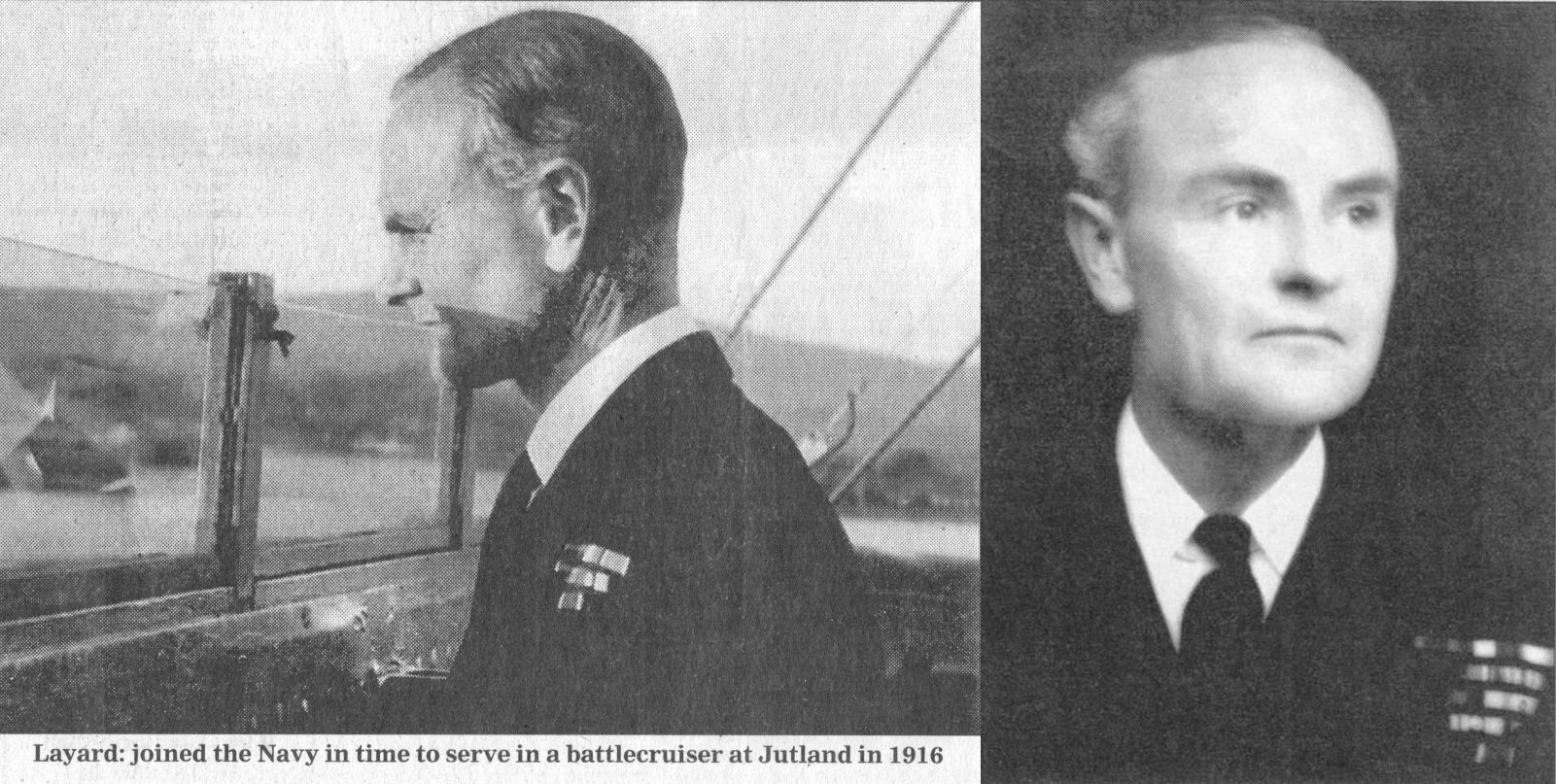
1. A Frank C Layard: Images from his obituaries.
Frank Layard at sea.
Frank in his later years of service.
Arthur married Joan Blythe BINNING [33613] [MRIN: 12023] in 1932 in Brompton Oratory Kensington. (Joan Blythe BINNING [33613] was born in Bombay India. and died circa 2004.)
|