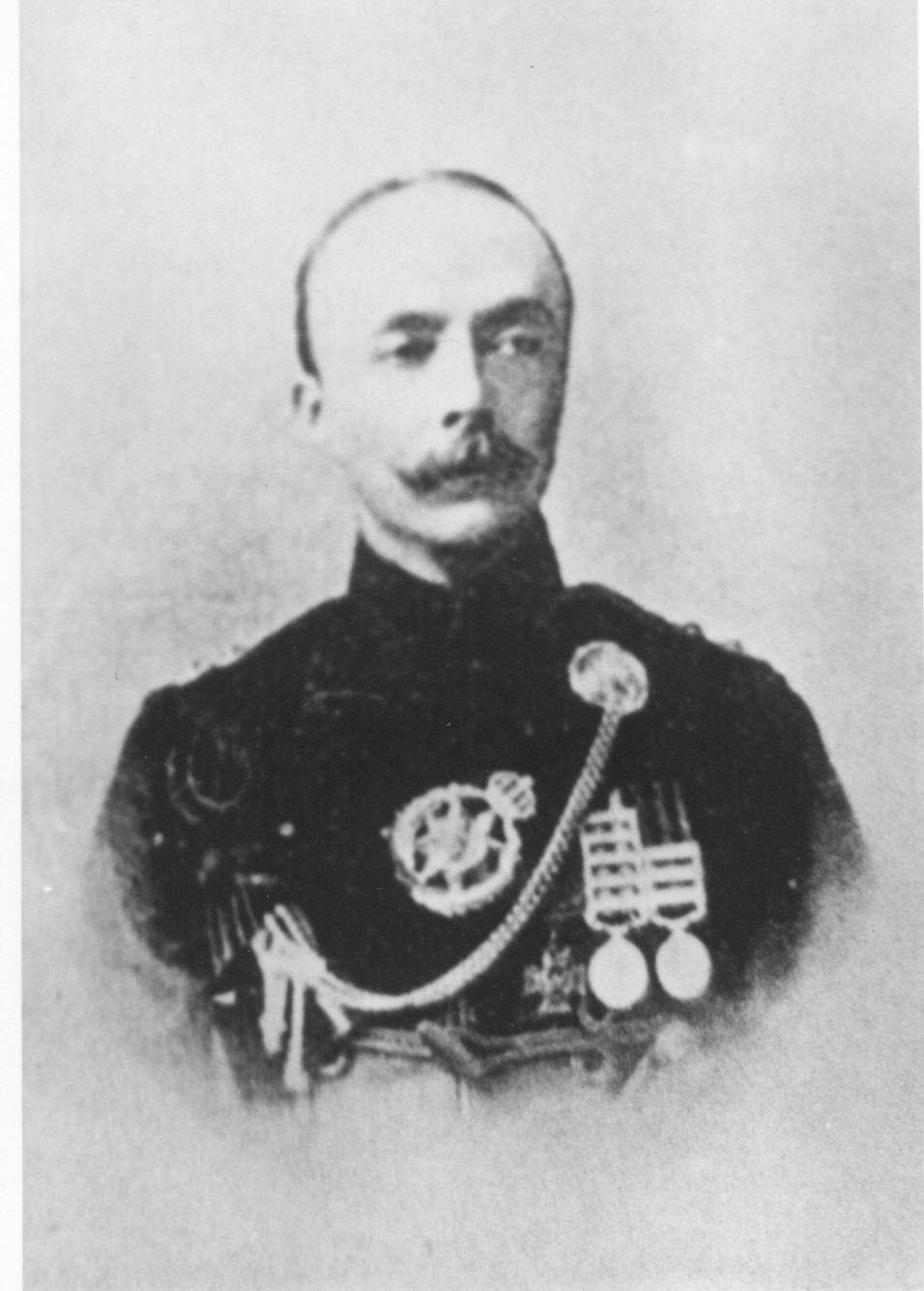
Guy Hudleston BOISRAGON VC [32486]
- Born: 5 Nov 1864, Kohat Punjab India
- Died: 14 Jul 1931, Biarritz FRA aged 66

 General Notes: General Notes:
Brigadier Guy Hudleston Boisragon VC (5 November 1864 \endash 14 July 1931) was a recipient of the Victoria Cross, the highest and most prestigious award for gallantry in the face of the enemy that can be awarded to British and Commonwealth forces.
Boisragon was 27 years old, and a lieutenant in the Indian Staff Corps , British Indian Army , and 5th Gurkha Rifles during the Hunza-Naga Campaign , India when the following deed took place for which he was awarded the VC.
On 2 December 1891 during the attack on Nilt Fort , India , Lieutenant Boisragon led the assault, forcing his way through difficult obstacles to the inner gate, when he returned for reinforcements, moving fearlessly to and fro under heavy cross-fire until he had collected sufficient men to drive the enemy from the fort. He later achieved the rank of brigadier .
Wikipedia
COLONEL G. H. BOISRAGON, V.C. The Colonel of the 5th Royal Gurkhas, Frontier Force. writes : In the obituary notice of Colonel G. H. Boisragon. V.C., of the 5th Royal Gurkhas, a few points were omitted of which he, though the most modest of men, was justifiably proud. and which his relatives. brother officers, and friends would like brought to notice.
He was the representative of a very ancient, Huguenot. family. His ancestor, Louis Chevelleau do Boisragon, after the Edict of Nantes, escaped to Holland, took service with Schomberg's Horse, came to England with William of Orange, and fought at the battle of the Boyne. He married Marie daughter of the Marquis de Rambouillet another refugee to England. Some of the family pedigree and portraits are reproduced by the Marquis of Huntley in his book " Auld Acquaintance." Colonel Boisragon had a very strong family connexion with the 5th Gurkhas, as his father, Henry Boisragon, afterwards Major-General raised the regiment in 1858. Practically all his service was spent in this regiment, and with them he took part in almost all the expeditions of the period on the N.W. Frontier, including the Hunza-Nagar Expedition of 1891, when he gained the Victoria Cross. In the Great War he commanded the regiment, and several independent columns, in Egypt. and in Gallipoli, until he was seriously wounded and incapacitated for further service. He will be finaly laid to rest at 11.30 a.m. on Tuesday, August 4, at Kensal Green.
Ref The Times Wed Jul 29 1931 Pg 14
VC Online.
Guy Hudleston Boisragon (1864-1931) was born on 5th November 1864 in Kohat, Pakistan, the eldest son of Major-General Henry M. Boisragon, the Commandant of the 4th Sikhs, Punjab Frontier Force, and Anna, daughter of William Hudleston, of the Madras Civil Service. He was sent back to England for his education at Charterhouse, and then at the Royal Military College, Sandhurst.
He joined the 10th Regiment of Foot (later Lincolnshire Regiment) in 1885, and transferred to the 5th Gurkha Rifles in 1887. In 1888 he served in the Hazara Expedition, and in 1891 in the 2nd Hazara Expedition. He also served in the two Miranzai Expeditions in 1891, with the first expedition as Orderly Officer to the General Officer in Command. From 1891 to 1892 he served in the operations in the Hunza-Nagar country, including the capture of the Nilt Fort. It was there that with Captain Fenton Aylmer and Lieutenant Badcock, he took a prominent part in the reduction of the fort. He would be mentioned in despatches and awarded the Victoria Cross (London Gazette, 12th July 1892).
He led the assault on the Fort on 2nd December 1891, and forced his way through difficult obstacles to the inner gate, when he returned for reinforcements, moving back and forwards, under heavy fire, until he collected enough men to force the enemy out. He was presented with his medal later in 1892 in India, though by whom is not known.
Following his service at the Nilt Fort, he served in the Waziristan Campaign under Sir William Lockhart in 1894-1895. He then was Aide de Camp to the Lieutenant-General of the Punjab Command. In 1896, he was promoted to Captain, and in 1897 and 1898 he took part in the operations in the Samana and Kurrum Valley. He then served in the Tirah Campaign of 1897-1898.
He was promoted to Major in 1903, Brevet Colonel, and later Colonel of the Frontier Force. He served during the Great War, and was wounded. He received the Order of the Nile, Fourth Class for his service. Following his service in the Great War, he retired with the rank of Brigadier. He decided to live in retirement in the south of France, and died there in Biarritz on 14th July 1931, aged 66. His body was returned to England, and he was buried in Kensal Green Cemetery, London. In 2006, following work by the Victoria Cross and George Cross Association, a new headstone was placed on his grave. His medals are not publicly held.
b. 05/11/1864 Kohat, India. d. 14/07/1931 Biarritz, France.
LOCATION OF MEDAL: NOT PUBLICLY HELD.
BURIAL PLACE: KENSAL GREEN CEMETERY, WEST LONDON.
For more details see:
http://www.vconline.org.uk/guy-h-boisragon-vc/4585985842 - Also Image.
The Gurkha Museum
Lieutenant Guy Huddleston Boisragon VC \endash 2nd December 1891 \endash Hunza Campaign, 1891.
Guy Boisragon was born in Kohat in Punjab in November 1864, the son of a Major-General who had founded what would become the 5th Royal Gurkha Rifles (Frontier Force) in 1858. Boisragon followed in his father's steps and was appointed as a Lieutenant to 1/5th Goorkhas in April 1877. He saw much initial action against the Hunza and Nagar tribal groups, who had been occupying Kashmiri outposts and acting in defiance of the Ruler of Kashmir. This instability and predicted resistance to the plan to build roads through Hunza and Nagar territory led to the mounting of the Hunza-Nagar military expedition in September 1891 to pacify the region. This expedition consisted of 200 Gurkhas of 1st/5th Goorkhas and a section of mountain artillery. The expedition advanced through several treacherous mountain passes and lost their commanding officer to frostbite. This led to Lieutenant Boisragon being given command of the expedition. The force soon met up with reinforcements, putting their strength up to 1130 rifles. After final ultimatums to the leaders of the Nagar and Hunza groups were ignored the force marched on the fort of Nilt on the Hunza river.
The Nilt fort was positioned on a ledge and surrounded by steep precipices, as well as being defended by 14-foot high, 8-foot thick walls of stone, reinforced with timber, and possessing only one entrance. Undaunted, Lt. Boisragon led his Gurkhas to take the fort by assault after a detachment od Sappers had blown the fort's single gate. Though under direct and often point-blank fire Boisragon, his Gurkhas and a contingent of sappers managed to reach the gate and set a charge which blew the gate wide open. Under a shower of dust and debris the Gurkhas attempted to storm the fort, but were heavily outnumbered and so Lt. Boisragon returned to fetch reinforcements, dodging fire both leaving and returning. Fortunately, the gate had been held during his absence and Lt. Boisragon was able to lead his troops into the fort and end the battle. His citation reads:
"For his conspicuous bravery in the assault and capture of the Nilt Fort (Hunza) on 2nd December, 1891
This officer led the assault with dash and determination, and forced his way through difficult obstacles to the inner gate, when he returned for reinforcements, moving intrepidly to and fro under a heavy cross-fire, until he had collected sufficient men to relieve the hardly pressed storming party and drive the enemy from the fort".
The campaign carried on and on December 20th another 5th Goorkhas officer (Lt. John Manners-Smith) would also be awarded the V.C. The region would be finally pacified by the end of the year. Lt. Boisragon would go on to see much more frontier action and would lead his battalion again to Egypt in November 1914 during the First World War, being shot through the knee as a Lieutenant-Colonel during the Gallipoli campaign. He was subsequently evacuated and declared unfit for service but was promoted to full colonel in 1916, working with the War Office in London until retiring in 1920. Guy Boisragon died in France in July 1931, aged 66.
https://www.facebook.com/TheGurkhaMuseum/posts/two-gurkha-vcs-captain-john-cook-vc-2nd-december-1878-and-lieutenant-guy-boisrag/2645275772206130/
|