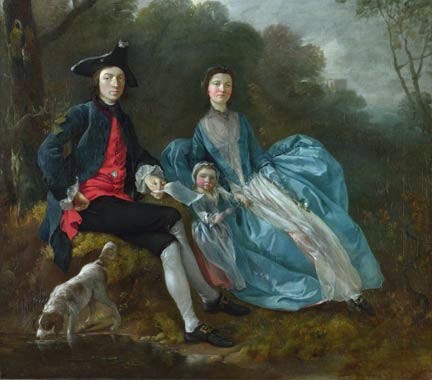
Thomas GAINSBOROUGH [30001]
- Born: Sudbury SFK
- Baptised: 14 May 1727, Great Meeting House Frair St Sudbury SFK
- Marriage (1): Margaret BURR [30002] on 15 Jul 1746 in St George Mayfair Westminster LND
- Died: 2 Aug 1788, London aged 61

 General Notes: General Notes:
Gainsborough was, with Reynolds (his main rival), the leading portrait painter in England in the later 18th century. The feathery brushwork of his mature work and rich sense of colour contribute to the enduring popularity of his portraits. Unlike Reynolds, he avoids references to Italian Renaissance art or the Antique, and shows his sitters in fashionable contemporary dress.
He was a founding member of the Royal Academy, though he later quarrelled with it over the hanging of his pictures. He became a favourite painter of George III and his family.
He was born in Sudbury, Suffolk, the son of a wool manufacturer. He trained in London, and set up in practice in Ipswich about 1752. In 1759 he moved to Bath, a fashionable spa town, attracting many clients for his portraits. He settled in London in 1774. His private inclination was for landscape and rustic scenes, and his amusing letters record his impatience with his clients' demands for portraits.
For his work see: https://en.wikipedia.org/wiki/Thomas_Gainsborough
Image Courtesy National Gallery London.
Thomas Gainsborough was born in Sudbury, Suffolk in 1727 and christened at the Independent Meeting House on 14 May of that year. The formative years of his childhood were spent at the family home on what is now Gainsborough Street (formerly Sepulchre Street), alongside parents John, Mary, and eight siblings.
Gainsborough and his brothers were all educated at the nearby Sudbury Grammar School, founded in 1491 and run in the mid-1700s by his uncle, the Reverend Humphry Burroughs (also curate of the church of St Gregory). Gainsborough and his brother, known as 'Scheming Jack' for his many inventions, both showed early ingenuity, with young Thomas displaying talent for drawing and painting at an early age.
Preferring the great outdoors to schooling, Gainsborough spent much of his childhood in the natural landscape surrounding Sudbury, including the famous Water Meadows just outside town. On his way to sketch in the fields and woods, he would have passed many historic buildings still in existence today, such as the fine medieval timber-framed home known as Salter's Hall. Gainsborough's training during this period was so comprehensive that his later biographer Philip Thicknesse would declare, 'Nature was his teacher, and the woods of Suffolk his academy'.
Gainsborough's family was heavily involved in the cloth trade, his father a manufacturer of woollen funerary shrouds. His uncle Thomas, an influential merchant and clothier, was considerably more successful, moving in to the prominent Buzzards Hall on Friars Street in 1709. After his death in 1739, a legacy left by Uncle Thomas in his will allowed young Gainsborough to begin his artistic training in London.
Gainsborough and his wife Margaret Burr moved back to Sudbury in 1749, living for three years on Friars Street before moving to Ipswich in 1752. Although the artist is not buried in Sudbury, instead being interred at St Anne's Church in Kew, London, many of the Gainsborough family members are buried at All Saints Church in Sudbury. A prominent vault and box tomb can be seen in the churchyard today, with the spire of the church visible in the background of Gainsborough's famous double portrait, Mr and Mrs Andrews (1748), painted at the couple's estate, the Auberies, outside of Sudbury.
Gainsborough is now commemorated as Sudbury's most famous native son by a monumental statue of the artist on Market Hill. Designed by Bertram Mackennal in 1913, the statue gazes down towards the artist's birthplace and what is now the museum and art gallery dedicated to him: Gainsborough's House.
Ref: Gainsborough's Sudbury
Thomas married Margaret BURR [30002] [MRIN: 10591] on 15 Jul 1746 in St George Mayfair Westminster LND. (Margaret BURR [30002] was born in 1728 and died in 1797.)
|