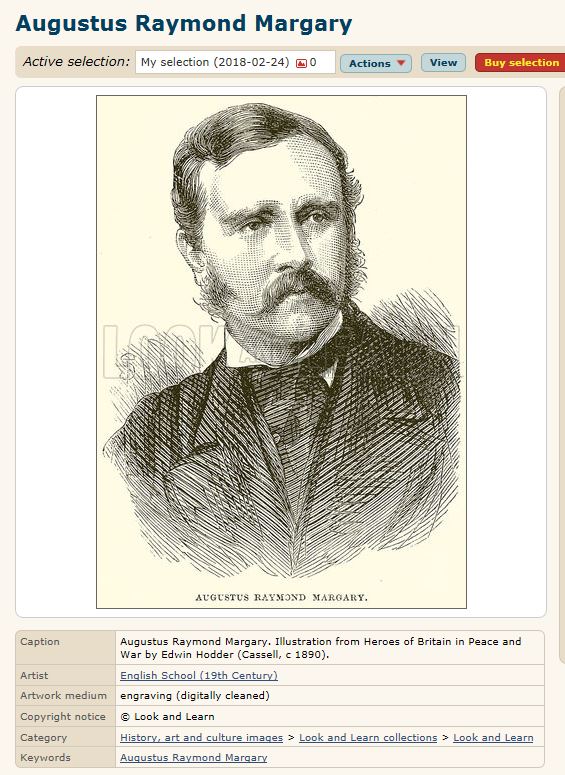
Augustus Raymond MARGARY [27285]
- Born: 26 May 1846, Belgaum Bombay India
- Baptised: 29 Sep 1846, Belgaum Bombay India
- Died: 21 Feb 1875 aged 28

 General Notes: General Notes:
657 MARGARY (AUGUSTUS RAYMOND), 11, brother of No. 655. 1858-65.
Passed a competitive examination before the Civil Service Commissioners: obtained an honorary certificate ; and was appointed a Student Interpreter on the Chinese Consular Establishment. 1867, and a 3rd Class Assistant, 1869. Received in 1872 the Silver Medal of the Royal Humane Society for saving the lives of several men who were wrecked during the raging of a typhoon, which burst upon the island of Formosa on the night of August 9th, 1871; and also the Albert Medal of the lst Class. Was made a 2nd Class Assistant, 1872. Was Acting Interpreter at Shanghai, 1873: Acting Consul at Chefoo, 1873, and Acting Interpreter at Chefoo, 1873-74. "Selected for an arduous and solitary mission in 1874, he was the first in modern times to penetrate from China to Burmah ; and on the return journey he was treacherously murdered at Manwyne, on the frontier of those two countries, February 21st, 1875, in his 29th year, terminating thus suddenly a career of the highest promise.
" Memorial Tablet in the College Chapel.
Author : Notes of a Journey front Hankow to Ta-li Fu, Shanghae, 1875. In 1876 was published, The Journey of A. R. M. from Shanghae to Bhamo, and back to Manwyne. From his Journal and Letters. To which is added a concluding Chapter by Sir R. Alcock, K.C.B., dr.
Ref: Brighton College Register.
Board of Trade, Whitehall, October 28, 1872.
The Queen has been graciously pleased to confer the decoration of the " Albert Medal of the First Class " on each of the undernamed gentlemen ; viz. MR. AUGUSTUS RAYMOND MARGARY, Assistant in Her Majesty's Consular Service in China, and MR. JOHN DODD, a British Merchant residing at Keelung, Formosa. The following is an account of the services in respect of which the decoration has been conferred During the raging of a very violent typhoon, -which burst over the north 'coast of Formosa on the 9th August, 1871, the schooner "Anne," of Hong Kong, and the French barque " Adele " were amongst the vessels blown from their anchorage and driven on the rocky shore of Keelung Harbour. 'The night was very dark, with a blinding rain, and great quantities of wreck were floating in the water and being washed ashore in the surf ; but, by the aid of a brilliant light of burning camphor, the position of the ships was made out from the shore. MR. AUGUSTUS RAYMOND MARGARY, Assistant in Her Majesty's Consular Service in China, and MR. JOHN DODD, a British Merchant, at Keelung, had a rope fastened to their bodies and went into the surf with a view to aiding the crew of the schooner " Anne," of Hong Kong, the nearest ship that could be discerned. Aiding each other, they waded and then swam a distance of some thirty or forty yards through the surf. The rope proved to be too short, and they were compelled either to throw it away or to return to the shore. They threw the rope off and reached the ship by swimming. They then tried to reach the shore with a rope from the ship, and after making an unsuccessful effort to do this, they persuaded two volunteers to lower a small boat, which was done with great difficulty, in which MESSRS. MARGARY and DODD tried to row back with a rope. Their efforts were frustrated. The boat was turned completely over and MR. MARGARY was for a few moments underneath it. They were, however, thrown on shore with fortunately but few bruises. The ship was rocking violently from side to side when they left her, but seemed to sustain no damage, and by the advice of the Captain, who appeared confident then of the strength of his ship, they desisted from further efforts, as there were more distressing cases calling for assistance further off. Timber was strewn on the beach and was beating amongst the rocks in such a way that little hope could be entertained of any living thing yet remaining; but an occasional wail of the sufferers in the sea induced MESSRS. MARGARY and DODD to persevere for several hours. They then with difficulty, effort, and danger, and in the dark, crawled over sandstone rocks of a peculiarly rugged nature, amidst breakers and wreck, until they arrived to within a short distance of the remains of the French, ship "Adele," and by swimming they were able to make a connexion with her by a rope from the shore. MR. DODD swam" to seize the buoy which the Frenchmen threw over, while MR. MARGARY swam to meet him with the shore rope. They joined the two and immediately gained the deck, which was by this time shattered. With the aid of the rope the greater part of the crew passed safely to shore, when MR. DODD and MR. MARGARY discovered the boatswain lying half under water, with his leg completely broken above the ankle. They raised him and carried him on shore by swimming. They then made repeated efforts to cross the broken back of the ship, to save four men who remained cut off in the bows. These men were helplessly frightened, and could scarcely be got down. MESSES. MARGARY and DODD in the end succeeded, but were both washed down by a heavy sea, which caused much injury to MR. DODD. The last thing which left the ship was a black cat, which clung to Mr. MARGARY'S shoulder in spite of the heavy surf which was rolling over all, and when they left the ship she was actually breaking up beneath their feet.
Ref: The London Gazette TUESDAY, OCTOBER 29, 1872.
Augustus Raymond Margary
From Wikipedia, the free encyclopedia
Augustus Raymond Margary (26 May 1846 - 21 February 1875) was a British diplomat and explorer. The murder of Margary and his entire staff, while surveying overland Asian trade routes, sparked the Margary Affair which led to the Chefoo Convention.
Education and early career
Margary was born in the city of Belgaum, in British India as the third son of Major General Henry Joshua Margary (d. 1876). Margary was educated in France, at Brighton College and University College in London. Having failed the entrance exam for the foreign service three times, Margary finally passed the exam and was appointed student interpreter in the British consular service in China in February 1867 and left for China the following month. In China, he served in the British Legation in Beijing, and the British consulates in Taiwan, Shanghai and Yantai.
The "Margary Affair"
Main article: Margary Affair
As part of efforts to explore overland trade routes between British India and China, Margary was sent from Shanghai through southwest China to Bhamo in Upper Burma, where he was supposed to meet Colonel Horace Browne. It took Margary six months to make the 1800-mile journey through the provinces of Sichuan, Guizhou and Yunnan, after which he met Browne in Bhamo in late 1874. On the journey back to Shanghai, Margary heard rumors that the return route was not safe and changed the route to Tengyue, where he and his personal staff were murdered on 21 February 1875.
According to Jonathan Spence, Margary was part of a survey team exploring routes from Burma into Yunnan. Susan Orlean gives a different account: "The linguist and plant collector Augustus Margary survived toothache, rheumatism, pleurisy, and dysentery while sailing the Yangtze only to be murdered when he completed his mission and sailed beyond Bhamo"
Consequences
The murder of Margary, or the "Margary Affair" as it was known, created a diplomatic crisis and gave British authorities an excuse to put pressure on the Qing government on a number of unrelated issues. The crisis was only resolved in 1876 when Thomas Francis Wade and Li Hongzhang signed the Chefoo Convention, which covered a number of diplomatic/political items. The British demanded, and got, according to Spence, an indeminty of 700,000 taels of silver, a mission of apology to Queen Victoria, and four more treaty ports.
In 1880, a memorial was erected to the memory of Margary, which was moved to the Public Gardens in 1907. The memorial was removed during the Japanese occupation of Shanghai and was never restored after Japan's defeat in World War Two.
MARGARY, AUGUSTUS RAYMOND (1846 - 1875), traveller, third son of Henry Joshua Margary, major-general R.E., was born at Belgaum, in the Bombay presidency, 26 May 1846. He was successively educated in France, at North Walsham grammar school, and at University College, London. Having received a nomination from his relative, Austen Henry Layard, he studied Chinese seven hours a day, passed a competitive examination before the civil service commissioners, obtained an honorary certificate, and was appointed a student interpreter on the Chinese consular establishment 2 Feb. 1867. In the following month he went to China, and on 18 Nov. 1869 rose to be a third-class assistant. The silver medal of the Royal Humane Society was awarded to him 16 July 1872 for saving the lives of several men who were wrecked during a typhoon in the island of Formosa, 9 Aug. 1871, and he also received the Albert medal of the first class 28 Oct. 1872. Till 1870 he was attached to the legation at Pekin, when he was sent to the island of Formosa, and there took charge of the consulate during twelve months. He was made a second-class assistant 7 Dec. 1872, was acting interpreter at Shanghai 16 Oct. to 12 Nov. 1873, and interpreter at Chefoo 24 Nov. 1873 to 9 April 1874. In August he received instructions from Pekin to proceed through the south-western provinces of China to the frontier of Yunnan, to await Colonel Horace Browne, who had been sent by the Indian government on a mission into Yunnan, from the Burmese side, in the hopes of opening up a trade with Western China. To this mission Margary was to act as interpreter and guide through China. On 4 Sept. 1874 he left Hankow on an overland journey to Mandalay. Passing the Tung-ting lake on the Yang-tse he ascended the Yuen river through Hoonan, and travelled by land through Kweichow and Yunnan, and on 17 Jan. 1875 joined Colonel Browne at Bhamo. He was the first Englishman who had traversed this route. On 19 Feb. 1875 he was sent forward to survey and report on the road from Burmah to Western China, but on 21 Feb. he was treacherously murdered at Manwein on the Chinese frontier.
Dictionary of National Biography volume 36.djvu/163
Other Records
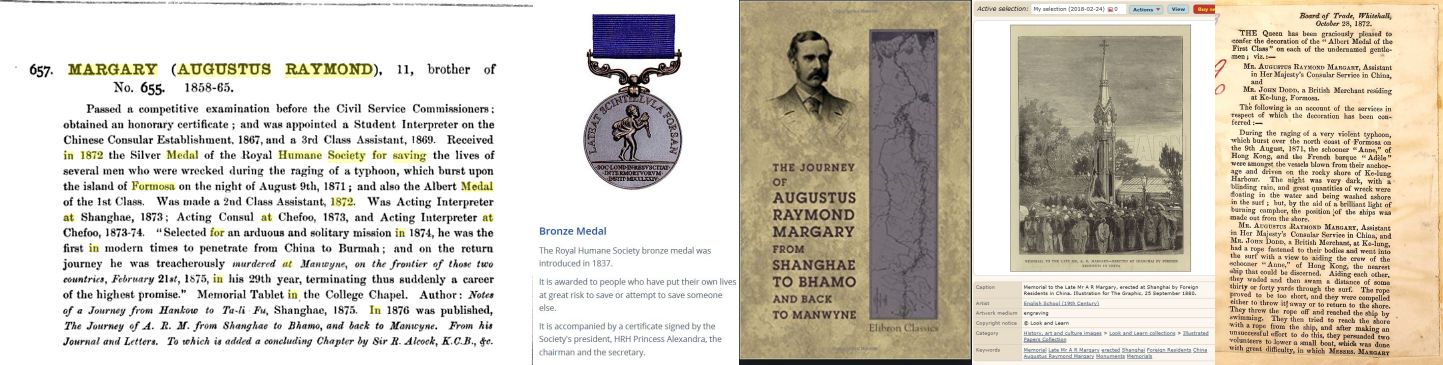
1. Augustus Raymond Margary: Images from his life.
|