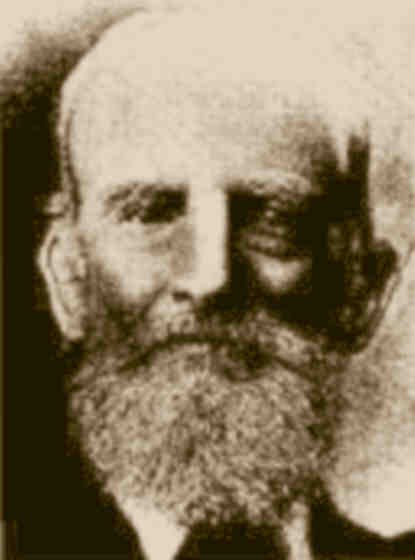
George DAMMEREL [18595]
- Born: Abt 1838
- Marriage (1): Sarah PRIOR [18596] in Australia
- Died: 1933, Marrickville Sydney NSW aged about 95

 General Notes: General Notes:
George's family were Huguenot and came to England then on to Australia in the first half of the 19th C. He settled Wandsworth Gyra NSW where he grew wheat and ran sheep, then to Fiddermans Creek Moonee NSW.
The Dammerell family also manned the Signal Station built on the shore at Dammerell's Head, opposite South Solitary Island Lighthouse Coffs Island NSW. This was part of the Maritime safety infrastructure of the time.
It might be supposed that this was on or close to George Dammerel's land, several streets in Emerald Beach NSW nearby carry the family name - 2013
South Solitary Island NSW
http://www.southsolitaryisland.com.au/page12.htm
The Signal Station
A Court of Enquiry, held after the collision of the Keilawarra and the Helen Nicoll on December 8, 1886, with the loss of 48 lives, recommended that the South Solitary lighthouse should be placed in telegraphic communication with the mainland. As this would have meant the laying of submarine cable, a compromise was reached by building a signal station on Dammerel's Headland. The signal station was established by the NSW Marine Board and George Dammerel was appointed signal master by the board in 1887.
So far as structures were concerned the Station consisted of a flagstaff surmounted by a vane showing wind directions, a flaghouse in which were housed a set of signal flags, each flag stored in its own pigeonhole, a powerful telescope, code book (for assembling and de-coding flag signals), morse lamp and log books, also a writing desk, chair and minor accessories. There was a slot in the wall on the seaward side of the building in which was mounted a swivelling nest for the telescope to enable a clear view to be obtained from within the building of a large segment of the sea including, of course, South Solitary Island and its lighthouse. With the telescope, flag signals on the mast on the Island could be read, and on a clear day, the people making them could be seen. A rain gauge was also provided.
Mr Dammerel's duties as Signal Master were to keep a twenty four hour daily watch on shipping and weather, and for communications from the Island, to identify all passing vessels, transmit such messages to and from them and the Island as may be required and to maintain appropriate records in relation to these matters. A telephone was installed in his home and he was required to phone at fixed hours each day to Coffs Harbour for transmission to the Marine Board (later the Department of Navigation) in Sydney, details of the names and times of passing the Station of north and south bound vessels and of weather wind direction and strength, condition of sea, temperature and rain gauge readings etc. Communication with ships and the Island was by flags in the day time and morse lamp - using morse code - at night. Ships passing between the Island and the coast were identified by him, and those outside the island by the lighthouse staff, who reported details to him. In all these duties he was only assisted by his wife and family, all of whom became experts with the signalling systems.
Mr Dammerel was also required to maintain the Station equipment in good working order, including periodical painting of the flaghouse and mast (always white). The mast, with roughly six feet sunk in the ground, was approximately a foot in diameter at its base tapering to about 41/2 inches at the top and rose to some 55 feet in height exclusive of the wind vane at its summit. It was supported by steel ropes and had a cross span something like 18 feet in length at 42 feet from the ground and running in a north-south direction.
Flag signals were hoisted on the mast by means of a halyard of 1/4 inch or slightly heavier strong white rope running from ground level, through a block or pully attached to the top of the mast and back to he ground. One end was fitted with a wooden toggle about 2 1/3 in. long and the other with a loop of appropriate size to allow the toggle to pass through it and make a secure fastening (like a button in a button hole). One end of each flag was reinforced with a length of similar rope enclosed in a canvas strip, the rope being fitted with toggle and loop to match those on the halyard ends. Needless to say it was necessary at all times to ensure that one or both ends of the halyard did not escape and get away out of reach. A similar halyard was also attached through a pully to each end of the cross-span, but these were seldom used for signalling under ordinary conditions because of the greater height and visibility afforded by the mast-head halyard.
To ascend the mast it was necessary to climb a steel rope ladder running at an angle from the ground to the junction of the cross-span. The top section of the pole was fitted with wooden cleats fastened at intervals of about eighteen inches on alternate sides, to provide footsteps for climbing. As may be imagined, climbing to the masthead was no fun and in a strong wind it was a hazardous undertaking.
Many shipwrecks and other incidents of the sea took place within sight of the Signal Station, and George Dammerel on occasions, took part in rescue operations, recovery of bodies, etc. and reporting details of the events to the relevant authorities. George Dammerel and the Skinner family combined together in rescue operations on the 19th July, 1889, when a ketch "Lady of Lorn" with a crew of tour and the captain, went ashore on Moonee Beach. They were able to save the lives of all seamen but one, Alfred Egmond, who was drowned. Egmond was buried in the corner of Moonee Headland and Moonee Beach on 21st July, 1889. He was aged 33 years.
Mr Dammerel having had some experience in seafaring matters was the suitable choice and soon adapted to his task. Later some of his daughters became quite competent in such matters also.
Mr Dammerel understood shipping and international code flags and signals, but the Morse lamp work was attended to by his daughters. They sent a daily weather report at 9 am, they would probably discuss doings of self and family and even the latest news from the S.M. Herald. So, messages were sent for many years between the Signal Station and the Island until about 1918 when, with the advent of wireless, the Signal Station was closed down.
Dammerel Family
George Dammerel was born on April 5, 1837 at Plymouth. His ancestors were Huguenots who fled from France to England to escape the massacre of St Bartholomew's Eve. They settled on the outskirts of Plymouth and a portion that triple city is called after their old home, Stoke Damerell.
George Dammerel said Plymouth people are born web-footed. When they can walk they make for the water, so he made for the sea. He could recall seeing the first steamship to travel up the Thames - no wind, no sails, still it moved on. He was amazed.
After a short period at sea George arrived in Australia about 1857. He went bush where he worked for James Tyson (afterwards one of our first millionaires), whose advice to George was "Never take a sixpence out of your pocket if you can leave it there".
He met and married Sarah Prior and they made their home at Wandsworth, near Guyra, where he acquired a sheep and wheat farming property and where the first of his children were born.
In 1884 he applied for and was granted some Crown Land near Moonee, immediately north of Fiddeman's Creek. We do not know what took him there - perhaps the webbed feet were itching. How proudly he would have shown his wife from the inland, the glorious view which opened as they saw Mt Coramba, the sandhills, the islands and the blue sea!
Mr Dammerel had suffered a sad loss in his family when his son George Jnr., died on the 5th April, 1888. Mr Dammerell believed his son died from eating green cucumbers and from then on he would not allow them in the home again, by all accounts he probably died of appendicitis.
Tragedy, again came to Mr Dammerel on the 10th November, 1894 when his wife died in childbirth at their home, aged 43 years. A Doctor Watson from Grafton was in attendance, but his efforts were fruitless to save either her or the baby, the latter being born dead, Mrs. Dammerel was buried beside George Jnr.
After Mrs Dammerel's death, George Dammerel carried on with the operating of the Signal Station and to rear his family. The eldest daughter, Hannah, was then about 22 years of age and upon her fell most of the responsibility of the housekeeping and bringing up the younger children. On the 1st March, 1900, Hannah was married to Leonard Robert Rudder at the Dammerel Homestead and the responsibility was then passed to Matilda for a short time as she then married on the 25th April, 1905 to Charles Fox Julius. By this time of course, the other children were growing up and some had already grown up.
Still there was always duty, and so George raised his family until finally he went to live with one of his daughters, Mrs Fisher, whose husband was a lighthouse keeper, where he was lovingly cared for, still beside his beloved sea, until his call came at the age of 96 years.
George Dammerel's remains were cremated and the ashes were scattered on the sea, between North and South Solitary Islands, directly opposite the old Signal Station, half a mile off land, by his old friend Captain Hunter, Master of the S.S. Wollongbar.
After Maud and Harry were married and had left the area Mr Dammerel carried on with the operations of the Signal Station for a few more years until about 1918.
Ref: The following information was written and supplied by Harold Rudder, son of Hannah (Dammerel) and Leonard Rudder. From "Look-At-Me-Now" book by Benjamin J Holder.
Research Notes:
Pictures courtesy of http://www.southsolitaryisland.com.au/page12.htm
This data is not proven to George
George Dammeral
Death Age:95
Birth Date:1838
Death Date:1933
Cemetery:Unknown Crematorium
Remarks:Headstone: No; Ashes: Scattered at Sea.
Australian Cemetery Index
George Damerell
Death Date:1933
Death Place:New South Wales
Registration Year:1933
Registration Place:Marrickville, New South Wales
Registration number:2648
Australian Death Index
Was this George
George Dammerel
Spouse Name:Sarah Acheson
Marriage Date:1868
Marriage Place:New South Wales
Registration Place:Wellingrove, New South Wales
Registration Year:1868
Registration number:3592
Australian Marriage Index
George married Sarah PRIOR [18596] [MRIN: 6686] in Australia. (Sarah PRIOR [18596] died on 10 Nov 1894.)
|