James Newman SEAGROVE [16731]
- Born: 1816, Portsea HAM
- Marriage (1): Mary Ann MARRS [16763] in 1843 in St Phillips Sydney Aust.

 General Notes: General Notes:
James was a mariner in Australsia.
The loss of the whaling barque Magnet - 1844
The following item includes a lightly edited and noted version of an article published in the Shipping Gazette & Sydney General Trade List of 1844. This item is the first section of a trilogy that covers three disasters in which James N Seagrove was involved when at sea in Australasian waters - 1833 to 1852
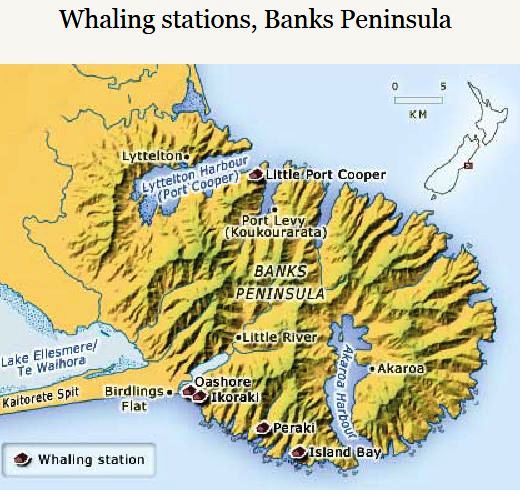
In June of 1844 the Sydney registered whaling barque Magnet, Capt Lewis, departed Port Jackson bound for the South Island of New Zealand. James Newman Seagrove, aged 28, was serving as Mate; the destination of the vessel was the whaling port of Akaroa Harbour located at the Banks Peninsula, south of Christchurch. After two days at Akaroa the Magnet set sail for the whaling station of Ecolacke, only a short distance away and also on the south shore of the peninsula. The barque anchored off-shore in the evening of the 31 August.
Following two days of loading whale oil and other cargo, the weather changed dramatically for the worse and the Magnet was driven onto a reef where she was destroyed within several hours. In an interview about the loss of the ship, James Seagrove commented as follows and as printed in the Shipping Gazette and Sydney General Trade List, 1 March to October 31, 1844:
The loss of the Magnet:
Captain Lewis, Mr Seagrove - the chief officer, and the crew of the Magnet have arrived in Sydney by the schooner Ariel. From Mr Seagrove we have been favoured with the following account of the loss of that vessel:
"August 31st. Left Akaroa Harbour1 with a light breeze from NW; at 6 p.m. brought up at Ecolacke (Ikoraki), a whaling station on the south side of Banks Peninsula, and anchored in ten fathoms [60 ft] of water, with fifty fathoms of the small bower [anchor] chain; the head of the bay where the station was bearing NNW distant about one mile and a half. Put the slip buoy on the chain, double reefed the topsails, and furled sails; everything being prepared for slipping in case the wind should come in.
"Sunday, September 1st. Light NW winds, and fine weather. Busily employed taking in oil and bones for Port Nicholson, on account of Mr Jones.
"Monday, September 2nd. Calm and pleasant weather. Employed as the preceding day; at eight bells [8 p.m.]set the anchor watch, with orders to call the Captain or myself at midnight, there often being a change of weather at this time. Went on deck and found there was a light NW wind off the land, with every appearance of a continuation of fine weather. At three in the morning, a sudden shift from the NW to SE which came like a clap of thunder; turned the hands up immediately, loosed the topsails and set them, found the vessel was driving in towards the land, slipped the chain and stood in towards the long beach that formed the (Canterbury) Bight, under the courses, double-reefed topsails, staysail and mizzen; when well in, tacked ship and stood to the eastwards, thinking to fetch a harbour called Perack (Peraki), the vessel burying herself [into the waves] with the press of sail, and the sea running mountains high.
"Finding it was impossible to get out on account of the vessel missing stays2, occasioned by the heavy sea, and in by a bluff head, squared the after yards and ran in to the first opening for the preservation of the lives of those on board. About a quarter after four in the morning we struck on a hard stony bottom; cut the whale-boat on the skids adrift, and got her into the water with four hands but having been stove [in] under the quarter, they were compelled to return on board. We then thought it advisable to stop by the wreck until daybreak, hanging on by the weather mizzen rigging3, this being only safe place as the sea was running fore and aft the decks. At break of day, myself and one of the crew got into the weather quarter boat4, this being our only resource; watched the smooth of the sea5, and lowered the boat, with two single lines, having one fast on board and the other in the boat thinking to haul her from the shore to the ship and back again, in the event of our landing in safety.
"Providentially this was accomplished and the boat was then hauled back towards the wreck, when we found the line on shore too short, and were compelled to let it go, being up to our waists in water. The boat then got foul of the main yard, when one of the hands on board got into her, after which Mr Jones, Mr J J Curtis and Captain Lewis got into her from the mizzen boom6 with two others of the crew, and reached the shore in safety. The ship was by this time breaking up fast and the remainder of the crew got ashore by different parts of the wreck, with the exception of William Davis; assistance having been rendered from the shore by Mr Price and one of his men.
"Three hours after the ship first struck, she was completely in pieces, forming a complicated mass of rigging, chains, spars, oil casks and whalebone. The cargo on board consisted of 50 tons of oil and 9 tons of whalebone; together with a quantity of slops7 and £350 cash, Mr Jones being the chief loser. We received the greatest kindness from Mr Price at the whaling station, likewise from the people in Wellington, especially from Mr Joseph and … [? 8]"
The first knowledge in Sydney of the loss of the Magnet was received from the daily coastal steamer from Boydstown, a port some 300 miles south of the New South Wales capital. News of the disaster had been brought to Boydstown on 28 September by the schooner Comet, the captain of which reported the total loss of the barque. He said that the captain, crew and passengers of the whaler were all saved except for one seaman - William Davis. All cargo had been lost and the remains of the wreck had been sold for £4 sterling. A Mr J J Curtis and Mr Jones were the passengers. All the survivors had been transported to Port Nicholson, Wellington by the Comet which left them there to be brought to Sydney by another vessel.
Simultaneous to the above reportage, Mr Curtis had written to the owners of the barque as follows: '… the Magnet was lost on Thursday 3 September at about 3 a.m. having been driven ashore onto a reef of rocks by a fierce SE gale. We had the assistance of Mr Cria of the nearby whaling station, who at daylight at his look-out point observed the wrecked ship and immediately came down and got hold of the poor fellows in the surf who, otherwise, would have perished'.
On Monday 7 October, 1844 the schooner Ariel 104 tons, Capt Preston, arrived at Port Jackson, Sydney from Port Nicholson, New Zealand. She was carrying 40 tons of black oil, and other whale related products. And among the thirteen passengers on board were: Mr J J Curtis, Capt Lewis, James Seagrove and four crewmen, all of the ill-fated Magnet. The remaining two of the crew returned on a later ship.
Subsequently Capt. John Chend Lewis appeared before an official enquiry.
Note: A copy of the original article is enclosed in the project folder and has been retrieved from the State Library of New South Wales [Newspaper Archive], Macquarie Street, Sydney NSW 2000, Australia. Librarian email: library@ilanet.slnsw.gov.au.
Notes to above text:
1. Akaroa Harbour is on the south side of the Banks Peninsula, 25 miles from Christchurch
2. Missing stays: failing to go about, thus losing speed, control and direction
3. … by the mizzen weather rigging: the rigging of the aft-most mast, this rigging being on the wind blown side of the listing vessel therefore highest above the water
4. Quarter boat: one of the two ship's boats and carried at the stern of the vessel
5. … the smooth of the sea: looking for a moment when the sea adjacent to the ship was less rough
6. Mizzen boom: the lowest fore and aft sail-carrying spar on the aft-most mast
7. Slops: clothing
8. Name indecipherable
The barque Magnet: 150 ton vessel built at Dartmouth, England 1815. Re-registered at Sydney 1844. Wrecked near Paraki whaling station 3 September 1844. The area of this incident now known as Magnet Bay.
'Johnny Jones': owner of the whaling station
James Newman Seagrove b 1816 Portsea, Hants. At September 1844 he was aged 28 and had married Mary Ann Marrs at St Phillip's church, Sydney in 1843. At this time the Seagrove family comprised one young child - Emily aged 7 months. Their home was in George St, Sydney. During his nineteen years sailing out of Sydney James served on twelve different merchant ships [mainly schooner/barque sized], but in 1853 James and his expanding family returned to England. This move was made mainly to enable James to obtain his master's certificate. Thereafter he embarked on a trans-world mariner's career in larger ship-size vessels [c1000 tons] that would continue until 1882.
Ref: J Seagrove.
Research Notes:
Image Courtesy of Nigel Prickett, Archaeology of New Zealand shore whaling. Wellington: Department of Conservation, 2002
James married Mary Ann MARRS [16763] [MRIN: 5998] in 1843 in St Phillips Sydney Aust.
|