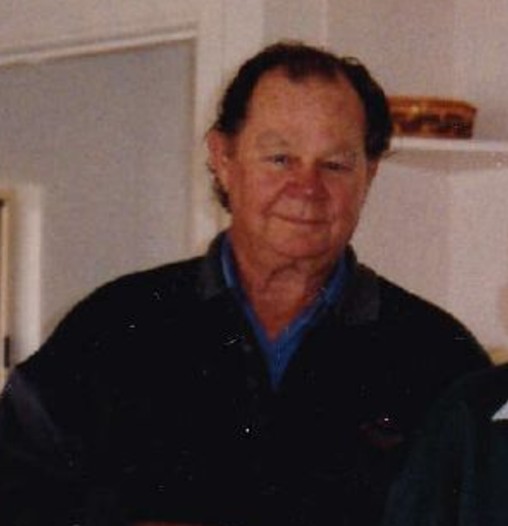
Albert Norman "Albie" WILDER [12880]
- Born: 24 Jul 1925, Charters Towers QLD
- Marriage (1): Evelyn Maud FLETCHER [15191]
- Died: 2009, Townsville QLD aged 84

 General Notes: General Notes:
Kindness Itself - Reminiscences of Albie Wilder.
We lived in Goldring Street next to Kaeser's bakery in a house that came from the mining town of Kuridala. That's our backyard and that's the house. See how it's up and down in a valley? It's actually two houses put together. Dad and my step-grandfather, old Hornung, did that. Over on the right you can see a part of the bakery. That stick on the left, that was our see-saw and merry-go-round all in one. It was just a post in the ground with a piece of timber across and a spike down the middle. We'd get on it and spin round-n-round or go up-n-down.
Mary Winton and I are playing on it one day and she wouldn't get off - and I wanted her to get off. I had a tomahawk in my hand: Get off or I'll cut ya! And still she wouldn't get off. So I aimed to go close but I got her on the foot. It's a wonder she didn't tell you about that. Anyway, the evil deed was done on that stick. The other stick on the right, that's the prop for the clothes line; you can see the wire.
The front of the house was the same as the back except it had beds on the verandah. We used to get under there as kids - the verandah was three steps off the ground. From the front gate to the door there was a hedged walkway. It was a salt bush hedge that went all the way around the house. On the corners, and on both sides of the gate, Clive built it up like a rampart. It was his job to keep it trimmed.
As you walked in the front there was the main bedroom on one side a lounge on the other, then you came through a passageway to two more bedrooms, and then the dining room. Beyond that, right at the back you were in this great big kitchen the full width of the house. You can see the chimney for the stove sticking out above the alcove on the bakery side.
When you wanted a bath you went out to the wash house in the backyard through the gate in the hedge. You can't see the wash house its off to the side. And of course, further down the back was the thunderbox.
All us kids lived in that house. There was five of us, then there got to be six, and then there got to be Pat.
Albie Wilder
I was born on the 24th July 1925 in Charters Towers. And the reason for that was: the family was living in Julia Creek but when one of us was to be born Mum always went to the Towers. Mum and Dad met there. I think they came to Julia Creek around 1912 or 14 and more or less used it as a base.
Dad was a teamster, drover, fencing contractor. Mum used to go with him until there were too many kids. After 1922, when Herbie and Biddy started school, she stayed in town. Dad would work at anything. When the council couldn't get a dunny carter he took that on for a while. He didn't have much schooling behind him and couldn't read or write, but he was learning. Towards the end he could write his own name. He was Common Ranger when he died. I tell you what happened to him. He was on Mick Byrne's property, Wallacooloobie, woolpressing. There's a lever with a pawl on it that drives a ratchet mechanism. You push on the lever and the pawl presses the wool down. He had it just about down and the pawl broke; the lever sprang back and hit him under the heart. Well, he was quite sick for a while there, and he decided that we were all going to his brother's place for a holiday, a milk farm out from the Towers.
At the Cape River a fella was bogged - it was all sandy roads. Dad had no tow rope so he gets out and helps push. He was a big powerful bloke. When we got to his brother's place he felt tired and went to have a lie down. They got tea ready and then Mum tried to wake him. He was dead. His heart was strained too much by pushing the car, plus the damage from the accident on Wallacooloobie. He's buried in Charters Towers. I was three 1928, yeah.
Mum was left with all us kids: Herbie, Biddy, Hilda, Clivey, myself and Donny - six kids. And then Pat, seven kids. She married Mick Skinner soon after Dad died. Nick was a navvy. He'd work at anything, anything at all; a bit like Dad. He started a little fruit shop in Julia Creek and did all right in that. They called him Mick but his name was Percy. He was a good bloke, too - treated us really well. It couldn't have been too long before he married Mum because Donny was a baby in arms. Eventually they had Pat, their only child. He's a half brother, Pat. He's a Skinner and we're all Wilders.
One of the first things I can remember about Dad is his car when he was the Ranger. It was one of those rag hood models, a 1924 Dodge, and my one recollection of that is: Mary Winton and I were toddlers and we hid in the car and did a round with him on the Common. I also remember he had a harness shed down the back with all his droving gear and horse collars hanging up. We used to get on them and swing. Anyway, one day it broke and down we came. I wouldn't have been much older than three.
We never had shoes as kids, and our feet cracked and bled with the cold weather in winter. I'd go out to the scour, playing, and bring home lanoline, the grease scoured from the wool. Mum rubbed it into my feet. By jeez, it fixed them up.
Jimmy Brisbane and I used to sneak into the scour and play there when it wasn't working. We'd climb inside the drier - at the end of the scouring tanks - and crawl up-n-down the chute. We'd come out upstairs where the wool was, in these big rooms about the size of this house. It was blown there through the chute; all fluffy white stuff banked up in a heap ready to be bailed by the presser on the next shift. It looked just like snow. The electricity in it tickled hell out of you. You'd dive in amongst the wool and your hairs would start standing up on your arms.
Two brothers, Jim and Joe Eckford, had the picture theatre. Joe was the one who went round town and put the posters up. You'd say to him if you saw him in the street:
What's on at the pictures tonight?
Two goodies - a cowboy and anothery.
He'd take your tickets as you went in the door. Anyone throwing their bumper away - the cigarette butt - he'd pick it up and put it out. He had a tin of them and when he wanted a smoke he'd get this needle, pick out the tobacco and he'd fold a cigarette. And the old bugger had money. That's Dadie's uncle.
The pictures, well, we only got a go at them every so often. As you went in you bought your ticket. There was a counter selling lollies, peanuts and little bottles of soft drink. Or, if you wanted to, you could go down the back and get big bottles. They only had little bottles at the counter. When you went in - down the front near the screen - over this side were the boys and over that side were the girls. And it was funny: as soon as the lights went out you'd see heads going across. Then you'd see Jim Eckford; he'd be out the front with a torch, shining it round: "Get back to your seat:" And he'd chase the boys back to their seats.
We had a pet cockatoo that went to the pictures with us. He'd fly ahead and sit on the fence waiting till we caught up. Sometimes he'd come in and other times he'd stay outside. He talked like a thrashing machine. I'd come home after school: come up the back, open the door and throw my school bag in and he'd sing out: "Albie's home, Albie's home. Get the goats Albie, get the goats." Get the goats, that was my job. And of course, Mum'd know I was home and tell me to get the goats. We had him a long time. He was still there when I left Julia Creek.
I was out getting the goats once near the coal stage, and being a kid curious, I pulled up. We used to play around the coal stage, climb it sometimes and have high jinks. Here's this swaggie and he's cooking sausages. They used to jump off the train during the Depression and get in underneath the piers of the coal stage and camp. They were like flies leaving the train before it got into the station (called "Jumping the Rattler" it incurred a fine if caught). I hadn't seen too many sausages and I was there looking, drooling.
He said to me:
Hey kid can you play draughts?
Yes mister.
Well, it's your move first. If you don't get out of here I'll cut your bloody head off.
I thought I was gonna have me a game of draughts and a sausage. I never went back near the coal stage for a while.
Adie Sills used to come around delivering fruit and vegetables in a horse and cart. There was even a Chinaman gardener in opposition. Fancy having gardens in Julia Creek. Adie's garden was over on Hilton Park, but the Chinaman's was
in town; quite a little farm affair, growing everything. As you were going out to the cemetery you turned left into Coyne Street and the Chinamen was along there on the north side. He used to hessian bag his lettuces to break the heat. He made a little frame, only so-high, and stretched a bag over it - hose the bag and that kept the lettuce cool. He'd come around with two cane baskets over his shoulders. As soon as he picked them up he had to start jogging; that was the only way he could carry them.
Over the road from the Chinaman lived a Japanese fella, Harry Kamada - he was the laundry chap - and the
two of them were always squabbling. Harry had wooden steps over his fence - step step step - instead of a gate. One
day coming home - I didn't know the difference, being a kid, I thought they were all the same race - I said to Harry:
Do they have these steps in China?
You bloody bastid - you calla me a Chinaman, I'm not bloody Chinaman. . . . .
And I off. That night I was looking around to see if Harry was after me because he'd already been in strife in Julia Creek. He was in love with this. . . . . I'll probably think of her name in a minute - but she was married (Mrs Gertrude Hall). There was another bloke involved too. They had a fight and Harry pulled a dagger out and into him with it. (Emily Skinner rang the Police to report the affray).
At the age of twelve I was in the Cloncurry hospital for three months with rheumatic fever. It affects your heart. It leaves it with a murmur and it's weakened. When I came out of hospital I had to keep away from sports. I wasn't to get excited, that was the thing.
Around that time a new head teacher arrived, Arthur Cann, and he was a horrible old turd. I was halfway through fifth grade, just back from hospital, and this old bugger used to belt hell out of me because I couldn't get the grip of learning. It wasn't long before I left school, although I did go back for two weeks when the education train came out. One carriage was for the girls and one for the boys. The girls learnt dressmaking and cooking; the boys learnt tin smithing, woodwork, how to make chairs, and things like that. The two carriages parked on a side line just down a bit from our house. I went to it twice - the second time only because I liked woodwork. I'm pretty sure I'd left school by then, at grade 6.
My first job was with Bert Pollard. He was the undertaker and I was going to do an apprenticeship with him as a builder of coffins. Oh, he had the foulest mouth going, and his girls were just as foul mouthed. He used to talk with them any old how. He says to me one time there: "Go and find that fuckin spanner. I told you not to lose the bastard." And I told him: "Look, I've had enough of you. I don't have to put up with your swearing. I'm not one of your kids you're talkin to now." And I left and got a job at Jaques butcher shop.
Charlie Byrne had a butcher shop in the main street and George Jaques had the other one in the front street. At the time I was getting 15/6 a week. All my other mates from school were in the shearing sheds getting two and three pound a week and their keep. So I said goodbye to the butcher trade and went out to the sheds. And from there I joined up.
I was down at Gabba camp in Brisbane when they told me: "You're out". They gave me a little slip of paper saying: "Temporarily medically discharged" owing to heart whatever-it-was. That was on the 24th March, 1942. 1 remember Clive and his mate saying: "Look at this lucky bugger; he's been kicked out of the army because he's temporarily medically insane".
I came back from Brisbane and I went into the shearing sheds again. I wasn't out there long; the heat got too much for me. I came to Townsville and got tangled up with the Americans, their Fifth Airforce. I was attached to them during the war. It was in Townsville I met my wife and we got married in '46. I've been back to Julia Creek several times since, but never to live.
I liked the freedom we had as children in Julia Creek. You played here, you played there, you weren't frightened, you could go out and leave the house unlocked; you could come and go as you were able to - or let. Different nights we'd be at our place or at the Winton's, singing songs around the piana. On moon-lit nights we'd get out and play Crows & Cranes, Drop the Hanky or Red Red Rover. With Crows & Cranes there were two rows of children and there'd be one child calling. She'd sing our 'Crrrro. . . . . ', then change it to
Cranes'. The Crows ran off and the Cranes had to catch them.
We had good times playing those simple games; and we had good times at the fancy dress balls, too. Mrs Petersen organised them. She had this Grand March and she'd parade us round-n-round in Eckford's Hall. That's Clive, he went as a swagman. In the background you can see a miniature wagon. Another brother, Herbie, he used to yoke that wagon to the goats. He had all the team stuff, the bridles and yoking gear, and he'd go over to the railway with a team of four goats and cart cinders around town. Herbie went to old man Tracey, he had a store:
Do you want any cinders Mr Tracey?
Yes, Herbie, how much a load?
Herbie told him so-much.
How many loads you want, Mr Tracey?
Oh, you keep bringing them and I'll let you know,
But there must have been some misunderstanding because Herbie loaded up every bit of cinder he delivered and brought it home and spread it around our place.
I was in the Grand March as a baker boy one year, carrying a tray full of little buns and wearing an outfit with 'Baker' on it and
Eat More Bread'. Bally Kaeser made the buns and the other kids were stealing them off me. I wasn't selling them;
the mickie loaves were just advertising his bread. Mickies were a little bread roll, If Bally had dough left over he'd make balls out of it and put them in the oven, All us kids'd go to the bakery after school: "Ya got any mickies today, Bally?" and he'd hand them out.
Bally was a little nuggety bloke about so high and he had a big belly on him. He'd often get drunk and come home singing in German. He had a whole heap of daughters and three sons: Joey, Albie and Kenny. The two older boys were going off to war and Bally's drunk one night, crying and saying to Joey: "You're going over there and you'll be shooting your cousins".
He made excellent bread. You'd go a long way before you'd find any better. In those days the stores didn't handle bread. You couldn't buy it from them. You had to go to Bally and get fresh bread from him; or if he had stale bread he'd sell you that at a cheaper rate - or give it to you. There was a heap of us Wilders and we wouldn't have known much about bread other than old Bally would bake a bit-extra and pass it over the fence to Mum:
But I've got no money, Mr Kaeser.
That's all right. The goats will be getting it if you don't take it.
We were poor, yeah. We'd come home - you know how kids come home today and ask for a biscuit or an orange? - we'd come home and we'd ask Mum: "Have we got any crust of bread?" And if there was, we'd get the dripping, it was real black, and put it on the crust and sprinkle salt and pepper on it. That was our afternoon special.
We knew we were poor, yet we were quite happy. Never really wanted for any-thing. We grew vegetables and had our own goats. Still, we never had the things that others had. There was no money for shoes a lot of the time. I'd go to school bare footed. In the winter out there, as I've mentioned, it was very cold and my feet'd be cracking. Lanolin helped, but I remember Mum giving me two shillings to go to A J Smith's and buy a pair of sandshoes because my feet were that bad, Two shillings would also get you a pound of butter - a pat of butter - and a dozen boxes of matches. Two shillings would get you a lot, those days.
Ref: This delightful reminiscence by Albie Wilder is from "Tanksinker" by Guy Burns Published. 2009 - This magnum opus by Guy on his grandfather Max Burns and the people of Julia Creek Northern Queensland is a fascinating look at 20th C. life in the Queensland Bush.
See https://sites.google.com/site/tanksinker/Home/max-burns-tanksinker
Other Records
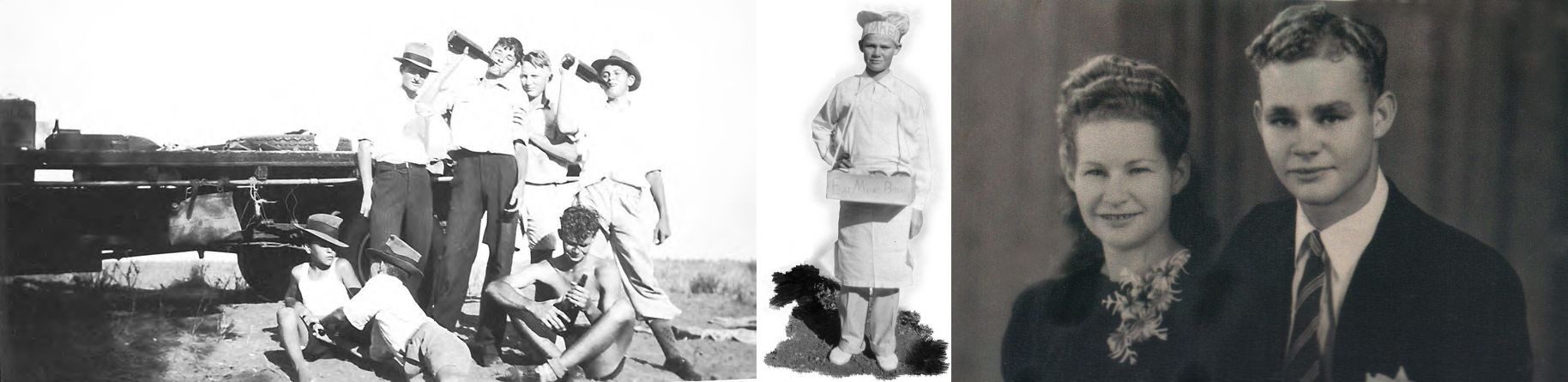
1. Albie Wilder: Pictures from days at Julia Creek Queensland.
Bill Gerahty centre back with bottle. Front Geo Winton left Albie Wilder with bottle:
We used to go out to Eddington waterhole to have picnics. The men put in two bob for the soft drink and petrol and the women made the cakes. There was no alcohol in amongst it, We were just kiddin that we were drunk.
Albie the Bakers Boy: "I was in the Grand March as a baker boy one year, carrying a tray full of little buns and wearing an outfit with "Baker" on it and "Eat More Bread". Bally Kaeser made the buns and the other kids were stealing them off me. I wasn't selling them; the mickie loaves were just advertising his bread.
Mickies were a little bread roll.
Albert Wilder & Biddy Thomsen (uncertain placement).
Bally had dough left over he'd make balls out of it and
put them in the oven. All us kids would go to the bakery
after school: "Ya got any mickies today, Bally?" and he'd
hand them out
Albie married Evelyn Maud FLETCHER [15191] [MRIN: 5342].
|